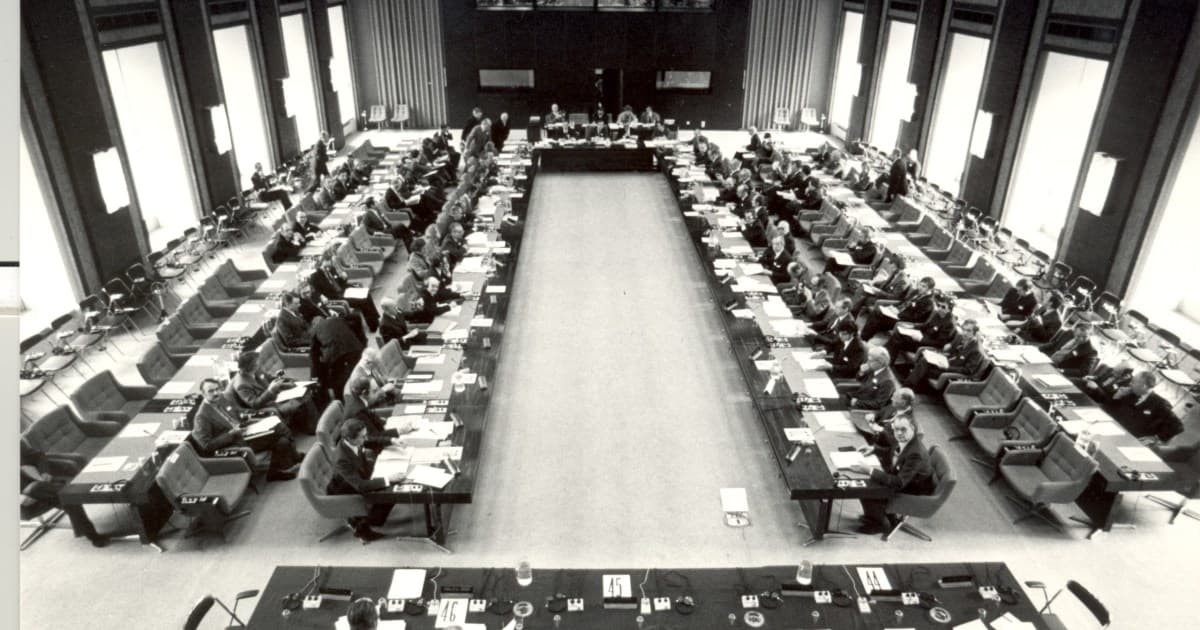
May 31, 1975: ESA Begins Operations
Why It Matters
ESA’s creation unified Europe’s space capabilities, establishing a credible third pole in the global space arena and enabling long‑term collaborative missions that shape today’s satellite, navigation, and exploration markets.
Key Takeaways
- •ESA formed by merging ESRO and ELDO in 1975.
- •Ten founding nations signed the ESA Convention on May 30, 1975.
- •ESA entered operations, becoming world’s third‑largest space agency.
- •Convention ratified in 1980, formalizing ESA’s legal status.
- •Today ESA comprises 23 member states plus associate partners.
Pulse Analysis
The 1960s saw Europe juggling two separate entities—the European Space Research Organization (ESRO) focused on scientific payloads, while the European Launcher Development Organization (ELDO) pursued launch‑vehicle technology. This split hampered coordination, especially as the United States and the Soviet Union raced ahead in the space race. European policymakers recognized that a single, integrated agency could pool resources, streamline decision‑making, and present a credible alternative to the superpowers. The push for consolidation culminated in the European Space Committee’s 1968 decision to merge ESRO and ELDO, laying the groundwork for a pan‑European space strategy.
The formal turning point arrived on May 30, 1975, when ten founding countries—Belgium, Denmark, France, Germany, Italy, the Netherlands, Spain, Sweden, Switzerland, and the United Kingdom—signed the ESA Convention in Brussels. The following day, ESA commenced de facto operations, instantly ranking as the world’s third‑largest space program behind the U.S. and USSR. Early achievements included the development of the Ariane launch family and collaborative scientific missions, demonstrating that a unified European agency could deliver both indigenous launch capability and cutting‑edge research without relying on external partners.
Four decades later, ESA has grown to 23 member states and several associate nations, operating a portfolio that spans Earth observation, navigation, and deep‑space exploration. Its Galileo navigation system rivals GPS, while missions such as Rosetta and the ExoMars rover showcase Europe’s leadership in planetary science. The agency’s collaborative model also attracts commercial partners, reinforcing Europe’s position in the increasingly crowded low‑Earth‑orbit market. As geopolitical tensions reshape global space policy, ESA’s multinational foundation provides resilience and a platform for future endeavors like lunar gateways and asteroid mining.
May 31, 1975: ESA begins operations
Comments
Want to join the conversation?
Loading comments...