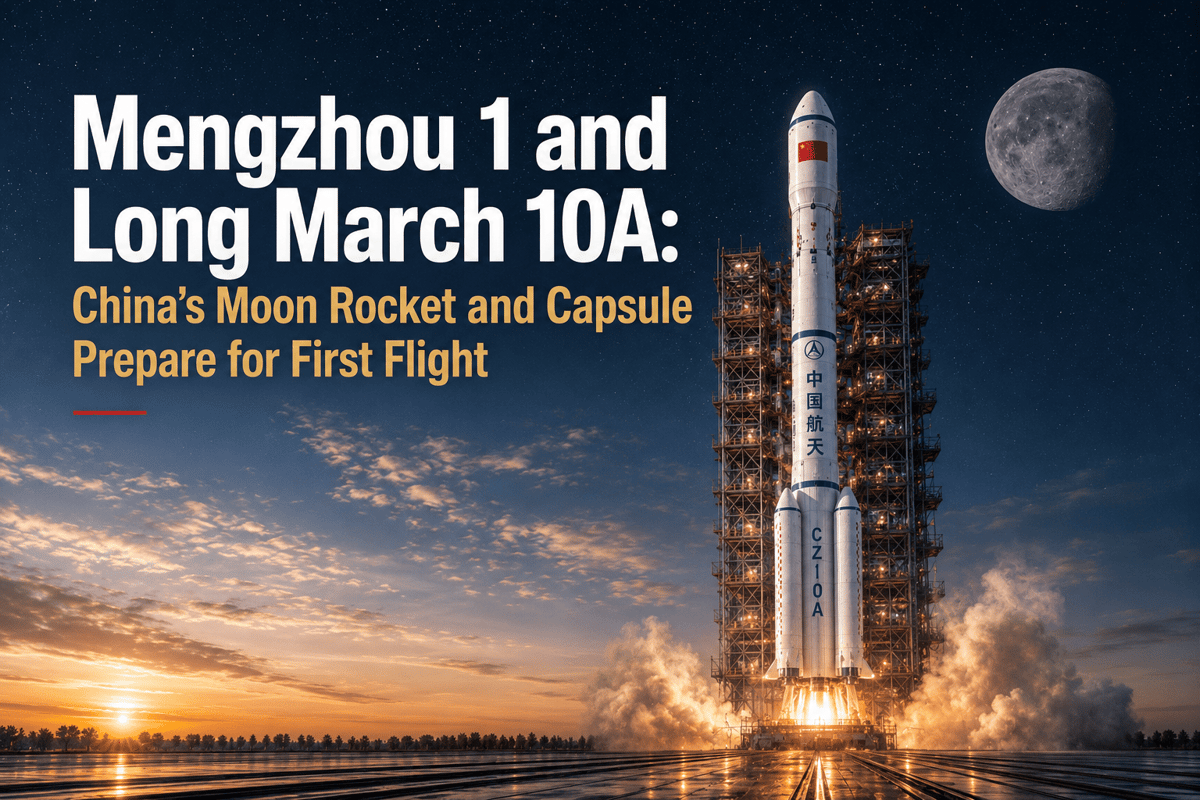
Mengzhou-1 and Long March 10A: China’s Moon Rocket and Capsule Prepare for First Flight
Why It Matters
Mengzhou‑1 will prove the integrated capsule‑rocket system needed for both low‑Earth‑orbit logistics and future lunar expeditions, signaling China’s accelerating human‑spaceflight capabilities. Success will diversify China’s crew‑launch architecture and strengthen its strategic position in the emerging deep‑space race.
Key Takeaways
- •Mengzhou‑1 will test new crew capsule on Long March 10A in 2026
- •February 2026 abort test validated max‑dynamic‑pressure escape system
- •Long March 10A serves both Tiangong logistics and future lunar launches
- •Reusable first stage performed engine restart and hover‑ignition in test
- •Successful docking and return would create baseline for crewed Moon missions
Pulse Analysis
The Mengzhou‑1 mission marks a pivotal transition from China’s Shenzhou heritage to a modular crew‑capsule architecture designed for both orbital and lunar operations. By pairing the new capsule with the Long March 10A launch vehicle, China is creating a unified human‑spaceflight stack that can service the Tiangong station while also serving as the workhorse for future Moon missions. The February 2026 abort demonstration, which successfully executed a maximum‑dynamic‑pressure escape, proved a critical safety milestone and showcased the rocket’s reusable first‑stage capabilities, including engine restart and hover‑ignition—technologies essential for precision recovery and rapid turnaround.
Beyond safety, the upcoming 2026 orbital flight will provide real‑world data on docking procedures, life‑support systems, and re‑entry performance. Docking with Tiangong’s radial port will validate navigation sensors, automated rendezvous software, and crew‑transfer protocols that are directly transferable to a lunar‑orbit rendezvous scenario. The mission’s payload suite, featuring environmental monitors and technology demonstrators, adds operational value, turning a qualification flight into a meaningful contribution to station science and logistics. Successful recovery of both the capsule and the rocket’s first stage will also refine maritime recovery operations, a step toward the larger, sea‑based recovery concepts envisioned for lunar return missions.
Strategically, Mengzhou‑1 and Long March 10A embody China’s stepwise approach to a crewed Moon landing before 2030. The reusable Long March 10A serves as a bridge, supporting Tiangong resupply while gathering flight data for the larger Long March 10 lunar variant. This dual‑use philosophy reduces development risk and accelerates technology maturation across the entire human‑spaceflight portfolio. As the United States pushes deeper with Artemis, China’s parallel progress in capsule reusability, launch‑vehicle recovery, and integrated lunar architecture positions it as a formidable competitor in the next era of crewed deep‑space exploration.
Mengzhou-1 and Long March 10A: China’s Moon Rocket and Capsule Prepare for First Flight
Comments
Want to join the conversation?
Loading comments...