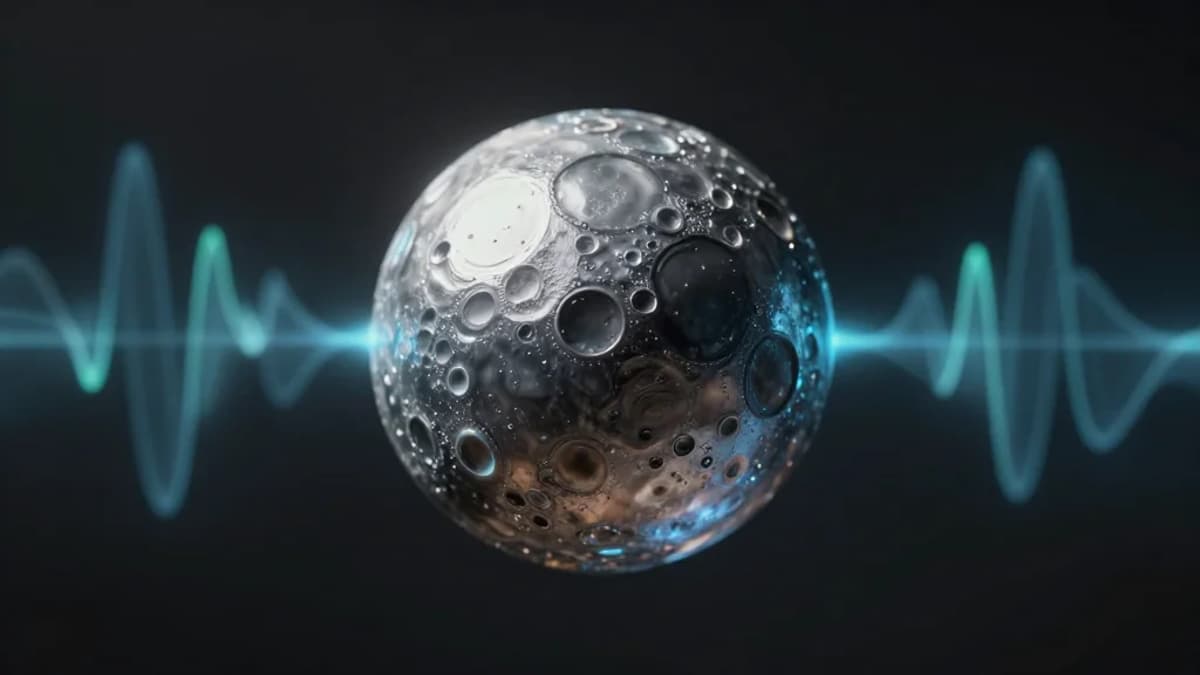
Mercury's BepiColombo Mio and Earth's GEOTAIL Show Shared Wave Frequency Properties Across Planetary Magnetospheres
•January 19, 2026
0
Why It Matters
Demonstrating identical chorus wave dynamics at Mercury validates universal plasma processes, improving space‑weather models and informing radiation‑protection strategies for future interplanetary missions.
Key Takeaways
- •Mercury shows Earth-like chorus wave signatures.
- •BepiColombo Mio detected audible-frequency plasma waves.
- •GEOTAIL data validated Mercury observations.
- •Findings suggest universal electron acceleration mechanisms.
- •Supports cold electron population predictions for Mercury.
Pulse Analysis
Chorus emissions have long been a cornerstone of Earth’s space‑weather research, linking resonant plasma waves to the formation and loss of radiation belts. By characterising the rapid rise‑and‑fall frequency patterns—often likened to birdsong—scientists can predict hazardous electron fluxes that threaten satellite electronics. Extending this framework beyond Earth, however, required a planetary analogue with comparable wave diagnostics, a gap now filled by Mercury observations.
The Plasma Wave Investigation aboard BepiColombo’s Mio orbiter was expressly calibrated to capture whistler‑mode waves in the audible band. During six targeted flybys, Mio recorded frequency chirps that mirrored the instantaneous changes documented by Japan‑U.S. joint mission GEOTAIL in Earth’s magnetotail. This cross‑planetary validation hinges on rigorous statistical matching of wave spectra, confirming that even Mercury’s magnetic field—only one‑hundredth Earth’s strength—supports the nonlinear electron‑wave coupling that drives chorus generation. The finding substantiates theoretical predictions of a cold electron atmosphere around Mercury, reshaping expectations of its near‑planetary radiation environment.
Beyond academic intrigue, the discovery carries practical implications for future exploration. Recognizing that chorus mechanisms operate universally enables more accurate space‑weather forecasting for missions to Mercury, Mars, and the outer planets, where radiation hazards remain poorly quantified. Engineers can now incorporate chorus‑driven electron acceleration models into spacecraft shielding designs, while planetary scientists gain a comparative baseline for auroral processes across the solar system. As BepiColombo continues its orbital phase in late 2026, the groundwork is set for a new era of multi‑planet plasma research, with ripple effects for both scientific understanding and commercial space operations.
Mercury's BepiColombo Mio and Earth's GEOTAIL show shared wave frequency properties across planetary magnetospheres
0
Comments
Want to join the conversation?
Loading comments...