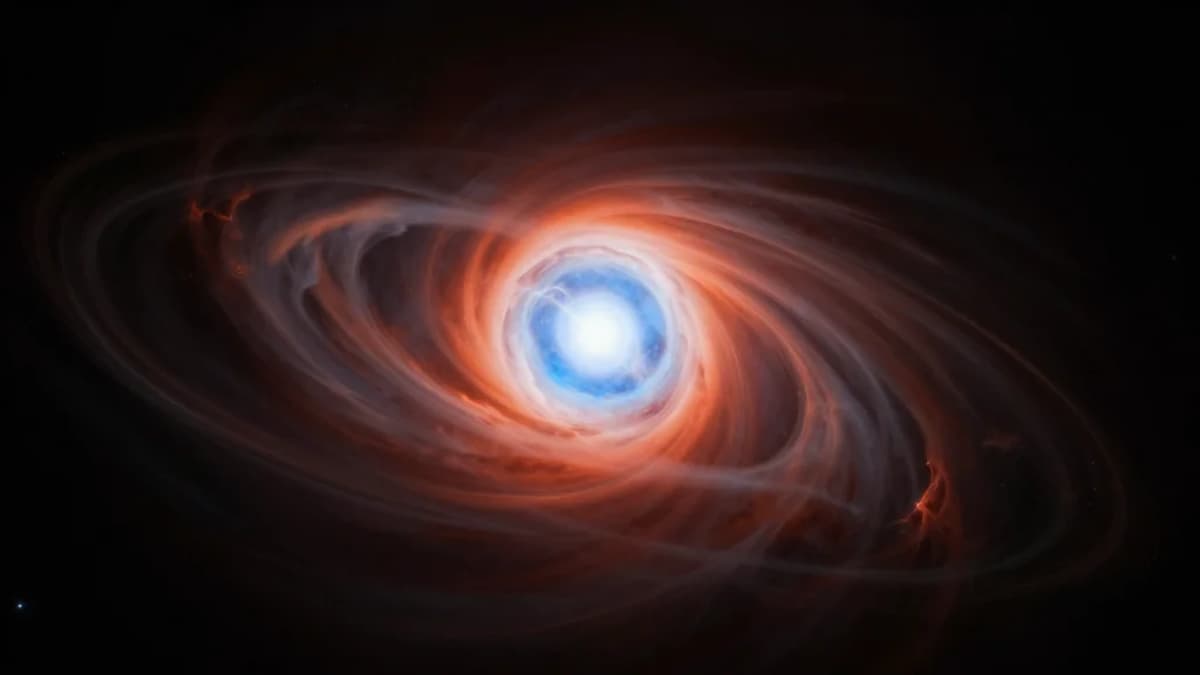
Multiwavelength Variability Reveals Dust Structure in Quasars
•January 23, 2026
0
Why It Matters
Understanding dust composition and geometry in AGNs improves estimates of black‑hole growth and bolometric luminosities, directly impacting models of galaxy evolution. The methodology paves the way for larger reverberation‑mapping campaigns with upcoming facilities like Rubin and SPHEREx.
Key Takeaways
- •Time delays reveal graphite-to-silicate size ratio ~0.4.
- •Polar dust detected in quasar VVV J1845‑2426.
- •Multi-band reverberation mapping limited but expanding with Rubin, SPHEREx.
- •Study refines AGN unified model dust torus structure.
- •Sample size only four quasars, need larger surveys.
Pulse Analysis
Reverberation mapping has become a cornerstone technique for probing the innermost regions of active galactic nuclei, yet most campaigns focus on a single wavelength band. By synchronizing optical, near‑infrared and mid‑infrared light curves, researchers can capture the delayed “echo” of dust re‑radiating central engine fluctuations, offering a three‑dimensional view of the torus. This multi‑band approach mitigates ambiguities inherent in single‑band analyses and yields direct constraints on dust grain composition, a critical factor for accurate AGN spectral energy distribution modeling.
The recent study of four variable quasars leverages time‑delay measurements across Pan‑STARRS, ZTF, VISTA‑VVV/VVVX and WISE to quantify the relative contributions of graphite and silicate grains. A derived size ratio of roughly 0.4 suggests smaller graphite particles dominate the near‑infrared response, while larger silicate grains shape the mid‑infrared output. In the case of VVV J1845‑2426, spectroscopic redshift and black‑hole mass estimates combine with spectral‑energy‑distribution fitting to reveal a warm‑dust‑deficient nucleus and a distinct polar dust component, challenging the simplistic doughnut‑shaped torus picture.
Looking ahead, the methodology aligns perfectly with the data deluge expected from the Vera C. Rubin Observatory and the SPHEREx mission. Their high‑cadence, wide‑field surveys will dramatically increase the pool of multi‑band variable AGNs, enabling statistical reverberation mapping at unprecedented scale. For the broader astrophysics community, refined dust models translate into more reliable luminosity corrections, better black‑hole mass estimates, and ultimately tighter constraints on galaxy formation theories.
Multiwavelength variability reveals dust structure in quasars
0
Comments
Want to join the conversation?
Loading comments...