NASA Administrator Jared Isaacman Workforce Message Signals a Mission-Centered Agency Realignment
Companies Mentioned

NASA
Why It Matters
By aligning organizational authority with concrete missions, NASA hopes to accelerate delivery, reduce bureaucratic overlap, and provide clearer signals to industry partners and Congress about funding priorities.
Key Takeaways
- •Mission directorates now report directly to the NASA administrator
- •Centers designated as “centers of excellence” receive baseline funding for core capabilities
- •Contractor‑to‑civil‑service conversion targets long‑term mission‑critical roles
- •Moon base, LEO transition, and space‑nuclear programs gain unified program offices
Pulse Analysis
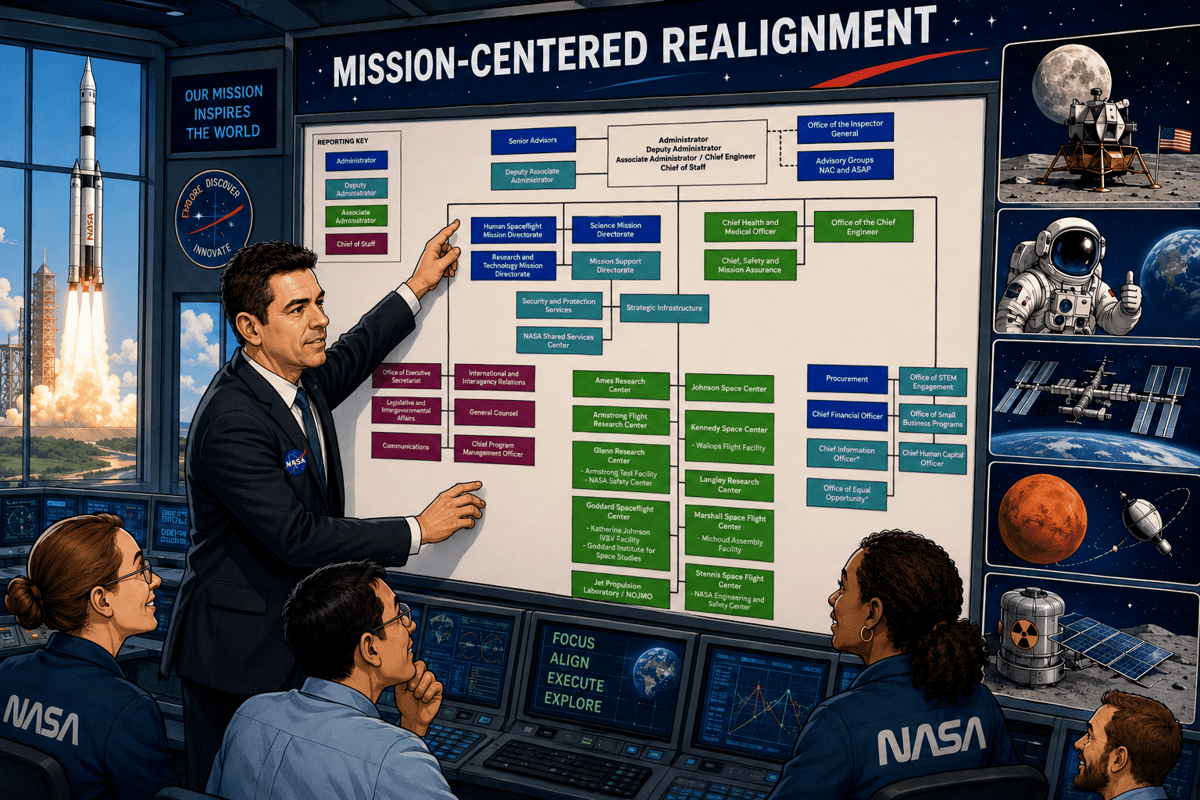
NASA’s May 22 workforce message marks a decisive shift from a historically layered bureaucracy to a mission‑centered architecture. After the successful Artemis II flight, Administrator Isaacman used the achievement to justify a governance overhaul that places mission directorates—human spaceflight, science, aeronautics, and technology—directly under his authority. By merging the Space Operations and Exploration Systems directorates into a single Human Spaceflight Mission Directorate and combining Aeronautics with Space Technology, the agency reduces internal silos and creates clearer lines of accountability for schedule, cost, and technical performance. This structural realignment mirrors corporate models where product lines report straight to the CEO, promising faster decision‑making and tighter alignment with strategic objectives.
The reorganization also redefines the role of NASA’s eight field centers, branding them as centers of excellence with guaranteed baseline funding. Johnson, Kennedy, Goddard, Marshall, and others will now serve as dedicated capability anchors, insulating core expertise from the ebb and flow of individual project budgets. Simultaneously, the agency’s contractor‑to‑civil‑service conversion targets long‑term, mission‑critical positions, leveraging early pilots that reportedly saved over $100 million annually. By retaining contractors for specialized, short‑term work while insourcing essential engineering and operations staff, NASA aims to preserve technical authority, reduce reliance on external vendors, and improve risk management without triggering layoffs.
For the commercial space ecosystem, the realignment sends a clear market signal. Unified program offices for the Moon base, post‑ISS low‑Earth‑orbit destinations, and space‑nuclear power provide stable, long‑term demand for launch services, lunar landers, habitat modules, and reactor technology. The Science Mission Directorate, though structurally unchanged, faces tighter reviews that could shift some data acquisition to commercial providers. Overall, the agency’s attempt to flatten hierarchy, secure core capabilities, and streamline procurement is poised to accelerate NASA’s ambitious exploration agenda while reshaping supplier relationships and investment priorities across the emerging space economy.
NASA Administrator Jared Isaacman Workforce Message Signals a Mission-Centered Agency Realignment
Comments
Want to join the conversation?
Loading comments...