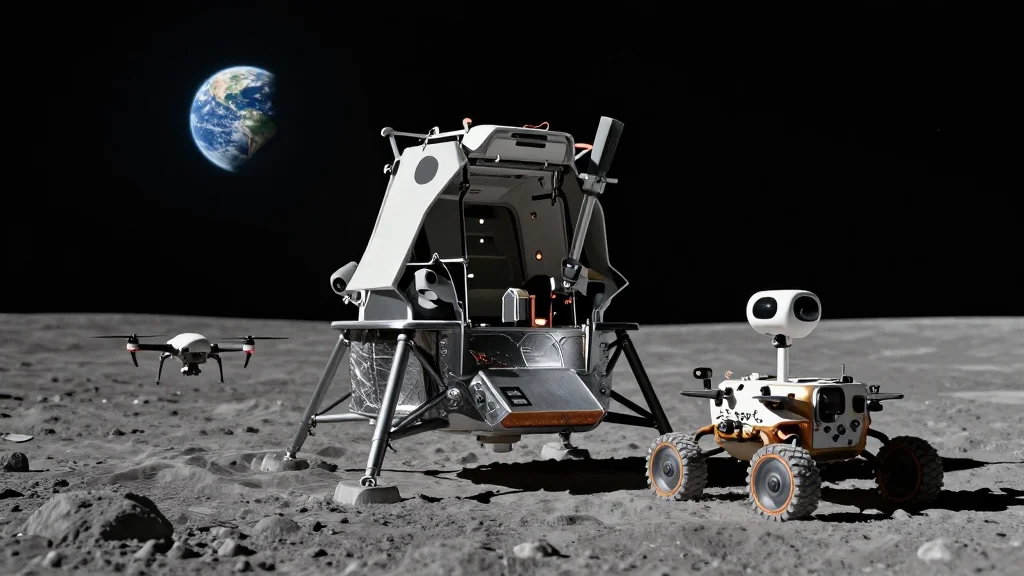
NASA Awards Hundreds of Millions in Contracts for Moon Base Landers, Rovers and Drones

Companies Mentioned

Why It Matters
NASA’s moon‑base procurement marks the first large‑scale, government‑backed purchase of commercial lunar hardware, effectively seeding a nascent lunar supply chain. By committing hundreds of millions of dollars, the agency is de‑risking private investment and accelerating the development of technologies that could underpin a sustainable lunar economy—resource extraction, manufacturing, and tourism. The initiative also sets a precedent for how future deep‑space missions, such as a crewed Mars venture, might be funded through a mix of public contracts and commercial participation. Beyond economics, the plan has strategic implications. Establishing a permanent presence on the moon strengthens U.S. leadership in space and provides a platform for scientific research, from lunar geology to testing life‑support systems for Mars. The deployment of autonomous drones and rovers also demonstrates the maturation of autonomous operations in harsh environments, a capability that will be critical for future off‑world habitats.
Key Takeaways
- •NASA awarded contracts worth "hundreds of millions of dollars" to four U.S. firms
- •Blue Origin will build two lunar landers; Firefly Aerospace will supply the first lunar drones
- •Phase 1 targets Artemis III crew landing by mid‑2027, with hardware arriving before a 2028 crewed landing
- •Phase 2 (2029‑early 2030s) will add power‑grid infrastructure; Phase 3 (2030s) will deliver permanent habitats
- •The program aims to spark a commercial lunar supply chain and lay groundwork for a future Mars mission
Pulse Analysis
NASA’s decision to contract multiple commercial providers for the first lunar outpost hardware reflects a deliberate shift from a single‑vendor model to a competitive marketplace. This approach mirrors the agency’s earlier success with the Commercial Crew Program, where SpaceX and Boeing vied for crew‑transport contracts, driving down launch costs and spurring rapid innovation. By spreading risk across Blue Origin, Firefly, Astrolab and Lunar Outpost, NASA not only secures redundancy but also creates a broader industrial base capable of scaling to the larger infrastructure needs of phases two and three.
The timing is critical. Artemis II’s successful flyby in April demonstrated the Orion capsule’s deep‑space capabilities, but the next step—delivering cargo and mobility assets to the lunar surface—requires hardware that can operate in extreme temperature swings and low‑gravity conditions. The contracts, while not specifying exact dollar amounts, likely represent a substantial portion of the $2‑billion budget earmarked for the Artemis program’s early phases. This infusion of private capital is expected to lower overall program costs, as commercial firms can leverage existing launch services and supply chains.
Geopolitically, the move also signals U.S. intent to claim a functional foothold on the moon before other nations solidify their own lunar ambitions. The inclusion of drones to demarcate territory—dubbed MoonFall—underscores a subtle but clear message about respecting international space law while asserting a presence. As China and Russia accelerate their lunar plans, NASA’s aggressive procurement schedule could set the tempo for the next decade of lunar activity, shaping everything from scientific collaboration to commercial exploitation.
NASA Awards Hundreds of Millions in Contracts for Moon Base Landers, Rovers and Drones
Comments
Want to join the conversation?
Loading comments...