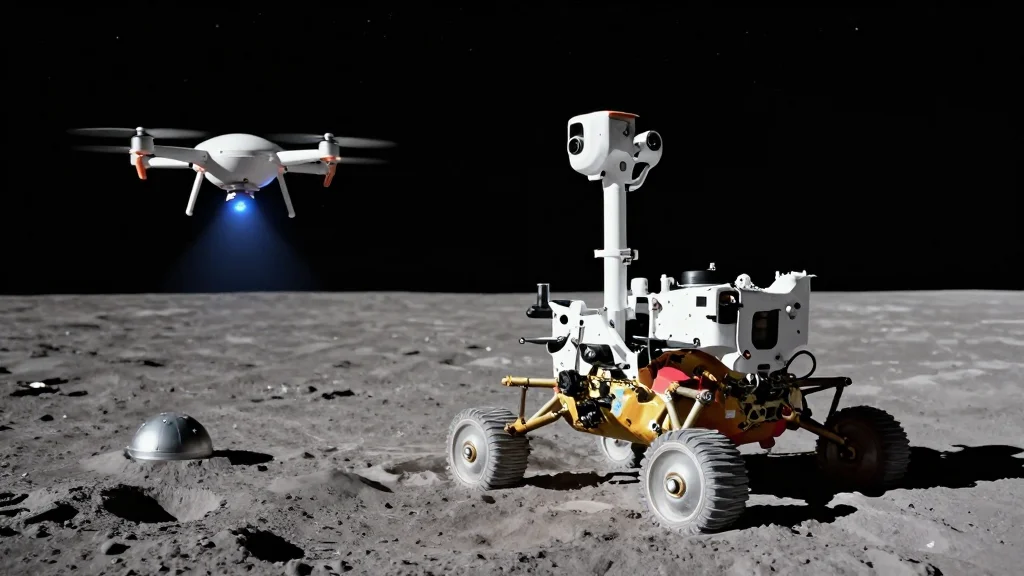
NASA Targets Lunar Trucks and Hopping Drones for First Permanent Moon Base

Companies Mentioned

Why It Matters
The deployment of lunar trucks and hopping drones marks the first large‑scale use of autonomous surface robotics beyond Earth, establishing a new benchmark for durability, navigation and resource extraction in extreme environments. Success will validate technologies that could be adapted for Mars surface missions, lunar mining, and even Earth‑based applications such as deep‑sea or Arctic exploration. Moreover, the program’s emphasis on commercial partnerships accelerates the maturation of a nascent space‑robotics supply chain, positioning U.S. firms to compete globally against China’s rapidly expanding lunar capabilities. By anchoring a permanent human presence on the Moon, NASA’s robotics strategy also creates a testbed for life‑support systems, in‑situ resource utilization, and long‑duration autonomy—critical stepping stones for future crewed missions to Mars and beyond. The competitive pressure from China adds a geopolitical dimension, turning robotic performance into a metric of national technological leadership.
Key Takeaways
- •NASA announced three 2024 missions to deliver lunar trucks and hopping drones to the south pole
- •Moon Base I will launch on Blue Origin’s Blue Moon Mark 1 Endurance lander, targeted for fall 2026
- •Administrator Jared Isaacman highlighted the challenge of limited Apollo EVA experience
- •Shift from Gateway orbital station to surface robotics signals a $10‑plus billion market opportunity
- •U.S. and China are in a strategic race to establish the first permanent lunar outpost
Pulse Analysis
NASA’s decision to prioritize surface mobility over the previously favored Gateway station reflects a pragmatic response to both technical risk and geopolitical competition. The agency’s historic reliance on crewed missions for surface exploration has given way to a robot‑first approach, mirroring trends in terrestrial industries where autonomous platforms reduce cost and increase safety. By locking in contracts with commercial launch providers and rover developers now, NASA is effectively de‑risking the later phases of the Artemis program, ensuring that when astronauts finally set foot on the Moon, the infrastructure will already be in place.
The emphasis on hopping drones is particularly noteworthy. Traditional rovers are limited by terrain and power constraints, whereas a one‑legged hopper can traverse shadowed craters—critical for locating water ice. This technology could become a cornerstone of in‑situ resource utilization (ISRU) strategies, lowering the cost of propellant production for deep‑space missions. If the hoppers prove reliable, they could be repurposed for Mars, where similar challenges of dust, low gravity, and rugged terrain exist.
Commercially, the roadmap opens a multi‑billion‑dollar market for specialized lunar robotics. Companies that can deliver high‑temperature‑tolerant electronics, radiation‑hardened autonomy software, and lightweight power systems will likely secure long‑term contracts. The competitive pressure from China adds urgency; a successful U.S. robotic deployment could cement American leadership in lunar commerce, while a lag could cede market share to Chinese firms. In short, NASA’s lunar trucks and drones are not just tools for a Moon base—they are the first building blocks of a new space‑based economy.
NASA Targets Lunar Trucks and Hopping Drones for First Permanent Moon Base
Comments
Want to join the conversation?
Loading comments...