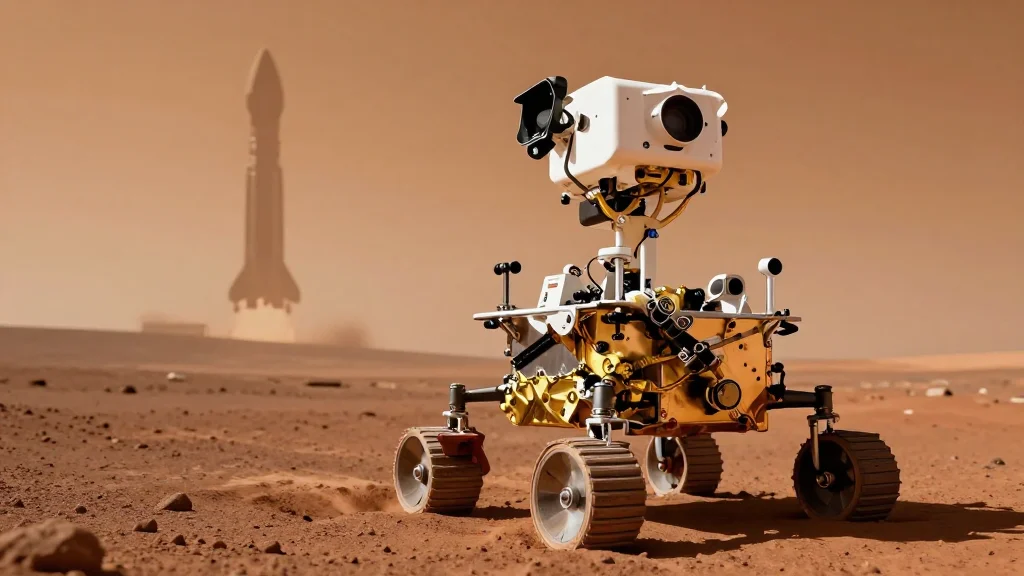
NASA Awards SpaceX $176 Million Mars Rover Launch Contract Amid White House Budget Fight

Companies Mentioned
Why It Matters
The contract signals a turning point for private‑sector participation in deep‑space exploration, moving SpaceX beyond low‑Earth‑orbit services into the planetary arena. By securing a NASA‑funded Mars mission, SpaceX demonstrates that its heavy‑lift vehicle can meet the stringent requirements of interplanetary payloads, a capability that could attract future scientific and commercial customers. The budget dispute also highlights the fragility of U.S. space policy when scientific programs depend on political goodwill. A decision to cut ROSA funding would not only delay a high‑profile Mars science mission but could also undermine confidence among international partners, such as ESA, that the United States can reliably launch missions requiring U.S.‑origin technology.
Key Takeaways
- •NASA awarded SpaceX a $175.7 million contract on April 16, 2026 to launch ESA’s Rosalind Franklin rover.
- •Falcon Heavy will perform the first Mars payload launch for SpaceX, targeting a late‑2028 launch.
- •U.S. export controls on radioisotope heater units limited launch options to domestic rockets.
- •The White House FY2027 budget proposal omits ROSA funding, creating a potential budget showdown.
- •SpaceX is preparing a confidential SEC filing and an IPO roadshow for early June 2026.
Pulse Analysis
SpaceX’s entry into the interplanetary launch market reshapes the competitive dynamics that have long been dominated by United Launch Alliance and legacy government programs. The Falcon Heavy contract provides a tangible benchmark for the company’s heavy‑lift credibility, a prerequisite for any future NASA or ESA deep‑space missions. Historically, NASA has relied on government‑run launch systems for planetary missions; this shift to a commercial provider could lower costs and accelerate timelines, but it also introduces new risk vectors tied to corporate financial health and political support.
The budget conflict underscores a broader tension between long‑term scientific investment and short‑term fiscal constraints. While the White House’s omission of ROSA funding reflects broader budgetary pressures, the scientific community’s pushback illustrates the strategic value placed on Mars exploration for both scientific discovery and national prestige. If Congress backs NASA, the mission could proceed as planned, reinforcing the United States’ leadership in planetary science. A defunding outcome, however, could force ESA to seek alternative launch partners, potentially reviving competition from ULA or even non‑U.S. providers, and could erode confidence in the reliability of U.S. launch services for missions involving sensitive U.S. technology.
Looking ahead, the contract’s timing ahead of SpaceX’s anticipated IPO adds a layer of market intrigue. Investors will scrutinize the company’s ability to deliver on high‑profile, deep‑space contracts as a barometer of future growth. Successful execution could boost the IPO’s valuation and cement SpaceX’s position as a full‑spectrum launch provider, while any delays or budget‑related setbacks could temper market enthusiasm. The outcome of the ROSA funding debate will therefore not only affect a single Mars mission but could also influence the broader trajectory of commercial space investment and U.S. policy on deep‑space exploration.
NASA awards SpaceX $176 million Mars rover launch contract amid White House budget fight
Comments
Want to join the conversation?
Loading comments...