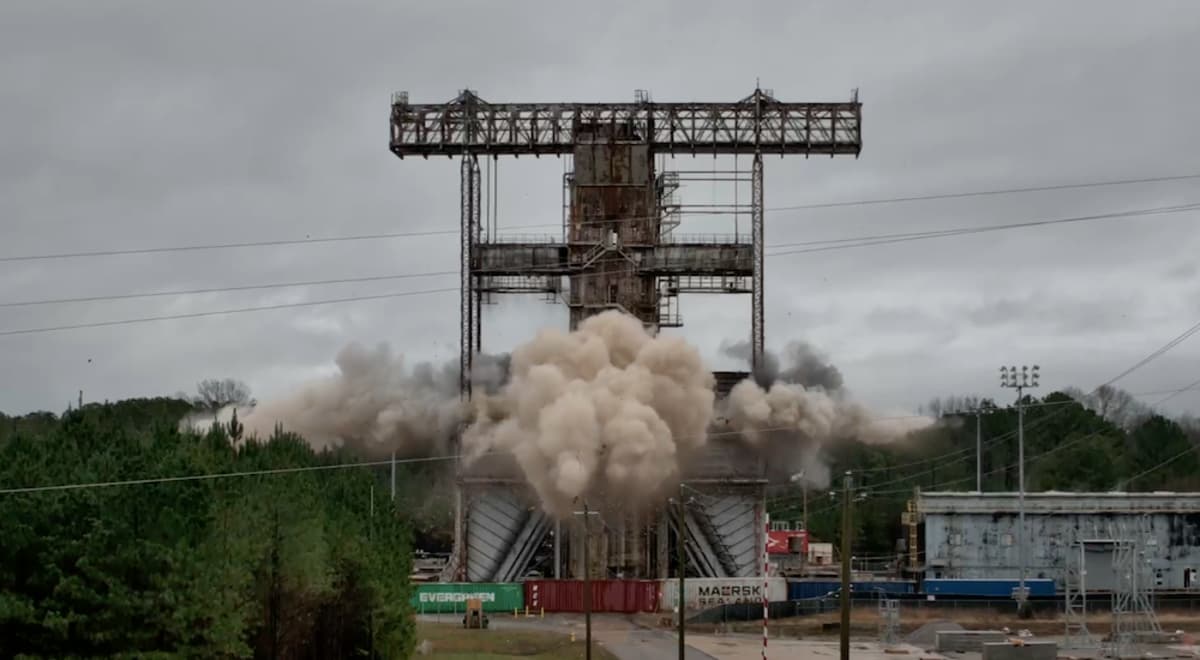
NASA Bids Farewell to Historic Test Stands That Built the Space Age
•January 14, 2026
0
Companies Mentioned

NASA
Why It Matters
The demolition clears budget and safety hurdles for NASA’s next‑generation facilities while safeguarding historic data for future research. It underscores the balance between heritage preservation and operational efficiency in high‑tech government programs.
Key Takeaways
- •Dynamic Test Stand collapsed Jan 10 2026
- •T‑tower tested Saturn V F‑1 engines in 1960s
- •Both structures designated National Historic Landmarks 1985
- •Demolition frees resources for modern NASA campus
- •Digital archives preserve towers via LiDAR models
Pulse Analysis
The two Marshall test stands were more than concrete and steel; they were the proving grounds that turned theoretical rocketry into the Apollo moon‑landing machine. The T‑tower, erected in 1957, hosted static firings of Saturn V’s massive F‑1 engines, providing the data that validated thrust, vibration, and thermal limits. Meanwhile, the 105‑metre Dynamic Test Stand simulated full‑scale flight stresses, allowing engineers to fine‑tune structural integrity before a single rocket ever left the ground. Their contributions extended into the Shuttle era, where they verified solid‑rocket booster performance and later facilitated microgravity research, cementing their place in aerospace history.
By the 1990s the facilities had outlived their original purpose, and the cost of upkeep began to outweigh their operational value. Safety concerns over aging steel and the need for a more integrated, technology‑ready campus drove NASA’s decision to retire and demolish the structures. The removal is part of a broader $1 billion campus transformation aimed at supporting Artemis, deep‑space habitats, and next‑generation propulsion systems. This shift reflects a strategic reallocation of resources toward flexible, modular test environments that can accommodate rapid innovation cycles.
Recognizing the cultural weight of the stands, NASA partnered with the Library of Congress and Auburn University to create high‑resolution LiDAR scans, 360‑degree photography, and comprehensive documentation. These digital assets ensure that engineers, historians, and educators can study the design and testing methodologies that defined the Space Age, even after the physical towers are gone. The effort illustrates how modern preservation techniques can bridge past achievements with future ambitions, offering a template for safeguarding other historic aerospace infrastructure worldwide.
NASA Bids Farewell to Historic Test Stands That Built the Space Age
0
Comments
Want to join the conversation?
Loading comments...