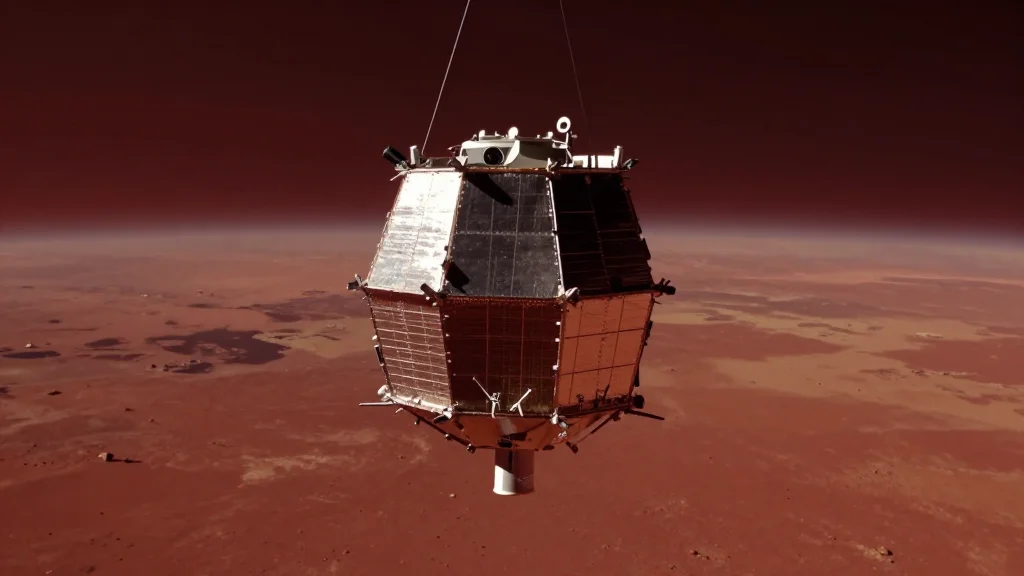
NASA Declares MAVEN Dead After 11 Years of Mars Study

Why It Matters
MAVEN’s termination marks the loss of the only spacecraft dedicated solely to probing Mars’ upper atmosphere, a critical piece of the puzzle for understanding planetary climate evolution. The mission’s findings on atmospheric sputtering and magnetic shielding have directly influenced models of how Earth‑like worlds retain water and habitability over billions of years. Without a dedicated orbiter, future studies of atmospheric escape will depend on opportunistic measurements from multipurpose platforms, potentially slowing progress toward a comprehensive picture of Mars’ transition from a wetter past to its current arid state. The spacecraft also demonstrated the value of long‑duration orbital science for supporting surface missions. Its role as a communications relay extended the operational life of Curiosity and Perseverance, underscoring how orbiters can act as force multipliers for rover science. The gap left by MAVEN will pressure NASA and its partners to prioritize new atmospheric instruments in upcoming missions, shaping the next generation of Mars exploration architecture.
Key Takeaways
- •NASA officially declared MAVEN unrecoverable on June 3, 2026 after a battery drain caused by an unexpected spin.
- •The anomaly review board cited high‑rate rotation and battery depletion as the immediate cause of the failure.
- •MAVEN operated for 11 years, far exceeding its one‑year design life, and delivered key data on atmospheric sputtering and auroras.
- •The loss removes the only dedicated Mars atmospheric orbiter, shifting reliance to existing platforms like Mars Odyssey and MRO.
- •NASA will continue an investigation and host a media teleconference on June 3 to discuss findings and future plans.
Pulse Analysis
MAVEN’s abrupt end is a stark reminder that even mature spacecraft can succumb to unanticipated dynamics in deep‑space environments. The mission’s longevity was a testament to robust engineering, yet the spin‑induced battery failure highlights a gap in real‑time health diagnostics for orbital assets. Future probes will likely incorporate more granular attitude‑monitoring sensors and autonomous power‑management algorithms to detect and mitigate similar anomalies before they become fatal.
From a market perspective, the vacuum left by MAVEN could accelerate private‑sector interest in Mars atmospheric research. Companies developing smallsat constellations for planetary science may see an opening to offer niche data services, especially as NASA looks to offload some observational responsibilities. Moreover, the data legacy—over a decade of high‑resolution measurements—will fuel academic publications and model refinements, sustaining a pipeline of scientific talent that can be tapped for upcoming missions.
Strategically, NASA’s decision to investigate the root cause rather than immediately launch a replacement suggests a measured approach to risk management. By extracting lessons from MAVEN’s failure, the agency can refine design criteria for the next generation of Mars orbiters, potentially integrating more resilient power systems and redundant communication pathways. This iterative learning cycle, while costly in the short term, may reduce the likelihood of mission‑ending failures in the era of crewed Mars exploration slated for the 2030s.
NASA Declares MAVEN Dead After 11 Years of Mars Study
Comments
Want to join the conversation?
Loading comments...