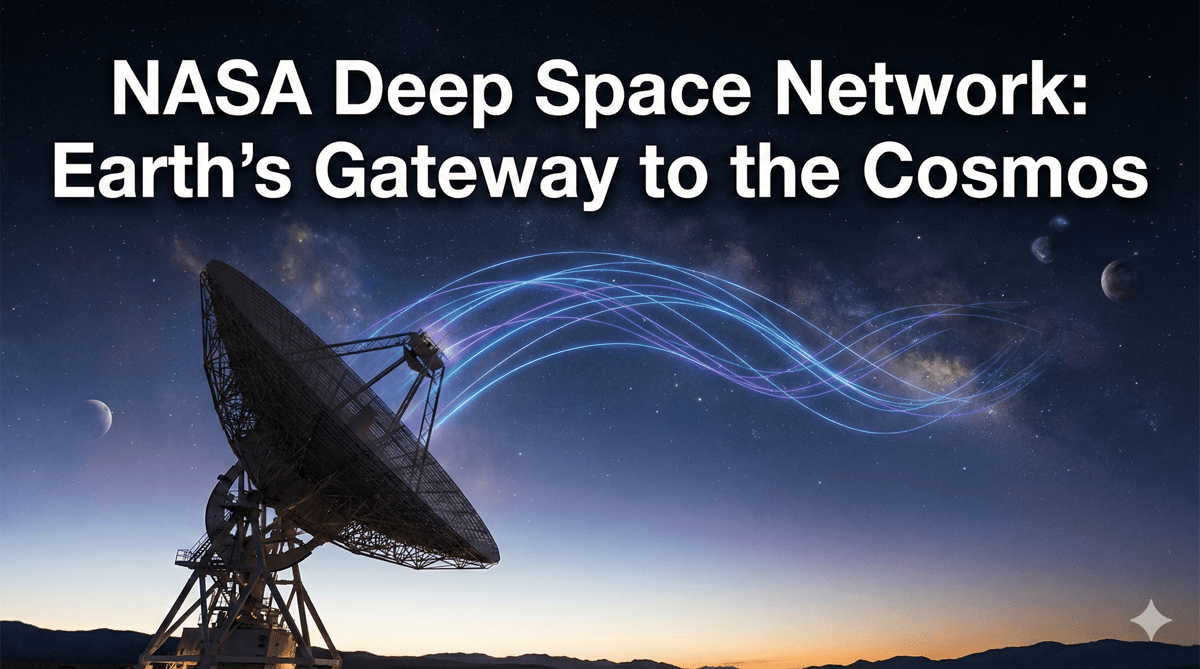
NASA Deep Space Network: Earth’s Gateway to the Cosmos
•January 4, 2026
0
Why It Matters
Continuous, high‑sensitivity contact is essential for mission success and for expanding humanity’s scientific reach beyond Earth. The DSN’s evolution underpins upcoming deep‑space probes and commercial lunar networks, shaping the future of space data infrastructure.
Key Takeaways
- •Three globally spaced complexes ensure continuous deep‑space coverage
- •70‑meter dishes receive faint signals from billions of miles
- •Network supports radio science, radar mapping, and VLBI
- •Upcoming upgrades add BWG antennas and laser communication tests
Pulse Analysis
The Deep Space Network remains the backbone of NASA’s interplanetary operations, leveraging a tri‑continental geometry that guarantees line‑of‑sight connectivity as Earth rotates. Each complex houses a mix of 70‑meter, 34‑meter beam‑waveguide, and high‑efficiency antennas, all tied to sophisticated signal‑processing centers. By converting attowatt‑level downlink signals into usable data, the DSN enables everything from rover imagery on Mars to Voyager’s journey into interstellar space, while also providing precise Doppler and ranging measurements for navigation.
Beyond its primary role as a communications conduit, the DSN doubles as a world‑class scientific platform. Its massive apertures conduct radio‑science experiments that probe planetary atmospheres, while high‑power radar transmissions map asteroids and moons, contributing directly to planetary‑defense initiatives. Integration with global VLBI networks further extends its reach, delivering milliarcsecond‑level astrometric data that supports both geodesy and deep‑space navigation. These ancillary capabilities make the DSN a unique, multi‑purpose asset in the broader space‑science ecosystem.
Looking ahead, NASA is modernizing the network with new 34‑meter beam‑waveguide dishes, advanced cryogenic receivers, and automated scheduling software to increase throughput. Parallel to these upgrades, the Deep Space Optical Communications (DSOC) experiment is demonstrating laser links capable of transmitting data at rates ten to a hundred times higher than traditional radio bands. Commercial partnerships are also emerging, with private ground‑station constellations handling near‑Earth traffic while the DSN reserves its most powerful assets for deep‑space missions. These developments promise to keep the DSN at the forefront of space communications for decades to come.
NASA Deep Space Network: Earth’s Gateway to the Cosmos
0
Comments
Want to join the conversation?
Loading comments...