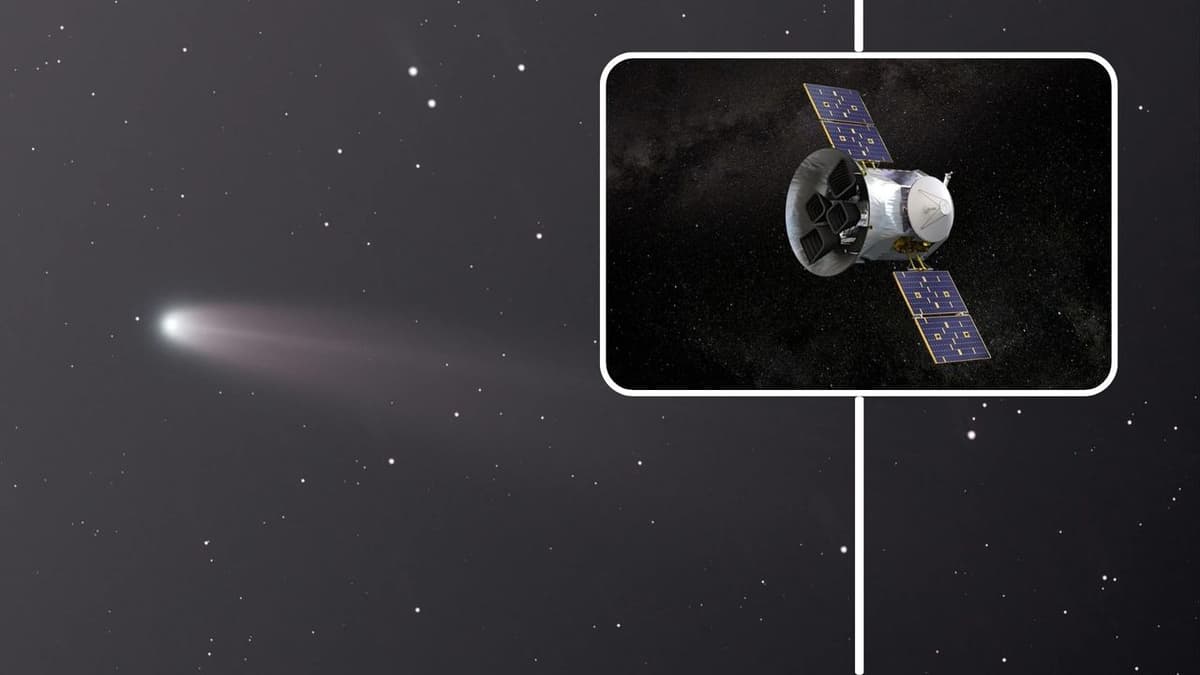
NASA Exoplanet Probe Tracks Interstellar Comet 3I/ATLAS to Gauge Its Spin
•January 28, 2026
0
Companies Mentioned

NASA
Why It Matters
The data demonstrate TESS’s versatility beyond exoplanet hunting and offer unprecedented insight into the physical properties of an interstellar visitor, informing models of comet formation and solar‑system dynamics.
Key Takeaways
- •TESS observed 3I/ATLAS for 28 hours in Jan 2026.
- •Brightness measured at magnitude 11.5, visible with telescopes.
- •Data will help determine comet’s rotation period.
- •Observations show TESS can track fast-moving objects.
- •Dataset released on MAST for global research.
Pulse Analysis
The unexpected capture of interstellar comet 3I/ATLAS by TESS highlights how a planet‑hunting satellite can double as a rapid‑response observatory for transient solar‑system objects. Designed to monitor stellar brightness for exoplanet transits, TESS’s wide field of view and continuous imaging cadence allow it to spot fast‑moving bodies that would otherwise slip past traditional surveys. This flexibility expands NASA’s scientific return, turning a mission originally focused on distant worlds into a valuable asset for cometary science and planetary defense.
Analyzing the 28‑hour photometric series, scientists will search for periodic fluctuations that betray the comet’s spin state. Variations in brightness arise when active jets of dust and gas rotate into and out of view, offering clues about the nucleus’s rotation period and surface heterogeneity. Determining the spin rate is crucial for modeling how interstellar comets shed material and evolve as they traverse interstellar space, shedding light on the composition of their parent planetary systems. Moreover, the measured magnitude of 11.5 places 3I/ATLAS within reach of ground‑based telescopes, enabling coordinated follow‑up observations that can refine activity models.
The public release of the TESS full‑frame images on the Mikulski Archive for Space Telescopes (MAST) invites the global research community to mine the dataset for additional signatures, such as outbursts or fragmentation events. Open access accelerates collaborative analysis, fostering citizen‑science contributions and cross‑mission comparisons with facilities like the James Webb Space Telescope. As more interstellar objects are discovered, the TESS approach sets a precedent for leveraging existing space assets to capture fleeting phenomena, ultimately enriching our understanding of the building blocks that travel between star systems.
NASA exoplanet probe tracks interstellar comet 3I/ATLAS to gauge its spin
0
Comments
Want to join the conversation?
Loading comments...