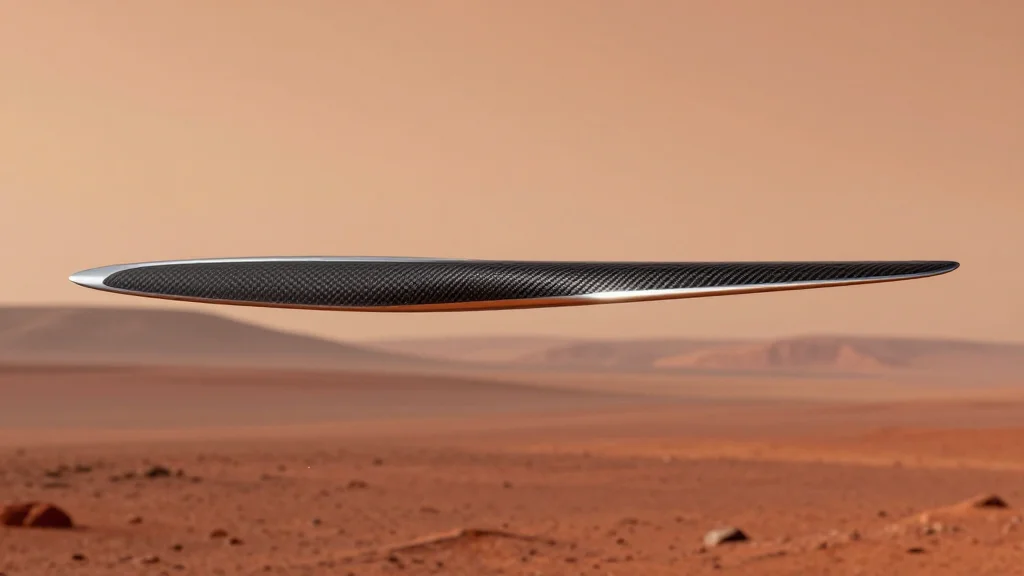
NASA JPL Engineers Unveil Rotor Breakthrough for Next-Gen Mars Helicopters

Why It Matters
The rotor breakthrough expands the envelope of what is technically feasible for aerial platforms on Mars, shifting helicopters from proof‑of‑concept tools to operational assets. Heavier payload capacity means more scientific instruments, larger communication relays, and the potential to transport small cargoes, directly supporting the broader goals of NASA’s Artemis and Mars Exploration Program. Moreover, the technology demonstrates that advanced materials and aerodynamic designs can overcome the challenges of low‑density atmospheres, a lesson that could be applied to future missions to Venus, Titan, or even exoplanetary bodies. By enabling longer flights and higher lift, the new rotors also reduce reliance on ground‑based rovers for terrain scouting, accelerating site selection for human habitats and resource extraction. This capability aligns with commercial interests in in‑situ resource utilization (ISRU) and could attract private partners seeking to leverage NASA’s flight heritage for lunar or Martian logistics services.
Key Takeaways
- •JPL engineers develop a new rotor blade geometry that increases lift in Mars' thin atmosphere
- •Design supports payloads several times larger than Ingenuity's 1.8 kg limit
- •Enables up to 30‑minute flight durations, extending mission coverage
- •Key component for NASA's SkyFall mission, targeting a late‑2028 launch aboard SR‑1
- •Future applications include expanded scientific payloads, cargo delivery, and support for human exploration
Pulse Analysis
NASA’s rotor breakthrough is more than an incremental engineering tweak; it represents a strategic pivot toward scalable aerial operations on other worlds. Historically, planetary exploration has been dominated by landers and rovers, with flight limited to brief, low‑risk demonstrations. Ingenuity proved the concept, but its modest mass and short flight windows kept it in the realm of novelty. The new rotor design, by delivering a higher lift‑to‑weight ratio, effectively removes that ceiling, turning helicopters into workhorses capable of carrying meaningful scientific and logistical loads.
From a market perspective, this development could catalyze a nascent commercial ecosystem around Martian aerial services. Companies that specialize in lightweight composites, autonomous flight control, and high‑energy batteries may find a new customer base in NASA’s follow‑on missions and in private ventures eyeing Mars. The timing aligns with the broader push for lunar and Martian infrastructure, where rapid, flexible transport of equipment and data could be a competitive differentiator.
Looking ahead, the success of the rotor technology will hinge on rigorous testing under simulated Martian conditions. If JPL’s wind‑tunnel and high‑altitude trials validate the projected performance, the SkyFall helicopters could set a new benchmark for interplanetary flight. That would not only reinforce NASA’s leadership in space exploration but also lower the barrier for future missions—both governmental and commercial—to incorporate aerial components as standard mission elements. The ripple effect could accelerate the timeline for human presence on Mars, as aerial scouting and cargo delivery become integral to habitat construction and resource extraction strategies.
NASA JPL Engineers Unveil Rotor Breakthrough for Next-Gen Mars Helicopters
Comments
Want to join the conversation?
Loading comments...