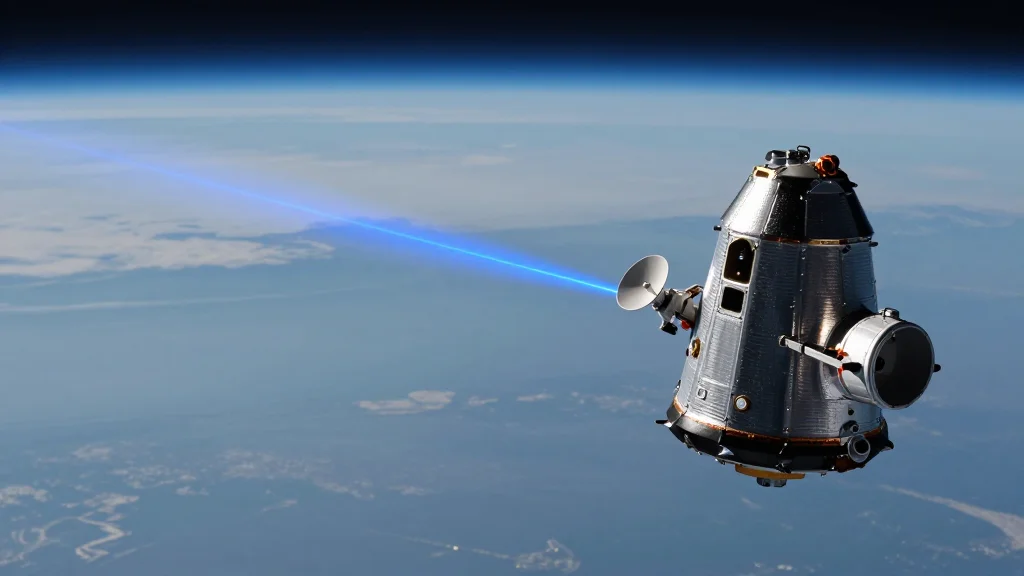
NASA Laser Terminal Enhances Views During Artemis II Mission
Companies Mentioned

NASA
Why It Matters
Laser communications dramatically increase bandwidth and reduce latency, enabling richer scientific return and faster decision‑making for deep‑space crews. The technology also lowers ground‑station costs, accelerating commercial participation in space data services.
Key Takeaways
- •First crewed mission using laser communications at lunar distance
- •Transferred 484 GB data, 260 Mbps downlink, 100 HD movies
- •Ground stations delivered 26 GB in under an hour
- •Australian optical station achieved 15.5 hours dual‑stream video
- •Commercial off‑the‑shelf parts cut optical ground‑station costs
Pulse Analysis
Laser, or optical, communications have long been touted as the next leap for deep‑space data transfer, but Artemis II provided the first real‑world proof point on a crewed mission. By swapping invisible infrared photons for traditional radio waves, NASA achieved data rates of 260 megabits per second—roughly a hundred‑fold increase over the megabit‑per‑second limits of the Near Space and Deep Space Networks. This bandwidth jump turned a 10‑day lunar flyby into a live, high‑definition broadcast, delivering 484 gigabytes of video, photos, and telemetry that would have taken days to downlink via radio.
The success hinged on a global optical ground‑station network. NASA’s JPL and White Sands sites handled the bulk of the downlink, moving 26 GB in under an hour, while a newly built Australian National University Quantum Optical Ground Station contributed over 15.5 hours of dual‑stream video. Crucially, the Australian station relied on commercial off‑the‑shelf components, demonstrating that high‑performance laser links can be assembled at far lower cost than bespoke aerospace hardware. This collaborative model signals a shift toward more open, cost‑effective infrastructure for space communications, inviting private‑sector partners to join the ecosystem.
Looking ahead, the Artemis program’s laser‑link validation paves the way for higher‑data‑rate missions to the lunar Gateway, Mars, and beyond. Faster, richer data streams will enable real‑time scientific analysis, more responsive crew support, and immersive public outreach, all while reducing the mass and power penalties of traditional antennas. As commercial players refine compact optical terminals and ground stations, the market for space‑based high‑speed connectivity is poised to expand, promising new revenue streams and accelerating humanity’s push deeper into the solar system.
NASA Laser Terminal enhances views during Artemis II mission
Comments
Want to join the conversation?
Loading comments...