NASA Moon Base Plans: Artemis, the Lunar South Pole, and the Buildout of a Permanent Human Outpost
Companies Mentioned

Why It Matters
Establishing a sustainable base lowers risk for deeper space missions and creates a commercial foothold on the Moon, accelerating the path to Mars and a lunar economy.
Key Takeaways
- •South Pole chosen for sunlight and water ice potential
- •Robotic missions will precede crewed landings to de‑risk base
- •Commercial landers and CLPS contracts supply cargo and tech demos
- •Power, communications, and dust mitigation shape base design
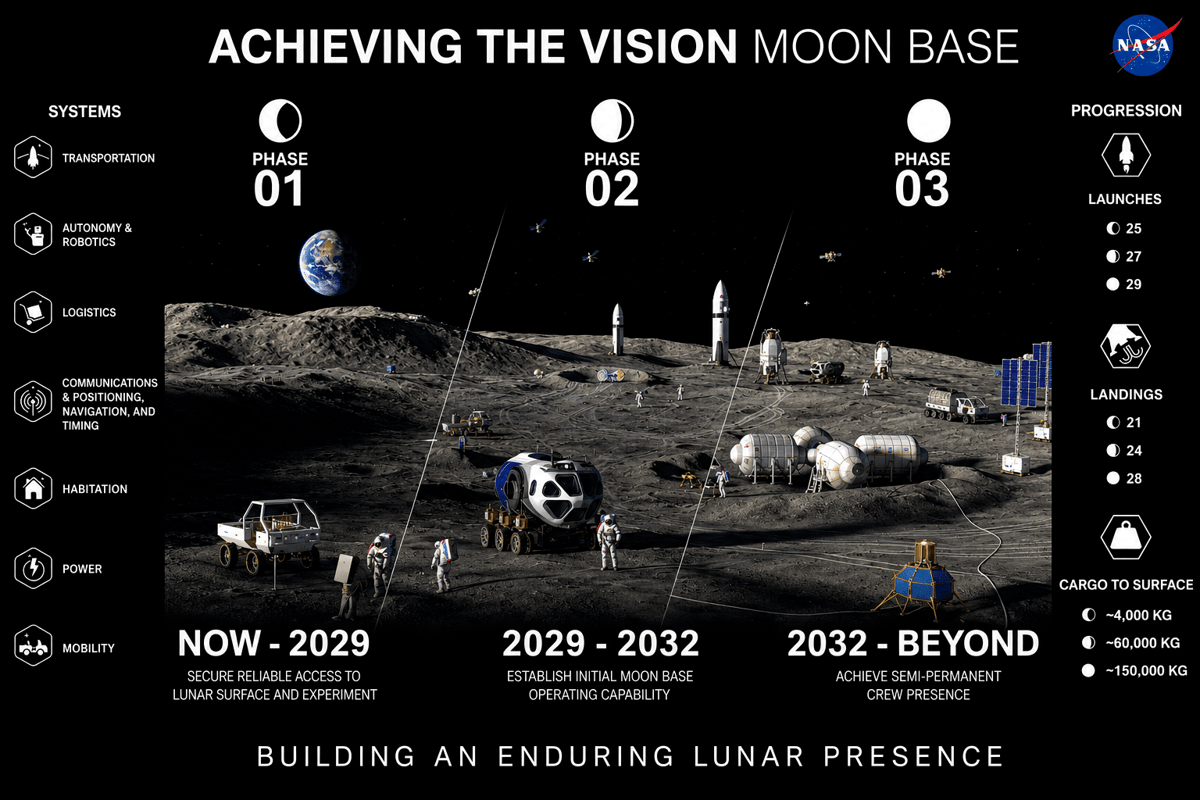
- •NASA targets semi‑permanent outpost by late 2020s
Pulse Analysis
The Artemis program’s evolution from a series of high‑profile landings to a continuous lunar presence reflects a broader industry trend toward sustainable space infrastructure. By anchoring the outpost at the South Pole, NASA leverages the region’s near‑continuous sunlight for solar power while positioning itself to tap water‑ice deposits that could fuel life‑support and propellant production. This dual advantage reshapes mission planning, moving away from short‑duration sorties toward a logistics chain that supports repeated crew rotations, scientific research, and technology validation.
Technical hurdles at the pole drive much of the base’s architecture. Low‑angle illumination creates long shadows that complicate hazard detection and solar array placement, while permanently shadowed craters plunge to –203 °C, demanding radioisotope heating and robust thermal control. Abrasive regolith threatens seals, optics, and mechanical joints, prompting NASA to invest in dust‑repellent coatings and suitport‑style airlocks. Autonomous rovers equipped with advanced traction and terrain‑mapping sensors will navigate steep slopes, ensuring cargo and crew can move safely across the rugged landscape.
Commercial partnerships are central to the plan’s feasibility and cost‑effectiveness. The CLPS program, backed by roughly $2.6 billion in contracts, delivers scientific payloads and technology demonstrators that de‑risk surface operations before humans arrive. Simultaneously, SpaceX’s Starship HLS and Blue Origin’s Blue Moon landers expand cargo capacity, while Axiom Space’s next‑generation spacesuits enable extended EVA work. This ecosystem of private providers not only accelerates hardware development but also seeds a nascent lunar economy, positioning the Moon as a testbed for technologies that will underpin future Mars missions.
NASA Moon Base Plans: Artemis, the Lunar South Pole, and the Buildout of a Permanent Human Outpost
Comments
Want to join the conversation?
Loading comments...