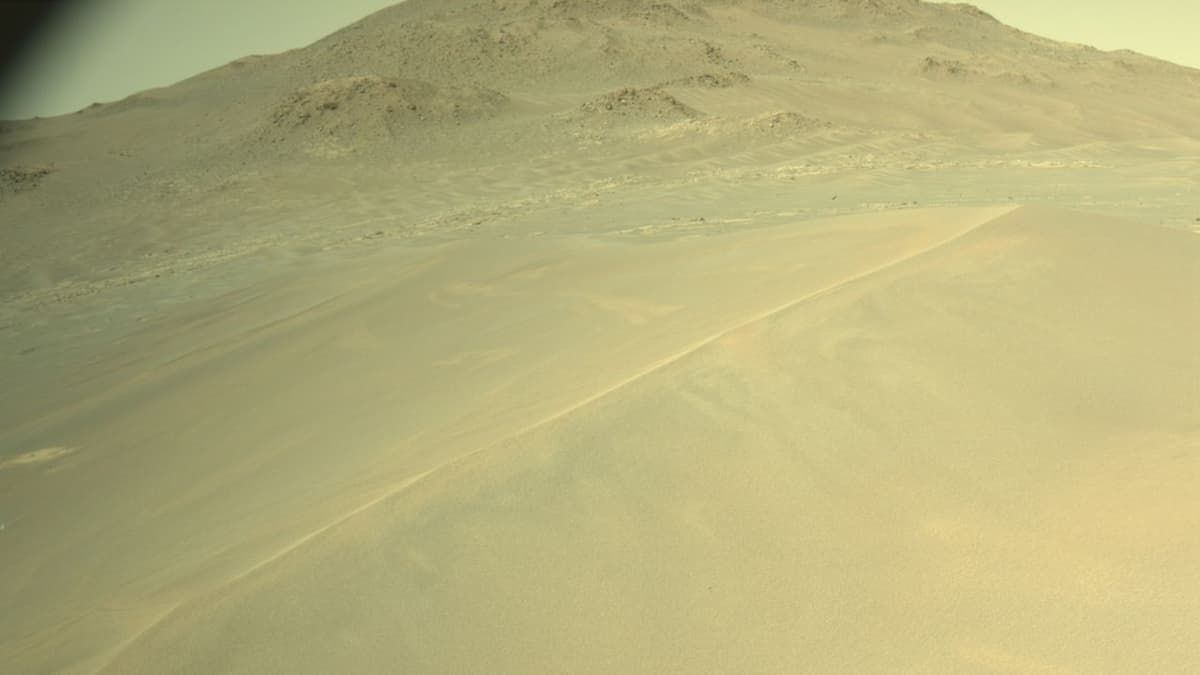
NASA Perseverance Rover Sees Megaripples on Mars | Space Photo of the Day for Jan. 7, 2026.
•January 7, 2026
0
Companies Mentioned

NASA

Jet Propulsion Laboratory
Why It Matters
Inactive megaripples act as time capsules of past Martian atmospheric conditions, offering clues to climate evolution. Their cohesion properties also affect rover traction and the feasibility of in‑situ resource utilization for human missions.
Key Takeaways
- •Perseverance captured detailed images of Martian megaripple “Hazyview”.
- •Megaripples can be up to 2 m tall and often inactive.
- •Crust formation links water‑dust interactions to ripple stability.
- •Observations used SuperCam, Mastcam‑Z, MEDA, PIXL, WATSON.
- •Findings inform future rover traction and in‑situ resource use.
Pulse Analysis
The thin Martian atmosphere still wields enough kinetic energy to sculpt the planet’s surface, producing dunes, ripples and the colossal aeolian formations known as megaripples. Unlike their smaller counterparts, which migrate with each gust, megaripples can reach heights of two metres and often remain stationary for centuries. Their size and apparent dormancy make them valuable archives, preserving the imprint of ancient wind directions, storm intensity, and even episodic interactions with atmospheric water. By studying these features, scientists gain a window into the Red Planet’s recent climatic shifts, a puzzle piece missing from orbital observations alone.
Perseverance’s latest campaign in the Honeyguide ripple field targeted a prominent structure nicknamed “Hazyview.” Using a suite of instruments—SuperCam’s laser spectroscopy, Mastcam‑Z’s high‑resolution imaging, MEDA’s environmental sensors, PIXL’s elemental mapping, and the WATSON microscope—the rover collected more than fifty targeted measurements. The data reveal a surface crust enriched with salty, dust‑laden particles, a product of transient water‑dust chemistry that binds grains together and suppresses movement. This crust not only records past humid events but also explains why the ripple appears largely inert under present wind regimes.
The implications extend beyond academic curiosity. Cohesive soils influence rover wheel slip, dust deposition on solar panels, and the handling of drill and sample‑acquisition hardware, all critical for upcoming missions such as NASA’s Mars Sample Return and eventual human landings. Understanding the thresholds that can reactivate megaripples informs risk assessments for habitat construction and in‑situ resource utilization, where loose regolith may be harvested for building materials or oxygen production. As planetary engineers translate these findings into design criteria, the humble sand ripple becomes a strategic factor in the roadmap to sustainable Mars exploration.
NASA Perseverance rover sees megaripples on Mars | Space photo of the day for Jan. 7, 2026.
0
Comments
Want to join the conversation?
Loading comments...