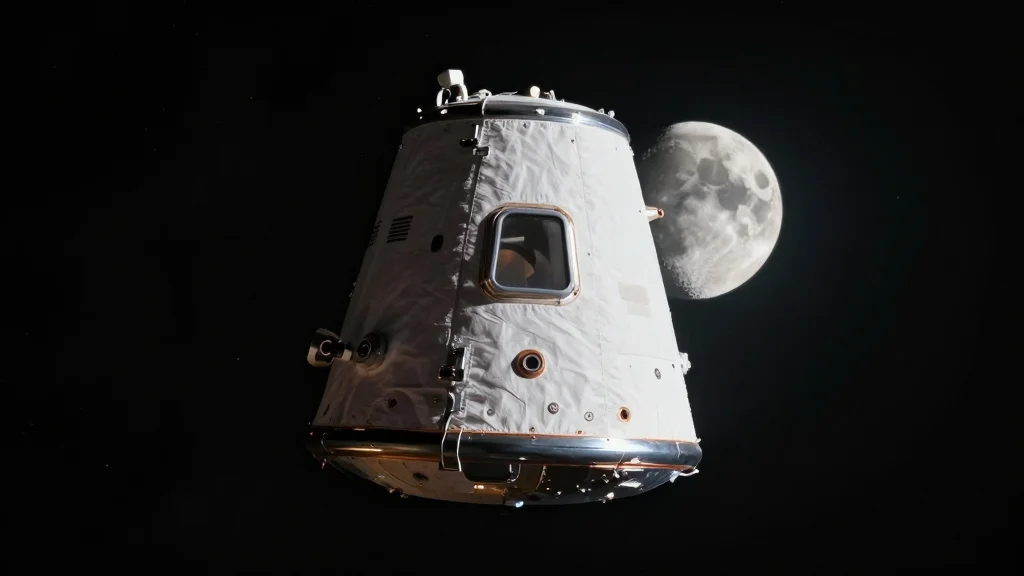
NASA Publishes Detailed Artemis II Post‑Flight Report, Highlighting 10‑Day Lunar Flyby Performance

Companies Mentioned

Why It Matters
The Artemis II post‑flight report provides the first hard data on a crewed deep‑space mission beyond low Earth orbit in over five decades, confirming that the Orion spacecraft can safely support long‑duration lunar missions. This validation reduces technical risk for Artemis III, the first crewed Moon landing of the 21st century, and signals to commercial partners that NASA’s deep‑space architecture is maturing. The data also reshapes the geopolitical balance, as the United States demonstrates operational capability that rivals China’s accelerated lunar ambitions, potentially influencing national space policies and international collaboration on lunar resource extraction. For the broader SpaceTech ecosystem, the report’s metrics on propulsion efficiency, thermal protection and life‑support reliability set new industry benchmarks. Companies developing lunar‑orbit habitats, in‑space propulsion, and re‑entry technologies can now align their roadmaps with proven performance parameters, accelerating investment and shortening development cycles for the emerging lunar economy.
Key Takeaways
- •Artemis II completed a 10‑day, 406,000 km lunar flyby, confirming Orion’s deep‑space performance
- •Orion’s main engine delivered 3,200 m/s delta‑v across 13 burns; re‑entry heating peaked at 8,000 °F
- •Communications reliability hit 99.8 %; CO₂ scrubber efficiency reached 98.7 %
- •Mission validates NASA’s timeline for Artemis III lunar landing in 2027
- •Data intensifies competition with China’s crewed lunar landing goal before 2030
Pulse Analysis
The Artemis II post‑flight analysis is more than a technical audit; it is a strategic inflection point for the U.S. space agenda. By delivering concrete performance data, NASA has turned speculative confidence into quantifiable risk reduction, a prerequisite for securing the billions of dollars tied to Artemis III and the Lunar Gateway. Historically, NASA’s crewed programs have suffered from budgetary volatility when technical milestones were ambiguous. This report, therefore, strengthens the agency’s bargaining position with Congress and commercial partners, potentially unlocking additional funding streams.
From a market perspective, the confirmed reliability of Orion’s propulsion and thermal protection systems lowers the entry barrier for private firms eyeing lunar‑orbit services. Companies like SpaceX, Blue Origin and emerging European players can now model their lander designs against a proven spacecraft, reducing engineering uncertainty and accelerating certification processes. This could compress the timeline for a commercial lunar transport market, which analysts estimate could be worth $30 billion by 2035.
Geopolitically, the data underscores the United States’ operational edge in deep‑space crewed missions, a narrative that will resonate in diplomatic circles as the nation negotiates lunar resource treaties and the future of the Lunar Gateway. China’s accelerated crewed lunar program now faces a benchmark that it must match or exceed, potentially spurring a new wave of investment in its own heavy‑lift launchers and crewed capsules. In sum, the Artemis II analysis not only validates technology but also reshapes the competitive dynamics of the emerging lunar economy, setting the stage for a decade of intensified activity both on the Moon and in the broader SpaceTech sector.
NASA Publishes Detailed Artemis II Post‑Flight Report, Highlighting 10‑Day Lunar Flyby Performance
Comments
Want to join the conversation?
Loading comments...