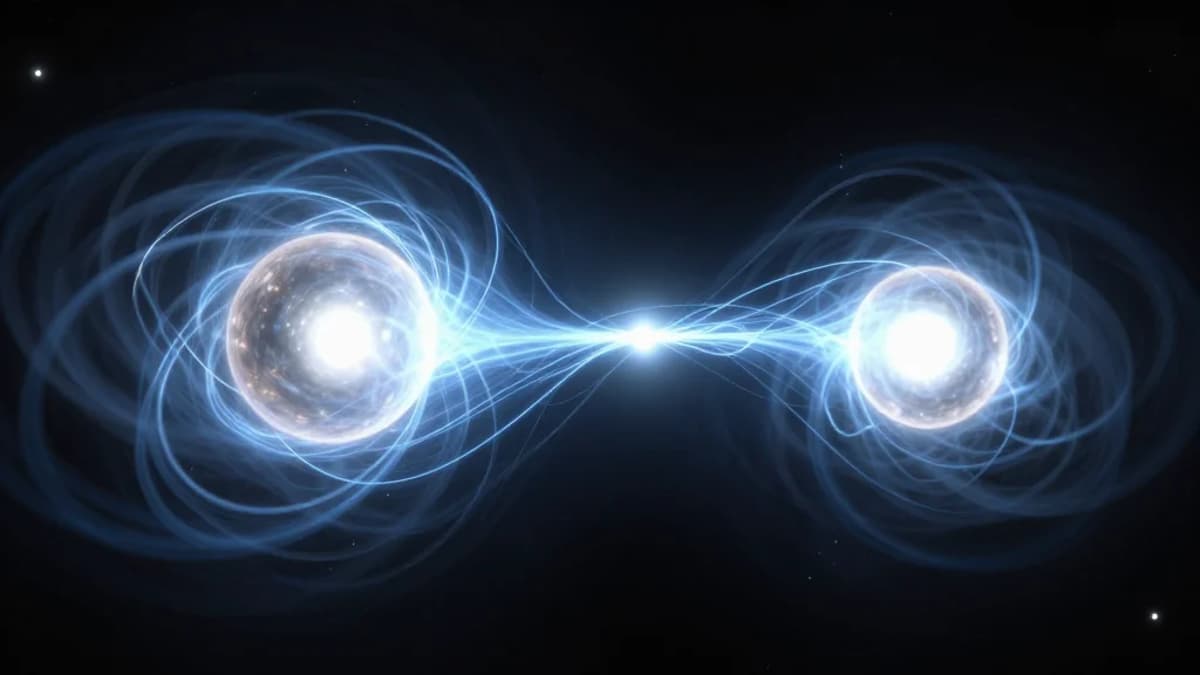
NASA Researchers Probe Tangled Magnetospheres of Merging Neutron Stars
•January 29, 2026
0
Companies Mentioned

Why It Matters
Detecting pre‑merger electromagnetic flashes would enrich multimessenger observations, improve localization of neutron‑star mergers, and help decode the physics of magnetosphere dynamics influencing gravitational‑wave waveforms.
Key Takeaways
- •100+ high‑resolution simulations of 1.4 M☉ neutron star binaries.
- •Magnetosphere reconnection drives bright, anisotropic pre‑merger gamma/X‑ray flashes.
- •Signal strength depends on magnetic orientation and observer angle.
- •Findings guide design of future wide‑field medium‑energy gamma‑ray telescopes.
- •Pre‑merger EM cues could complement next‑gen gravitational‑wave alerts.
Pulse Analysis
The extreme environments surrounding merging neutron stars have long been a frontier for astrophysics, but only the most powerful computers can capture their fleeting magnetospheric dance. By exploiting NASA’s Pleiades supercomputer, researchers modeled the last few milliseconds of binary inspiral at unprecedented resolution, tracking how magnetic field lines twist, break, and reconnect. This level of detail is essential because the plasma‑filled magnetospheres act like dynamic circuits, converting orbital energy into bursts of high‑energy radiation that traditional analytic approaches cannot predict.
Key findings show that the reconnection process produces highly anisotropic emission, with brightness varying dramatically based on the relative magnetic orientation of the two stars and the observer’s line of sight. While the most energetic gamma rays are quickly absorbed and re‑processed into lower‑energy photons, medium‑energy gamma rays and X‑rays can escape the chaotic plasma, forming brief precursors that precede the final merger flash. These signatures are strongest in the final milliseconds, offering a narrow but detectable window for instruments with wide fields of view and sufficient sensitivity.
The implications extend beyond a single astrophysical curiosity. Detectable pre‑merger flashes would provide an early electromagnetic warning that complements gravitational‑wave alerts from facilities like LIGO, Virgo, and the future LISA mission. Such multimessenger coordination could sharpen source localization, enable rapid follow‑up observations, and deepen our understanding of how magnetic stresses influence both the emitted light and the gravitational‑wave waveform. Consequently, the study informs the design priorities of next‑generation gamma‑ray observatories and helps shape strategies for integrated multimessenger campaigns.
NASA researchers probe tangled magnetospheres of merging neutron stars
0
Comments
Want to join the conversation?
Loading comments...