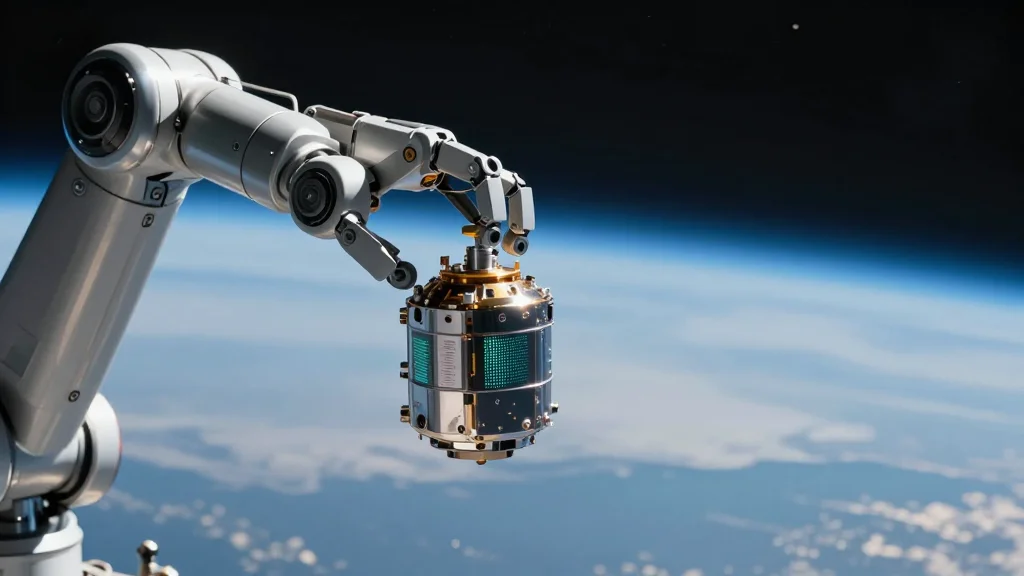
NASA Robotic Tech Demo Will Advance Prototype Gamma-Ray Detectors
Companies Mentioned
Why It Matters
Closing the gamma‑ray sensitivity gap will sharpen observations of bursts and distant active galaxies, while the robotic servicing demo shows a low‑cost path to upgrade space assets in orbit.
Key Takeaways
- •AstroPix chips contain 4 silicon detectors, each with 1,225 pixels.
- •Sensors target 20‑700 keV range, bridging 500 keV‑1 MeV sensitivity gap.
- •Demo flies on Fly Foundational Robots mission, launching late 2027.
- •Robotic arm will reposition the 30 cm Orbital Replacement Unit in orbit.
- •Successful test could enable cheaper in‑orbit upgrades for future space telescopes.
Pulse Analysis
Gamma‑ray astronomy has long been limited by detector sensitivity at the mid‑energy band. While NASA’s Fermi and Swift observatories excel at low and ultra‑high energies, the 500 keV‑1 MeV window—where gamma‑ray bursts and the brightest active galactic nuclei emit most of their power—remains under‑sampled. AstroPix’s silicon‑pixel architecture, akin to a cellphone camera sensor but tuned for high‑energy photons, promises to capture these elusive signals with unprecedented resolution, opening new avenues for studying the physics of cosmic explosions and supermassive black holes.
The upcoming Fly Foundational Robots mission provides an ideal testbed for this technology. Housed in a 30‑centimeter Orbital Replacement Unit, the AstroPix A‑STEP payload will be lifted, repositioned, and operated by a robotic arm built by Rocket Lab Robotics. This in‑orbit servicing demonstration not only validates the detector’s performance in the harsh space environment but also proves the feasibility of swapping or upgrading payloads without launching an entirely new satellite. The integration leverages existing power, data, and mechanical interfaces, illustrating a modular approach that could become standard for future science and commercial platforms.
If the demonstration succeeds, AstroPix could be stacked into larger arrays for dedicated gamma‑ray missions, dramatically improving detection rates of high‑energy transients. Moreover, the robotic servicing model reduces mission costs by allowing incremental upgrades, extending spacecraft lifespans, and mitigating risk for high‑value instruments. This synergy between advanced detector technology and on‑orbit robotics signals a shift toward more flexible, cost‑effective space science architectures, positioning NASA and its industry partners to maintain leadership in high‑energy astrophysics while fostering commercial opportunities in satellite servicing.
NASA Robotic Tech Demo Will Advance Prototype Gamma-Ray Detectors
Comments
Want to join the conversation?
Loading comments...