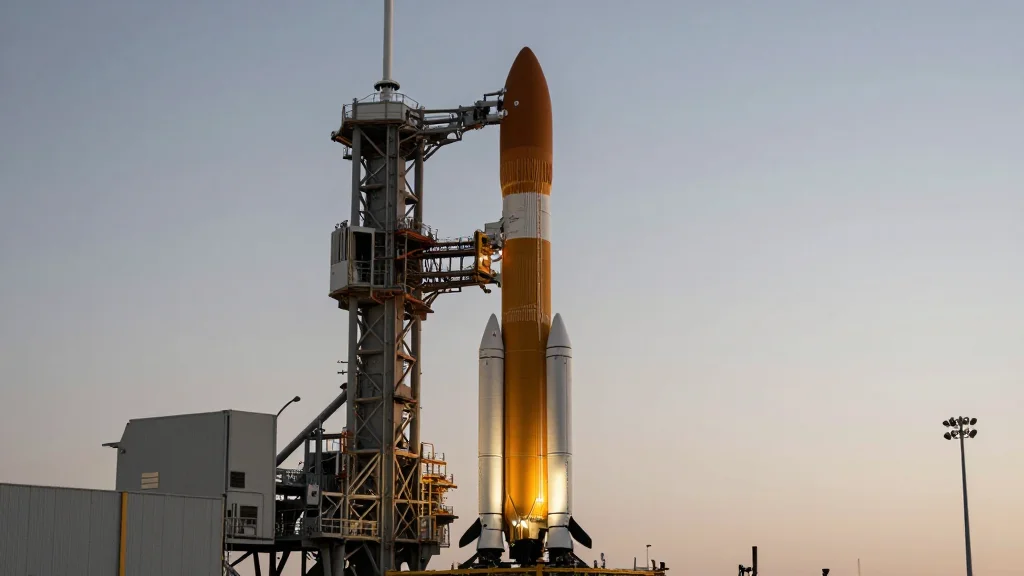
NASA Sets Launch Date for Roman Space Telescope
Companies Mentioned
Why It Matters
Roman’s earlier launch and cost‑effective delivery expand NASA’s infrared survey capacity, sharpening target selection for JWST and accelerating dark‑energy research. The mission reinforces U.S. leadership in space‑based astronomy while showcasing SpaceX’s heavy‑lift capabilities.
Key Takeaways
- •Launch set for August 30 on SpaceX Falcon Heavy.
- •Telescope mass 8,000 kg (10,500 kg with propellant) lifts from Kennedy.
- •Roman will operate at Sun‑Earth L2 for at least 5 years.
- •Wide-field infrared surveys will feed targets to James Webb.
- •Coronagraph enables direct imaging of exoplanets and dark energy studies.
Pulse Analysis
NASA’s decision to move the Roman Space Telescope launch up to August 30 reflects a broader trend of accelerating high‑profile science missions while keeping them under budget. The telescope, assembled at Goddard Space Flight Center, will ride a SpaceX Falcon Heavy, underscoring the growing reliance on commercial heavy‑lift providers for deep‑space payloads. By meeting its revised timeline, Roman not only validates NASA’s internal reorganization but also demonstrates the effectiveness of public‑private partnerships in delivering complex observatories on schedule.
Scientifically, Roman fills a crucial niche alongside the James Webb Space Telescope. While JWST offers unprecedented infrared resolution over narrow fields, Roman’s wide‑field optics will map vast swaths of the sky, identifying promising regions for JWST’s detailed follow‑up. Stationed at the Sun‑Earth L2 Lagrange point, the observatory will conduct panoramic surveys that probe dark energy, dark matter, and the early universe. Its onboard coronagraph adds a direct‑imaging capability for exoplanets, expanding the toolkit for characterizing worlds beyond our solar system.
The launch also signals strategic momentum for the next generation of U.S. space telescopes. Roman’s success paves the way for the upcoming Habitable Worlds Observatory, which aims to search for biosignatures on exoplanets. Moreover, the mission’s on‑time, under‑budget performance bolsters confidence among policymakers and industry stakeholders, reinforcing America’s competitive edge in astrophysics and commercial launch services. As the telescope begins its five‑year mission, its data will likely shape research priorities and funding decisions for decades to come.
NASA Sets Launch Date for Roman Space Telescope
Comments
Want to join the conversation?
Loading comments...