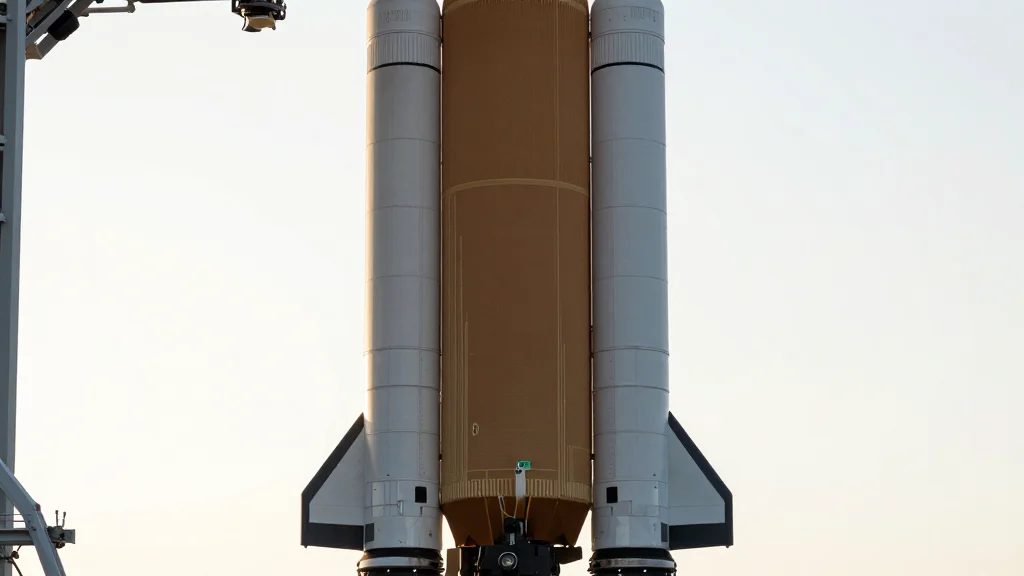
NASA Shifts Artemis III to Upper‑Stage‑Free SLS, Preps Crew Briefings for Congress

Companies Mentioned

Why It Matters
The decision to fly Artemis III without an upper stage fundamentally reshapes NASA’s near‑term lunar roadmap. By converting the mission into a LEO systems test, NASA reduces technical risk, preserves the ICPS for later crewed landings, and creates a clear integration path for commercial lander providers. Politically, the crew’s congressional outreach leverages the program’s high public profile to protect human‑exploration funding amid broader budget pressures on scientific missions. Together, these moves keep the Artemis program on schedule while aligning it with a growing commercial lunar‑landing ecosystem. The spacer approach also signals a shift in how NASA balances in‑house development with partner contributions. By deferring the larger Exploration Upper Stage and using a simple structural element, NASA can accelerate hardware readiness, lower launch‑vehicle costs, and provide commercial partners more launch windows to demonstrate their lander technologies. This could set a precedent for future deep‑space missions that rely on modular, upgradable launch configurations.
Key Takeaways
- •Artemis III will launch on SLS with a non‑propulsive spacer instead of the ICPS, redefining the mission as a low‑Earth‑orbit test.
- •The spacer, built at Marshall Space Flight Center, matches ICPS dimensions but eliminates propulsion hardware.
- •Orion’s European service module will handle orbit circularization, extending crew time aboard the capsule.
- •Artemis II crew delivered a congressional briefing, highlighting political support while NASA’s Science Mission Directorate faced a 47 % budget cut proposal.
- •The ICPS is slated for Artemis IV in 2028, giving NASA time to adapt the Centaur upper stage for SLS use starting with Artemis 5.
Pulse Analysis
NASA’s pivot to a spacer‑only SLS for Artemis III reflects a pragmatic risk‑management strategy that acknowledges both technical and fiscal realities. Historically, NASA has used upper stages like the ICPS to provide the high‑energy boost needed for translunar injection. By stripping that capability for a LEO test, the agency trades a single‑mission capability for a broader, more flexible architecture that can accommodate multiple commercial partners without committing to a costly propulsion system that is no longer in production.
The move also dovetails with the evolving commercial lunar‑landscape. Blue Origin and SpaceX have each invested heavily in their own human‑landing systems, but neither has secured a definitive flight slot on a NASA mission. By structuring Artemis III as a multi‑launch campaign that includes pathfinder landers, NASA creates a low‑stakes environment for these providers to demonstrate docking and rendezvous procedures. Successful integration could accelerate the timeline for a crewed landing on the Moon’s South Pole, a key objective of Artemis IV and beyond.
Politically, the Artemis II crew’s congressional briefing underscores how human‑spaceflight remains a potent lobbying tool. The stark contrast between the program’s protected funding and the near‑half‑budget cut proposed for the Science Mission Directorate illustrates the power of visible, crewed missions to capture legislative attention. As NASA continues to balance its dual mandate of exploration and science, the Artemis III redesign may serve as a template: prioritize high‑visibility, crew‑centric milestones that secure funding, while leveraging commercial partnerships to shoulder the cost and technical burden of lunar‑surface operations.
NASA Shifts Artemis III to Upper‑Stage‑Free SLS, Preps Crew Briefings for Congress
Comments
Want to join the conversation?
Loading comments...