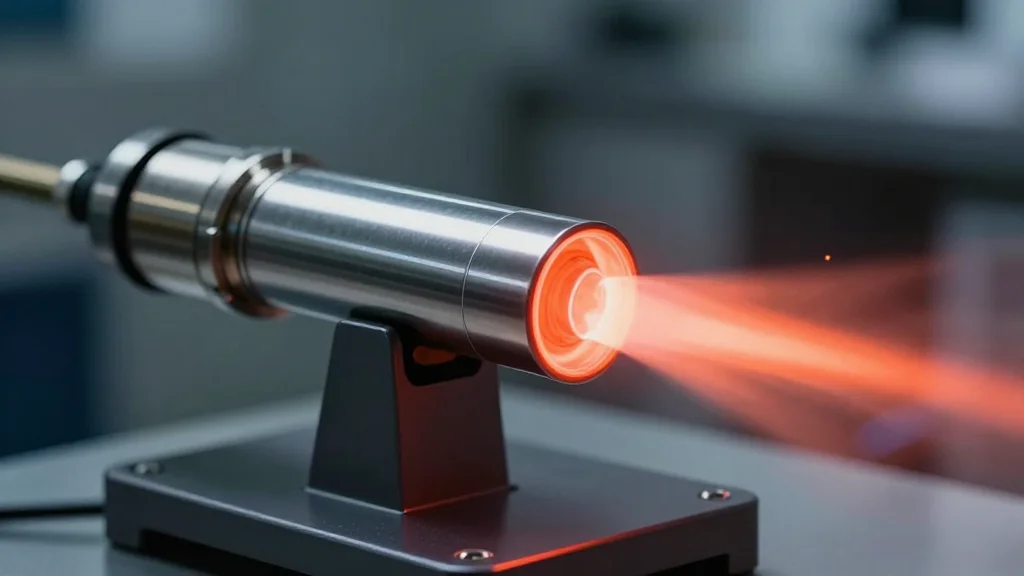
NASA’s 120‑kW Lithium‑Fed Plasma Thruster Marks First US High‑Power Electric Propulsion Test

Companies Mentioned

NASA

Jet Propulsion Laboratory
Why It Matters
The 120 kW lithium‑fed MPD thruster represents a paradigm shift in how the United States could reach deep space. By achieving power levels previously only demonstrated abroad, NASA reduces its reliance on chemical rockets for interplanetary travel, potentially cutting mission costs and expanding payload capacity. Faster, more efficient propulsion could accelerate the timeline for crewed Mars landings, a cornerstone of NASA’s long‑term exploration strategy. Beyond crewed missions, the technology could enable new classes of scientific probes that travel farther and faster than ever before. High‑power electric propulsion would allow spacecraft to reach the outer planets and Kuiper Belt objects on shorter timelines, increasing the scientific return of each mission and keeping the United States at the forefront of planetary science.
Key Takeaways
- •NASA’s lithium‑fed MPD thruster hit 120 kW, the highest‑power US electric propulsion test to date
- •Jared Isaacman, NASA Administrator, said the test shows real progress toward a crewed Mars landing
- •James Polk, JPL senior research scientist, highlighted that the thruster met target power and provides a testbed for scaling
- •The test used a unique metal‑vapor vacuum facility capable of megawatt‑class power levels
- •Future plans include longer firings and integration with high‑capacity power sources for a 2030s demonstration mission
Pulse Analysis
NASA’s successful 120 kW lithium‑fed MPD test arrives at a moment when the agency is juggling multiple deep‑space initiatives, from Artemis lunar landings to the upcoming Europa Clipper. Historically, electric propulsion has been a niche capability, limited to low‑thrust, high‑efficiency missions like Dawn and Psyche. By pushing power into the hundreds of kilowatts, NASA is attempting to bridge the gap between efficiency and the thrust needed for crewed interplanetary travel. This move mirrors a broader industry trend where private firms such as SpaceX and Blue Origin are investing heavily in high‑thrust, reusable launchers, while NASA bets on high‑specific‑impulse engines to reduce launch mass.
The technology’s reliance on lithium, a dense metal that can be stored compactly, could sidestep the supply chain constraints associated with xenon, the propellant of choice for many Hall‑effect thrusters. However, the engineering challenges are non‑trivial: managing megawatt‑scale electrical currents, mitigating electrode erosion, and ensuring thermal stability over months‑long burns will require breakthroughs in materials science and power electronics. If NASA can solve these problems, it will not only secure a competitive edge in government‑led deep‑space missions but also open a commercial market for high‑power electric propulsion, potentially attracting satellite operators seeking rapid orbital transfers.
Strategically, the test signals to international competitors that the United States remains committed to pioneering next‑generation propulsion. China’s recent advances in plasma thrusters and Europe’s investment in nuclear electric propulsion underscore a growing global race for efficient deep‑space travel. NASA’s progress could shape future partnership models, where the agency supplies propulsion expertise while commercial partners provide launch services and power generation. The next decade will likely see a convergence of high‑power electric thrusters with advanced power sources, and NASA’s 120 kW milestone positions it to be a key player in that emerging ecosystem.
NASA’s 120‑kW Lithium‑Fed Plasma Thruster Marks First US High‑Power Electric Propulsion Test
Comments
Want to join the conversation?
Loading comments...