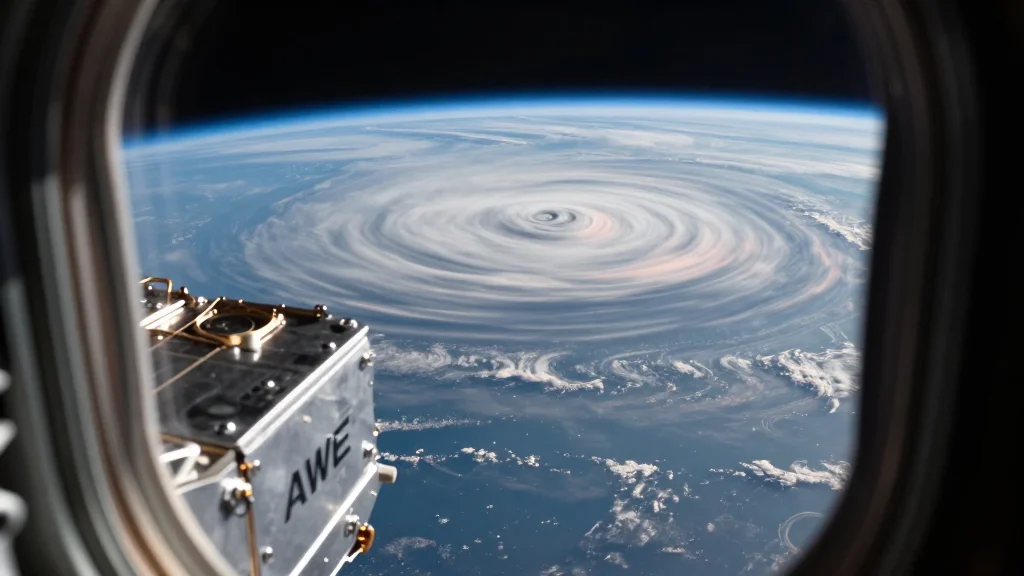
NASA's AWE Instrument Completes Mission to Study Earth's Effect on Space Weather
Companies Mentioned

NASA
SpaceX
Why It Matters
Understanding how weather‑driven gravity waves modulate ionospheric conditions is essential for safeguarding satellite‑based services and the broader orbital economy. The open dataset will fuel ongoing research and improve predictive models of space weather impacts.
Key Takeaways
- •AWE captured 80 million infrared images over 30 months on ISS.
- •Gravity waves from storms alter upper‑atmosphere plasma, affecting satellite communications.
- •Small‑scale waves (30‑300 km) have strongest impact on space weather.
- •AWE data will remain public, supporting ongoing research and citizen science.
Pulse Analysis
The Atmospheric Waves Experiment (AWE) was the first dedicated instrument on the International Space Station to image atmospheric gravity waves in the mesosphere using infrared airglow. Deployed in November 2023, the payload operated for 30 months, acquiring more than 80 million nighttime frames at a rate of four images per second. By tracking the upward propagation of ripples generated by thunderstorms, tornadoes and hurricanes, AWE filled a long‑standing observational gap between weather on the ground and the plasma environment that defines space weather.
The dataset revealed that gravity waves with horizontal wavelengths between 30 and 300 kilometers produce the most pronounced perturbations in the ionospheric plasma density. These perturbations can degrade GPS accuracy, disrupt satellite‑to‑ground links, and interfere with high‑frequency communications—critical services for aviation, maritime navigation and the burgeoning satellite‑based broadband market. By correlating specific weather events, such as Hurricane Helene and a May 2024 tornado outbreak, with measurable changes in the upper atmosphere, AWE demonstrated a direct pathway by which terrestrial weather influences the orbital economy.
All AWE observations have been released to the public, enabling both academic researchers and citizen scientists to explore the coupling between tropospheric dynamics and space weather. The instrument’s retirement makes way for CLARREO Pathfinder, a radiometric sensor promising five‑to‑ten‑fold improvements in Earth‑shine and lunar‑shine calibration, which will further refine climate and atmospheric models. The legacy of AWE underscores the value of the ISS as a flexible laboratory and sets a precedent for future missions that aim to protect satellite infrastructure through better understanding of atmospheric wave processes.
NASA's AWE instrument completes mission to study Earth's effect on space weather
Comments
Want to join the conversation?
Loading comments...