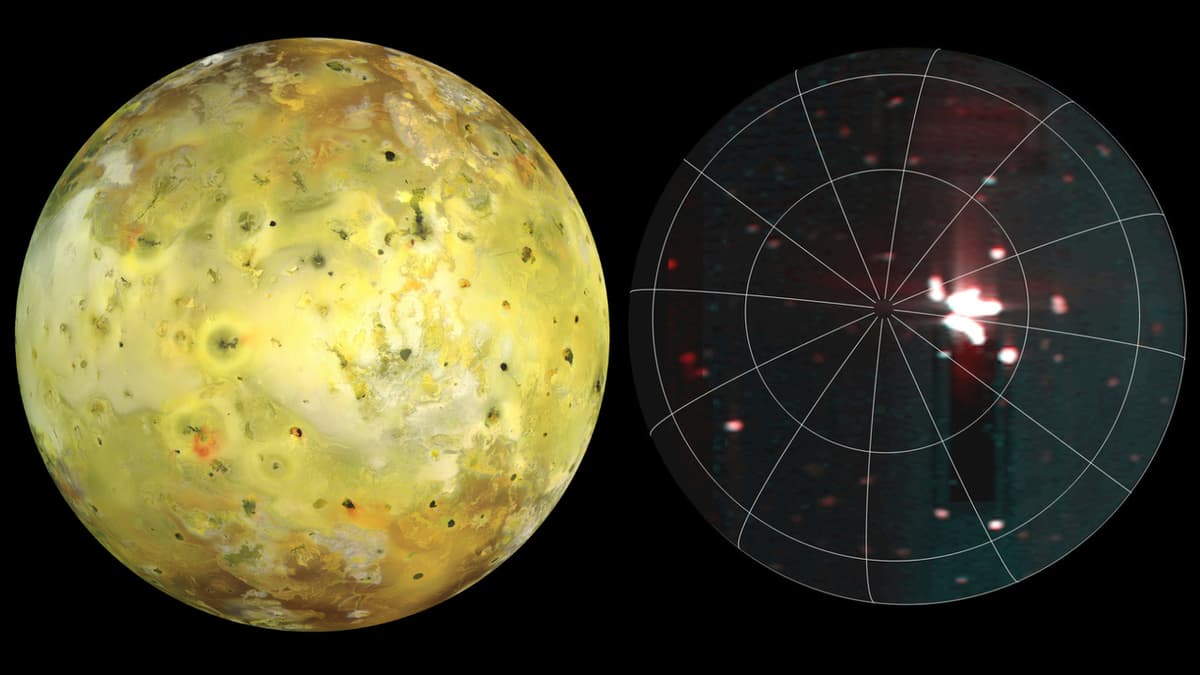
NASA's Juno Spacecraft Spots the Largest Volcanic Eruption Ever Seen on Jupiter's Moon Io
•January 29, 2026
0
Why It Matters
The discovery reshapes our understanding of Io’s interior, confirming that tidal heating creates extensive magma plumbing systems that can drive planet‑wide volcanic episodes. This insight refines models of tidal volcanism across the solar system and informs future exploration of icy worlds.
Key Takeaways
- •Juno recorded 40,400 sq mi volcanic hotspot on Io
- •Eruption power estimated between 140 and 260 TW
- •Multiple volcanoes erupted simultaneously, suggesting linked magma chambers
- •Tidal forces from Jupiter drive Io’s extreme volcanism
- •JIRAM instrument proved effective for infrared volcanic detection
Pulse Analysis
Io has long been the solar system’s poster child for tidal volcanism, its 400 active vents powered by Jupiter’s relentless gravitational squeeze. While Galileo mapped individual lava flows, Juno’s extended mission brings a new perspective: high‑resolution infrared snapshots taken during close fly‑bys. By leveraging JIRAM’s thermal sensitivity, scientists can now monitor real‑time heat output, turning Io into a natural laboratory for studying how external tides translate into internal melt generation. This capability bridges a gap between surface observations and deep‑mantle dynamics, offering a clearer picture of how energy is transferred within tidally heated bodies.
The Dec. 27 eruption dwarfs previous events, releasing up to 260 TW—five times the power of the 1980 Mount St Helens blast and more than triple the 2001 Surt eruption. Such magnitude implies a vast, interconnected magma reservoir, akin to a porous sponge that can feed multiple vents at once. This challenges the conventional view of Io’s volcanoes as isolated conduits, suggesting instead a planetary‑scale plumbing network that can synchronize activity across hundreds of kilometers. Understanding these reservoirs helps refine thermal evolution models, not only for Io but for other tidally stressed moons like Europa and Enceladus.
Looking ahead, Juno’s continued Io fly‑bys will map the evolution of new lava fields and track cooling rates, while JIRAM’s data will feed into 3‑D magma chamber simulations. The broader implication is a template for interpreting volcanic signatures on exoplanets subjected to extreme tidal forces. As mission planners consider future missions to the Jovian system, the ability to detect and quantify volcanic heat remotely becomes a critical tool for assessing habitability and geological activity beyond Earth.
NASA's Juno spacecraft spots the largest volcanic eruption ever seen on Jupiter's moon Io
0
Comments
Want to join the conversation?
Loading comments...