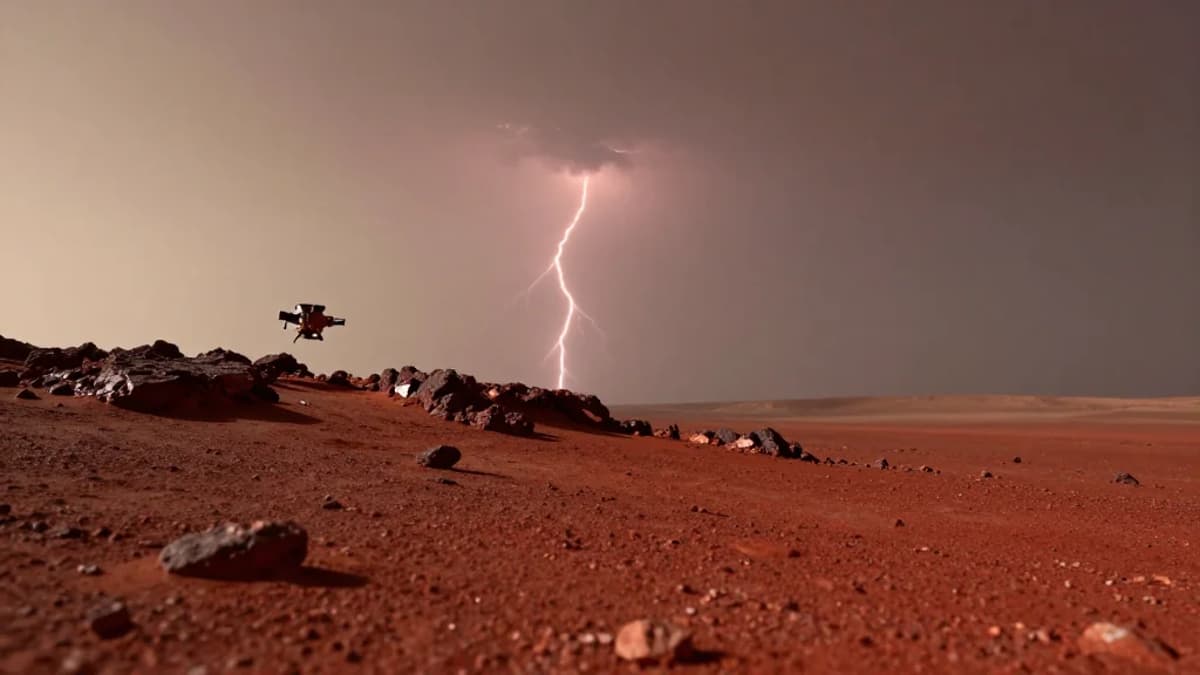
NASA's MAVEN Detects First Evidence of Lightning-Like Activity on Mars
•March 2, 2026
0
Why It Matters
Confirming electrical discharges on Mars reshapes our understanding of its atmospheric chemistry and informs the design of future landers and communication systems.
Key Takeaways
- •MAVEN recorded single 0.4‑second whistler wave at 110 Hz.
- •Detection required localized crustal magnetic field and night‑side ionosphere.
- •Dust storms may generate electric discharges similar to terrestrial lightning.
- •Only <1% of snapshots met conditions for observable whistlers.
- •Findings aid planning for atmospheric and communication systems on Mars.
Pulse Analysis
The detection of a whistler wave by MAVEN adds Mars to the short list of planets where lightning‑type phenomena have been observed, joining Earth, Jupiter, Saturn and Neptune. Whistler waves are low‑frequency radio emissions that travel along magnetic field lines, a process well documented in Earth’s magnetosphere. On Mars, the absence of a global magnetic field makes such propagation unlikely, yet localized crustal fields in the southern hemisphere can guide these signals, offering a unique diagnostic of atmospheric electricity.
Analyzing over 108,000 MAVEN snapshots, scientists isolated a solitary event that matched the spectral signature of terrestrial lightning‑generated whistlers. The detection required a confluence of factors: a strong, vertically oriented crustal field, night‑side ionospheric density, and a dust storm capable of charging particles through collisions. Because fewer than one percent of the examined snapshots satisfied these criteria, the rarity of observable events underscores how delicate the detection window is. The brief 0.4‑second burst, lasting up to 110 Hz, validates theoretical models that predict electric discharges during Martian dust storms, even without a planet‑wide magnetosphere.
Understanding Martian lightning has practical implications for upcoming missions. Electrical discharges can alter atmospheric chemistry, producing reactive species that affect surface oxidation and potential biosignatures. Moreover, transient electromagnetic bursts could interfere with radio communications and navigation for orbiters and surface rovers. By mapping where and when such events are detectable, mission planners can mitigate risks and perhaps even harness the phenomenon for in‑situ atmospheric studies, advancing comparative planetology and the broader quest to characterize extraterrestrial weather systems.
NASA's MAVEN detects first evidence of lightning-like activity on Mars
0
Comments
Want to join the conversation?
Loading comments...