NASA’s MAVEN Makes 1st Discovery of Atmospheric Effect at Mars
Companies Mentioned
Why It Matters
The finding reveals a new pathway for solar‑wind‑driven atmospheric loss on Mars, refining habitability models and informing risk assessments for future missions. It also provides a comparative template for similar processes on Venus, Titan and other bodies lacking global magnetic fields.
Key Takeaways
- •Zwan‑Wolf effect detected in Martian ionosphere below 200 km.
- •Observation occurred during a large solar storm amplifying the effect.
- •First atmospheric occurrence of a magnetospheric phenomenon ever recorded.
- •Insight improves models of space‑weather impact on Mars and similar bodies.
Pulse Analysis
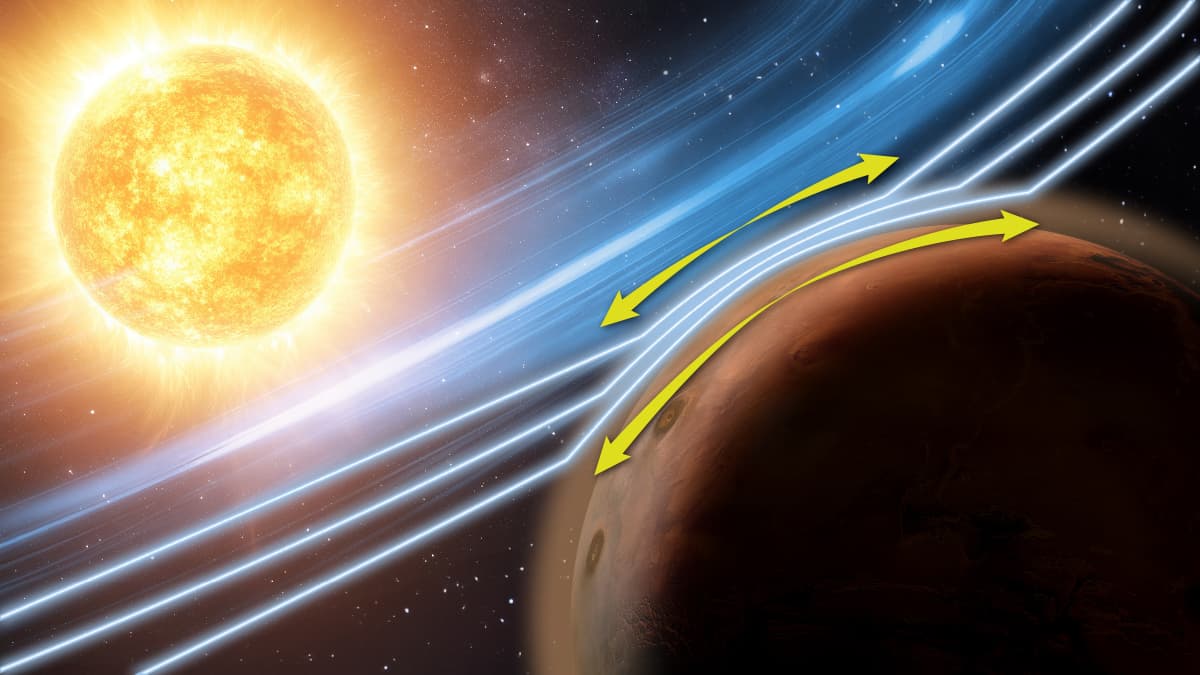
The MAVEN mission, launched in 2013, has been a workhorse for probing the Red Planet’s upper atmosphere and its interaction with the Sun. By measuring magnetic fields, charged particles, and atmospheric composition, MAVEN has already quantified how solar wind strips away Martian gases. The recent identification of the Zwan‑Wolf effect—a magnetic flux‑tube squeezing observed in Earth’s magnetosphere—adds a fresh layer to that narrative, demonstrating that similar magnetic dynamics can manifest deep within a planet’s ionosphere even without a global magnetic shield.
During a pronounced solar storm in late 2023, MAVEN’s instruments recorded anomalous wiggles in magnetic field data, which researchers traced to the Zwan‑Wolf effect compressing ionospheric plasma. This compression can accelerate atmospheric escape by funneling charged particles into pathways that intersect with the solar wind, potentially increasing loss rates during extreme space‑weather events. Incorporating this mechanism into atmospheric loss models could adjust estimates of how quickly Mars has thinned over billions of years, with downstream implications for its past climate, liquid‑water stability, and overall habitability.
Beyond Mars, the discovery opens a comparative avenue for studying unmagnetized bodies such as Venus and Saturn’s moon Titan, where induced magnetospheres also interact with solar wind. Understanding how the Zwan‑Wolf effect operates across different atmospheric compositions helps refine predictive tools for spacecraft safety and future human exploration. As NASA evaluates MAVEN’s health after its 2025 signal loss, the scientific payoff from its legacy data underscores the value of sustained planetary monitoring in unraveling the complex dance between stars and their planets.
NASA’s MAVEN Makes 1st Discovery of Atmospheric Effect at Mars
Comments
Want to join the conversation?
Loading comments...