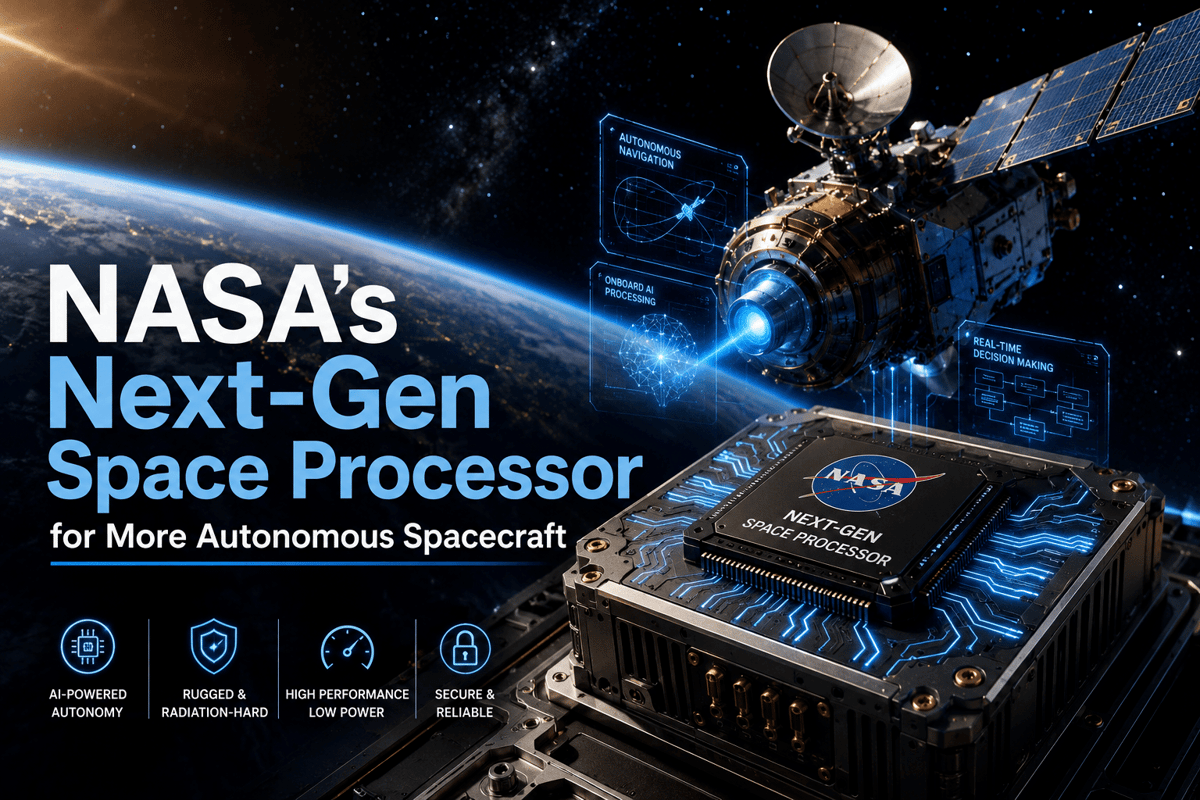
NASA’s Next-Gen Space Processor for More Autonomous Spacecraft
Why It Matters
The HPSC’s performance leap enables spacecraft to process sensor data and execute autonomous maneuvers without ground latency, boosting mission safety and scientific return while opening a commercial market for high‑speed, radiation‑tolerant processors.
Key Takeaways
- •HPSC testing at JPL shows 500× speed over existing space chips
- •Processor targets up to 100× computational capacity for future missions
- •Microchip’s PIC64‑HPSC family uses open‑source RISC‑V architecture
- •Includes AI/ML blocks, secure boot, and CXL 2.0 networking
Pulse Analysis
Spacecraft computers have traditionally lagged terrestrial processors because they must survive radiation, thermal extremes, and years without maintenance. NASA’s HPSC program confronts this bottleneck by delivering a system‑on‑a‑chip that merges multiple 64‑bit RISC‑V cores, vector accelerators, and AI/ML engines into a radiation‑hardened package. Early JPL tests indicate the chip can operate at speeds 500 times faster than the legacy processors that currently power most deep‑space probes, while still meeting stringent power and mass budgets.
The partnership with Microchip Technology brings commercial discipline to a historically government‑only domain. By offering both radiation‑hardened (PIC64‑HPSC1000) and radiation‑tolerant (PIC64‑HPSC1100) variants, the family addresses the needs of NASA, defense, and commercial satellite operators alike. Standard interfaces such as SpaceWire, Ethernet TSN, PCIe, and CXL 2.0, combined with support for Linux, RTEMS, and hypervisors, lower the software development barrier and enable multi‑core workloads that were previously impractical on flight hardware.
If qualification proceeds, the processor could transform mission architectures across the space economy. Autonomous landing algorithms, real‑time hazard detection, and on‑board science triage become feasible, reducing reliance on costly ground‑segment processing and downlink bandwidth. Commercial constellations could embed edge‑computing capabilities for rapid analytics, while defense platforms gain secure, high‑throughput processing in contested environments. Ultimately, HPSC promises a shift from single‑purpose flight computers to flexible, high‑performance computing platforms that accelerate innovation and reduce overall mission risk.
NASA’s Next-Gen Space Processor for More Autonomous Spacecraft
Comments
Want to join the conversation?
Loading comments...