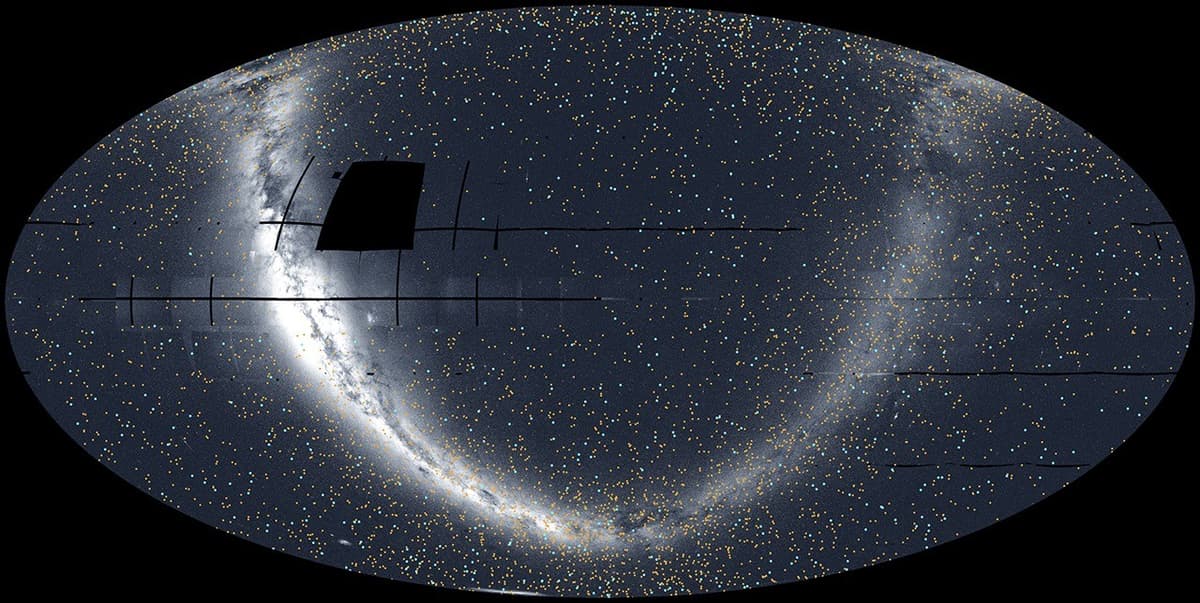
NASA’s Planet-Hunting TESS Reveals Dazzling Night Sky
Why It Matters
The comprehensive map showcases TESS’s role as the most prolific exoplanet hunter, accelerating target selection for follow‑up studies and informing the next generation of space telescopes. It also engages the public, turning citizen scientists into active contributors to planetary verification.
Key Takeaways
- •TESS mapped 96 sky sectors, completing an all‑sky mosaic.
- •679 confirmed exoplanets and 5,165 candidates identified by Sep 2025.
- •Mosaic reveals planets in habitable zones, volcanic worlds, and binary star systems.
- •Data supports studies of young stars, galactic dynamics, and near‑Earth asteroids.
- •Citizen scientists can join Planet Hunters TESS to verify candidates.
Pulse Analysis
The TESS mission, launched in 2018, was designed to scan large swaths of the sky for periodic dips in starlight that signal transiting planets. By operating in a series of 27‑day sectors, the satellite amassed a continuous photometric record across nearly the entire celestial sphere. The recent all‑sky mosaic, built from 96 sectors, represents the culmination of its second extended mission and provides the most complete visual inventory of known and candidate exoplanets to date, offering a valuable reference for astronomers worldwide.
Beyond sheer numbers, the mosaic underscores the diversity of worlds TESS has uncovered. It highlights temperate planets residing in their stars’ habitable zones, volatile Earth‑sized bodies with potential volcanic activity, and exotic systems where planets orbit twin suns. The dataset also fuels ancillary research, enabling scientists to trace young stellar nurseries, map dynamic structures within the Milky Way, and monitor near‑Earth asteroids. Such multi‑disciplinary insights illustrate how a planet‑finding mission can serve broader astrophysical investigations.
Looking ahead, the TESS catalog will guide high‑resolution spectroscopy with the James Webb Space Telescope and the upcoming Nancy Grace Roman Space Telescope, prioritizing targets for atmospheric characterization. Moreover, the public‑facing Planet Hunters TESS program invites citizen scientists to sift through light curves, accelerating candidate validation. As the exoplanet inventory expands, the industry sees growing opportunities for data‑driven services, from mission planning to commercial space‑weather forecasting, cementing TESS’s legacy as a cornerstone of modern space science.
NASA’s Planet-Hunting TESS Reveals Dazzling Night Sky
Comments
Want to join the conversation?
Loading comments...