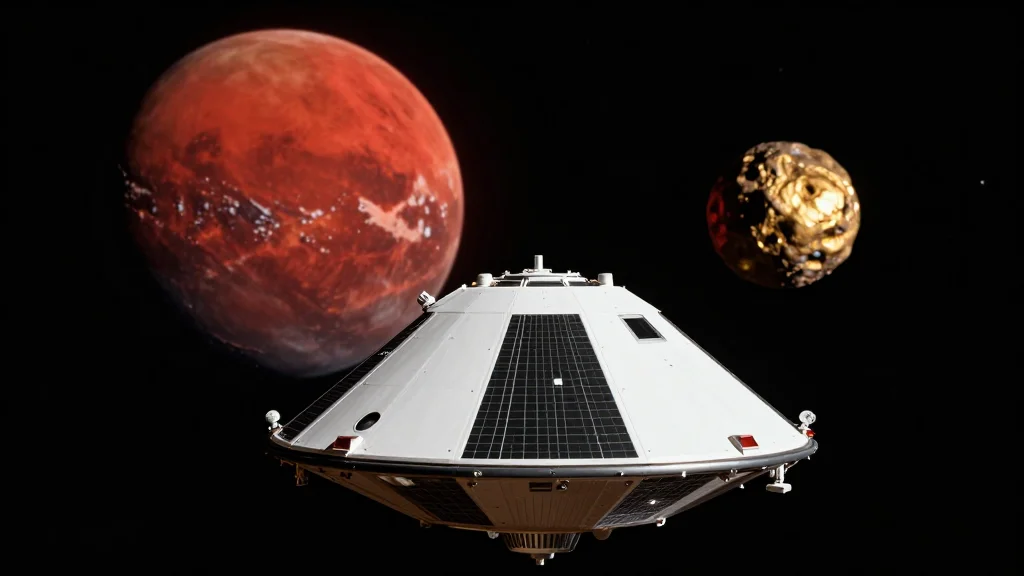
NASA’s Psyche Probe Uses Mars Flyby to Speed Toward ‘Trillion‑Dollar’ Asteroid

Companies Mentioned
Why It Matters
The Psyche mission bridges pure science and the emerging economics of space resources. By directly sampling a planetary core, it will validate theories of core formation, magnetic field generation, and early Solar System collisions—knowledge essential for future deep‑space habitats and in‑situ resource utilization. Simultaneously, confirming the asteroid’s metal richness could catalyze a new industry focused on asteroid mining, influencing policy, investment, and international cooperation around space law and resource rights. Moreover, the successful use of solar‑electric propulsion and a Mars gravity assist demonstrates a scalable, fuel‑efficient approach to interplanetary travel. These technologies could lower the cost and increase the flexibility of missions to the Moon, Mars, and beyond, accelerating humanity’s broader goal of a sustainable presence beyond Earth.
Key Takeaways
- •Psyche spacecraft performed a Mars gravity‑assist flyby at ~2,800 miles altitude on Friday.
- •The probe, launched Oct 2023, is on a 2.2‑billion‑mile journey to 16 Psyche, arriving Aug 2029.
- •16 Psyche is ~220 km wide and estimated to contain a trillion dollars’ worth of metals.
- •Mission uses solar‑electric ion thrusters, the first interplanetary craft to rely on this system for a deep‑space cruise.
- •Scientists aim to determine if Psyche is a true exposed planetary core, informing models of Earth‑like planet formation.
Pulse Analysis
NASA’s Psyche mission marks a turning point in how agencies approach deep‑space exploration. Historically, interplanetary probes have depended on high‑thrust chemical stages for rapid transits, but Psyche’s reliance on continuous ion thrust showcases a shift toward endurance‑based propulsion. This not only reduces launch mass but also offers unprecedented trajectory flexibility—evident in the Mars gravity assist that turned a routine cruise into a dual‑purpose science opportunity. The success of this approach could usher in a new class of missions that blend scientific observation with resource‑mapping, effectively turning every flyby into a data‑rich rehearsal for future commercial ventures.
From an economic perspective, the “trillion‑dollar asteroid” label has already sparked speculative interest from private investors and governments alike. While the mission does not aim to mine Psyche, the high‑resolution compositional data it returns will be the first hard evidence that such a resource exists in a form that could be harvested. If the asteroid’s metal content proves accessible, it could reshape the economics of space manufacturing, satellite construction, and even terrestrial markets for rare metals. However, the path from scientific discovery to commercial extraction is fraught with regulatory, technical, and ethical hurdles that will require coordinated international frameworks.
Strategically, Psyche’s timeline dovetails with NASA’s Artemis program and the broader goal of establishing a sustainable human presence on the Moon and Mars. The ion‑thruster technology validated by Psyche could be adapted for cargo transport between lunar orbit and Mars, reducing dependence on heavy‑lift launch vehicles. In the longer term, the mission’s data may inform the design of crewed deep‑space habitats that leverage in‑situ resources, turning the once‑theoretical concept of “space‑based manufacturing” into a practical reality.
NASA’s Psyche Probe Uses Mars Flyby to Speed Toward ‘Trillion‑Dollar’ Asteroid
Comments
Want to join the conversation?
Loading comments...