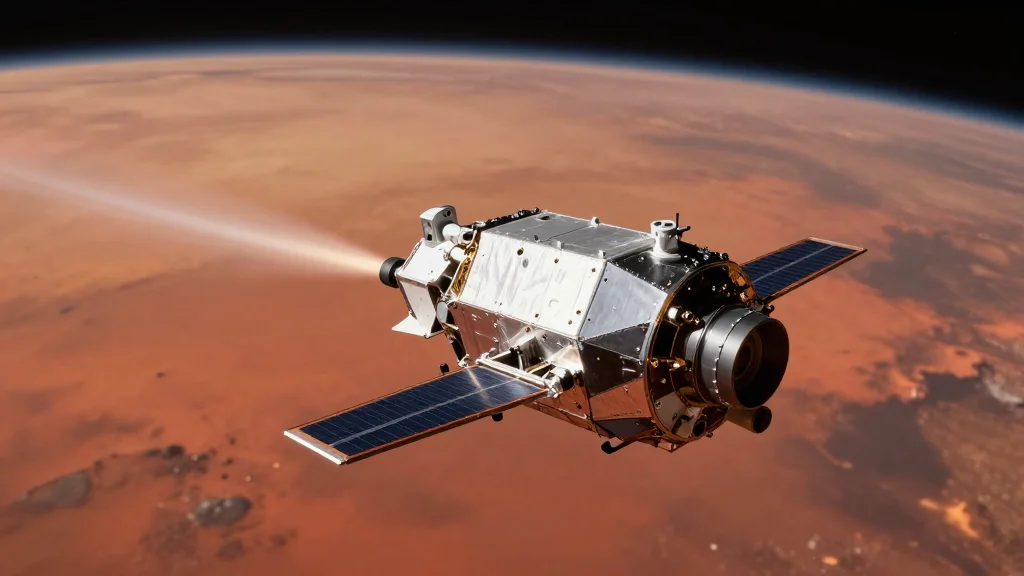
NASA’s Psyche Probe Uses Mars Gravity Assist to Speed Toward 2029 Asteroid Arrival

Companies Mentioned

NASA

Jet Propulsion Laboratory
Why It Matters
The Psyche mission’s Mars gravity assist showcases how mission planners can extract additional performance from existing trajectories, reducing fuel requirements and extending mission lifespans. By demonstrating a successful planetary slingshot en route to an asteroid, NASA provides a template for future deep‑space probes that must balance limited launch mass with ambitious scientific goals. Beyond operational efficiency, the maneuver underscores the growing importance of collaborative assets—such as Mars orbiters and the Deep Space Network—in supporting interplanetary navigation. The data gathered during the flyby will also enrich Mars science, offering a secondary return on investment for a mission primarily aimed at asteroid exploration.
Key Takeaways
- •Psyche will pass 2,800 miles above Mars on May 15, 2024.
- •Flyby speed is expected to be about 12,333 mph.
- •Gravity assist will save propellant for later trajectory corrections.
- •Mission launched in October 2023; arrival at asteroid Psyche planned for 2029.
- •NASA will track the maneuver via the Deep Space Network and share live visuals through its interactive map.
Pulse Analysis
NASA’s decision to incorporate a Mars gravity assist into the Psyche mission reflects a broader industry trend toward maximizing mission efficiency through clever orbital mechanics. Historically, iconic missions like Voyager and Cassini relied heavily on planetary flybys to reach their distant targets without prohibitive fuel loads. Psyche’s use of a relatively modest Mars encounter—just a few thousand miles above the surface—demonstrates that even smaller bodies can provide meaningful velocity increments when timed precisely.
From a market perspective, the successful execution of this maneuver could lower the perceived risk of deep‑space missions that lack large propulsion budgets, encouraging private investors and commercial partners to fund similar low‑cost, high‑return projects. The ability to stretch a spacecraft’s operational envelope without additional launch mass may also influence the design of future asteroid mining ventures, where payload capacity is at a premium.
Looking forward, the Psyche team’s integration of real‑time data from existing Mars assets illustrates an emerging collaborative model: leveraging assets already in place to support new missions. This approach not only reduces costs but also creates a networked ecosystem of spacecraft that can assist each other, potentially accelerating the cadence of interplanetary exploration in the coming decade.
NASA’s Psyche Probe Uses Mars Gravity Assist to Speed Toward 2029 Asteroid Arrival
Comments
Want to join the conversation?
Loading comments...