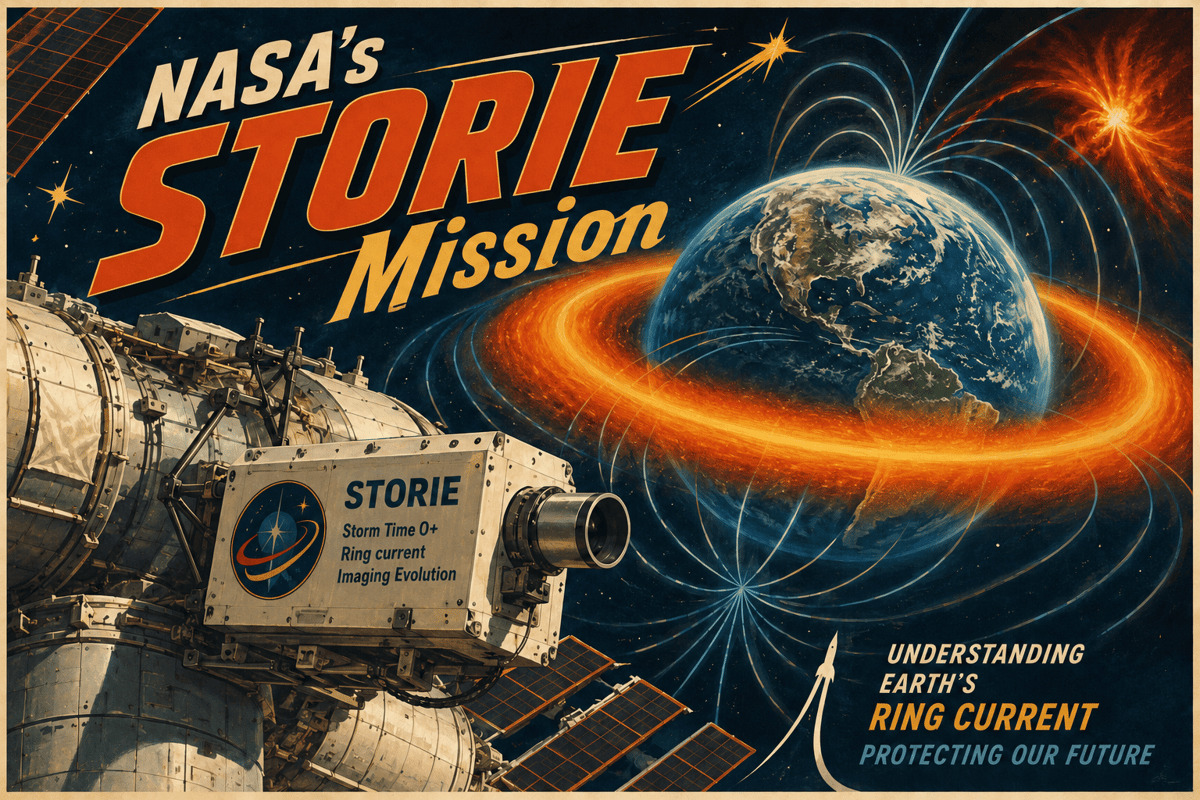
NASA’s STORIE Mission and the Science of Earth’s Ring Current
Why It Matters
Understanding the ring current’s composition and dynamics improves forecasts of geomagnetic storms that can disrupt satellite operations, navigation services, and terrestrial power systems.
Key Takeaways
- •STORIE launches May 12 2026 aboard SpaceX CRS‑34.
- •Instrument images energetic neutral atoms from ISS exterior.
- •Oxygen ion measurements reveal atmospheric vs solar‑wind sources.
- •Six‑month campaign captures ring‑current changes every 90 minutes.
- •Data will refine space‑weather models for satellites and grids.
Pulse Analysis
The Earth’s ring current, a doughnut‑shaped flow of charged particles, plays a pivotal role in shaping geomagnetic disturbances during solar storms. While earlier missions such as IMAGE and TWINS offered global views from higher orbits, they struggled to resolve the inner equatorial region because reflected ultraviolet light interfered with measurements. This gap left scientists with incomplete knowledge of how quickly the ring current can intensify and which particle populations dominate, limiting the fidelity of space‑weather predictions that underpin satellite and grid reliability.
STORIE tackles this limitation by mounting an energetic neutral atom (ENA) imager on the exterior of the International Space Station. By detecting neutral atoms that escape the trapped plasma, the instrument reconstructs the three‑dimensional distribution of the ring current from an “inside‑out” angle. The mission’s emphasis on O⁺ ions is strategic: oxygen’s abundance in Earth’s upper atmosphere makes it a clear tracer for atmospheric contributions, contrasting with the solar‑wind‑dominated composition. The ISS platform supplies power, data links, and a predictable 90‑minute orbital cadence, enabling continuous monitoring across multiple storm cycles without the cost of a dedicated spacecraft.
The scientific return promises tangible benefits for the burgeoning space economy. More accurate ring‑current data feed into physics‑based models that forecast satellite drag, surface charging, and radiation belt dynamics—critical inputs for commercial operators managing constellations in low‑Earth orbit. Power‑grid operators and insurers also stand to gain, as refined geomagnetic storm forecasts reduce uncertainty around geomagnetically induced currents that can stress transformers. By bridging a long‑standing measurement gap, STORIE not only advances heliophysics but also underpins the resilience of the satellite services and terrestrial infrastructure that modern society depends on.
NASA’s STORIE Mission and the Science of Earth’s Ring Current
Comments
Want to join the conversation?
Loading comments...