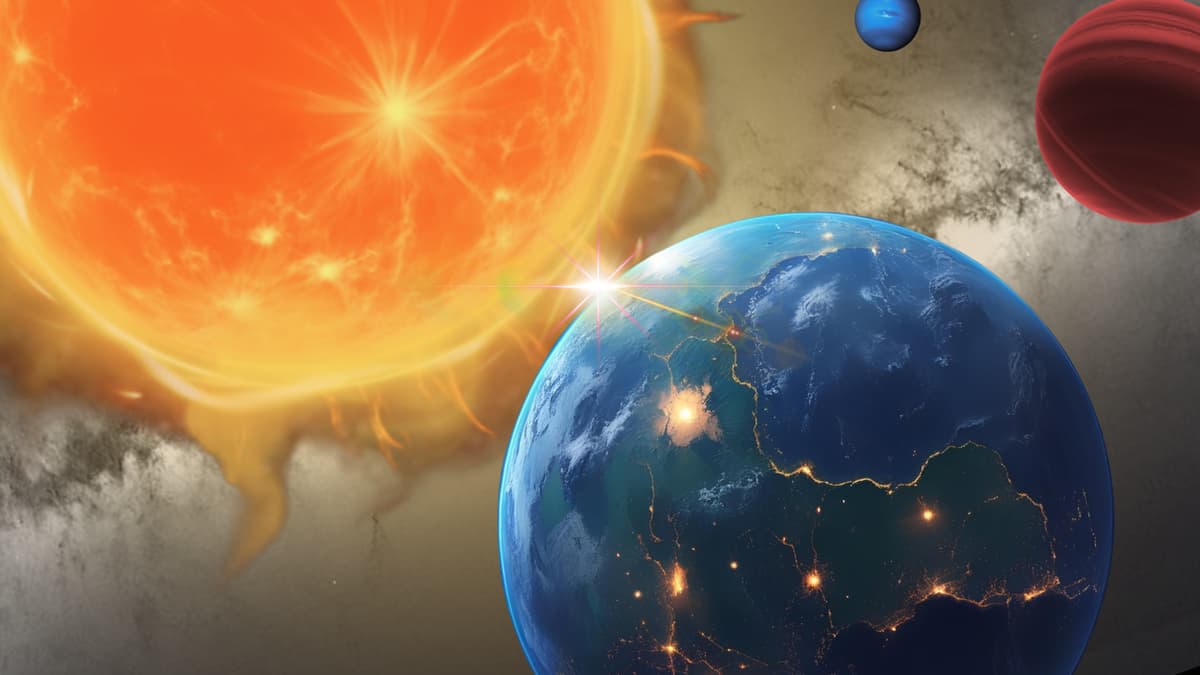
NASA's TESS Spacecraft Discovers a Weird System of Exoplanets Unlike Anything Seen Before
Companies Mentioned

Elsevier
Why It Matters
The discovery provides direct evidence of how gravitational interactions can reshape planetary systems shortly after birth, refining models of system stability and informing future exoplanet surveys.
Key Takeaways
- •TOI‑201 hosts a super‑Earth, a half‑Jupiter, and a 16‑Jupiter planet.
- •Outer giant’s tilted orbit forces rapid orbital re‑alignment of inner planets.
- •Transit of TOI‑201b delayed by ~30 minutes, observed in real time.
- •Antarctic ASTEP telescope enabled detection of long‑period outer planet transits.
- •System may lose transit alignment within 200 years, offering a rare glimpse.
Pulse Analysis
The Transiting Exoplanet Survey Satellite (TESS) has long been a workhorse for spotting distant worlds, but the TOI‑201 system pushes its capabilities into a new realm. By pairing space‑based photometry with ground‑based observations from the ASTEP facility on Antarctica’s Concordia Station, astronomers captured a planetary family that defies the usual “peas‑in‑a‑pod” pattern. The trio—spanning a dense super‑Earth, a half‑Jupiter gas giant, and an enormous 16‑Jupiter companion—offers a laboratory for studying extreme mass ratios and orbital inclinations that are rarely observable.
What makes TOI‑201 especially compelling is the real‑time dynamical evolution recorded by researchers. The outer giant’s highly tilted, elliptical orbit exerts a measurable gravitational torque on the inner planets, shifting their orbital planes and causing the 53‑day planet TOI‑201b to transit roughly thirty minutes later than predicted. Such transit‑timing variations, typically only inferred over millennia, were witnessed within months, providing a rare empirical window into the chaotic phase that follows planet formation. The Antarctic location proved critical, granting continuous darkness and stable atmospheric conditions needed to catch the long‑period outer planet’s fleeting transit.
Looking ahead, the TOI‑201 findings will shape how the exoplanet community designs observation campaigns. Detecting rapid orbital re‑configurations demands coordinated, multi‑site monitoring—an approach that could become standard as next‑generation telescopes like the James Webb Space Telescope and the Vera C. Rubin Observatory target dynamically active systems. Moreover, the insights gleaned from TOI‑201 will refine theoretical models of planetary migration and stability, influencing everything from mission planning to the broader narrative of how solar‑like systems evolve over time.
NASA's TESS spacecraft discovers a weird system of exoplanets unlike anything seen before
Comments
Want to join the conversation?
Loading comments...