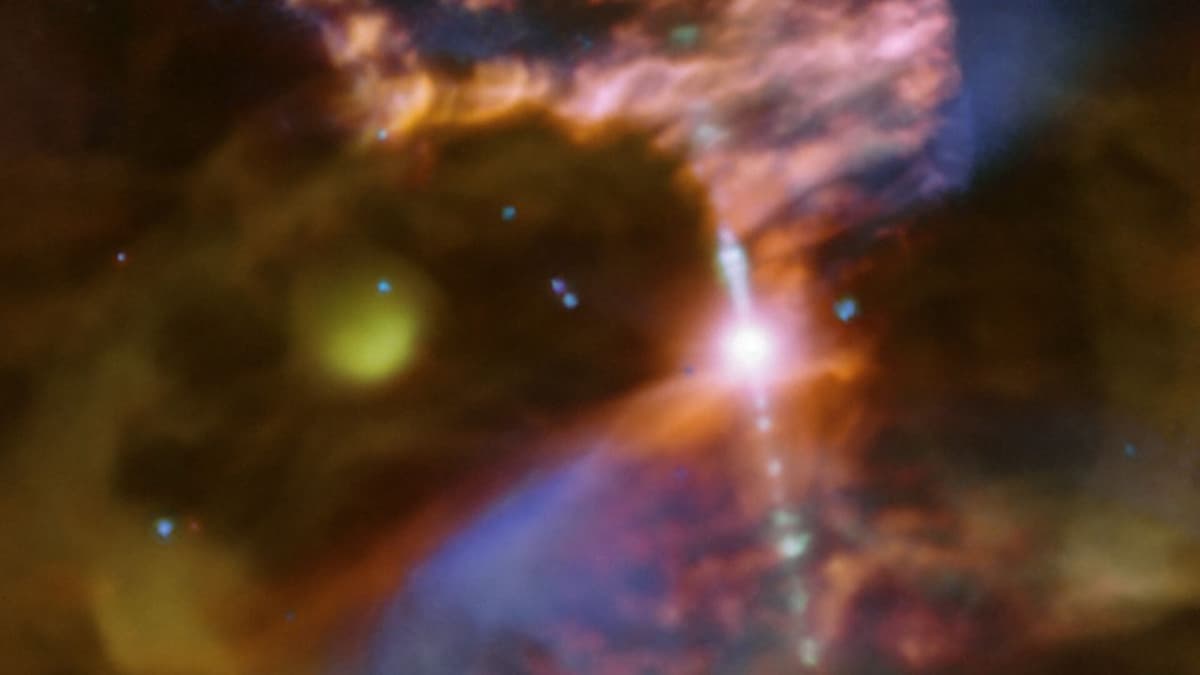
Neutron Star Photobombs Baby Star | Space Photo of the Day for Feb. 3, 2026
•February 3, 2026
0
Why It Matters
It resolves long‑standing distance uncertainties for Vela Junior and illustrates how supernova debris can seed new star formation, impacting models of galactic evolution.
Key Takeaways
- •Ve 7‑27 identified as newborn star, not planetary nebula
- •Image shows jets and bright knots typical of stellar nurseries
- •Star lies within Vela Junior supernova remnant
- •Neutron star sits beside forming star, linking birth and death
- •Distance to Vela Junior fixed at ~4,500 light‑years
Pulse Analysis
The Very Large Telescope’s Multi Unit Spectroscopic Explorer (MUSE) has turned a long‑standing mystery on its head. What astronomers catalogued for decades as the planetary nebula Ve 7‑27 is now recognized as a protostellar object still accreting material. High‑resolution spectroscopy revealed fast‑moving jets punctuated by bright knots—signatures that only a newborn star can produce. This reclassification underscores how modern integral‑field instruments can disentangle overlapping emission components, allowing researchers to separate the light of a forming star from the surrounding ionised gas.
Equally striking is the juxtaposition of a neutron star and a stellar nursery within the same field of view. The compact, yellow‑green source at the centre of the image marks the dense remnant of the Vela Junior supernova, while the adjacent jets trace the birth of a new star from the same expelled material. This rare alignment provides a natural laboratory for studying how supernova ejecta can seed subsequent generations of stars, and it offers direct insight into the feedback loops that regulate galactic evolution.
The discovery also resolves a persistent distance discrepancy for the Vela Junior remnant. By anchoring the nebula to Ve 7‑27, whose parallax places it at roughly 4,500 light‑years, astronomers can now refine the remnant’s size, expansion velocity and age with far greater confidence. Accurate distances are critical for calibrating supernova models and for mapping the Milky Way’s star‑forming regions. Future observations with the James Webb Space Telescope and next‑generation radio arrays will likely probe the chemistry of the surrounding gas, shedding light on how supernova‑driven turbulence fuels new star formation.
Neutron star photobombs baby star | Space photo of the day for Feb. 3, 2026
0
Comments
Want to join the conversation?
Loading comments...