New Map of the Milky Way's Magnetism Offers Insights Into Cosmic Evolution
•January 29, 2026
0
Why It Matters
The detailed magnetic map transforms models of star formation and galaxy evolution, and positions Canada as a pivotal player in global radio‑astronomy initiatives.
Key Takeaways
- •DRAGONS delivers first all‑sky broadband Faraday rotation map.
- •Over 50% of northern sky shows complex magnetic structures.
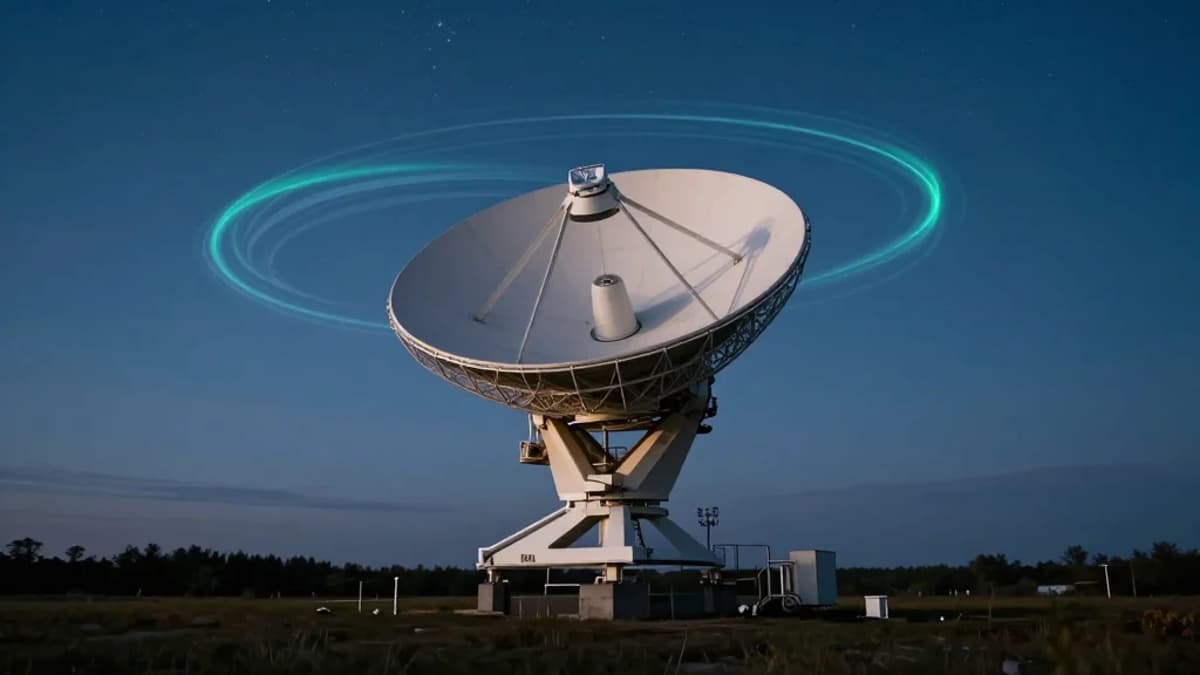
- •15 m DRAO telescope proved ideal for rapid all‑sky survey.
- •Data enable 3‑D modeling of Milky Way magnetic field.
- •Survey fuels studies of field reversals and supernova interactions.
Pulse Analysis
The Milky Way’s magnetic fabric has long been inferred from sparse, single‑frequency observations, leaving astronomers with a coarse, averaged picture. Faraday rotation—where polarized radio waves twist as they traverse magnetized plasma—offers a direct probe, but only when measured across a broad frequency range. Modern broadband receivers on the DRAO 15‑meter dish finally provide that capability, allowing the DRAGONS team to stitch together a continuous Faraday depth map of the entire northern sky. This technical leap bridges a half‑century gap between theory and observation.
What the map uncovers is a galaxy riddled with magnetic complexity. More than half of the surveyed sky displays “Faraday‑complex” signatures, indicating tangled field lines interacting with supernova‑driven bubbles, spiral arm shears, and interstellar turbulence. Such richness reshapes our understanding of how magnetic pressure regulates star‑forming clouds and guides cosmic‑ray propagation. By resolving the three‑dimensional orientation and strength of the field, researchers can now test competing models of galactic dynamo processes and refine simulations of galaxy evolution that previously relied on oversimplified magnetic assumptions.
Beyond its scientific impact, DRAGONS showcases a collaborative training ground for the next generation of radio astronomers. Students designed interference‑filtering algorithms and validated data quality, gaining hands‑on experience that directly feeds into the forthcoming Square Kilometre Array. The survey’s open‑access dataset already underpins studies of large‑scale field reversals and will serve as a benchmark for future all‑sky polarimetric missions. Canada’s contribution thus accelerates global efforts to chart the magnetic universe, cementing its role in the emerging era of high‑resolution, broadband radio astronomy.
New map of the Milky Way's magnetism offers insights into cosmic evolution
0
Comments
Want to join the conversation?
Loading comments...