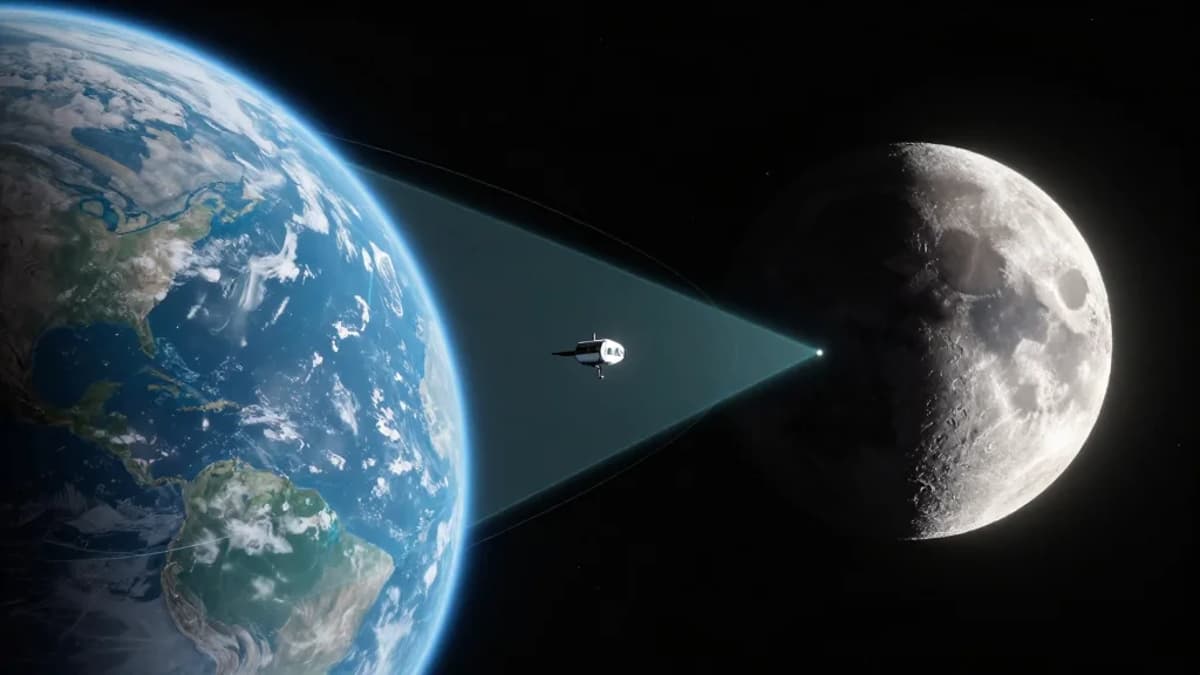
New Orbital Mapping System Targets Earth Moon Libration Traffic
•January 14, 2026
0
Why It Matters
Accurate, compact characterization of libration‑point orbits will enable reliable space‑situational awareness, collision avoidance, and efficient mission planning as cislunar traffic grows.
Key Takeaways
- •New six-parameter model maps Earth‑Moon libration orbits
- •Hyperbolic parameters detect transfer events via invariant manifolds
- •Center‑manifold variables distinguish Lyapunov, Halo, Lissajous families
- •Method tolerates 100 km position, 1 m/s velocity errors
- •Extension to L4/L5 and solar perturbations planned
Pulse Analysis
The surge in lunar‑related missions has turned the Earth‑Moon system into a congested arena, where traditional Keplerian elements fall short. Operators need a space‑situational‑awareness framework that can cope with the inherently chaotic three‑body dynamics near Lagrange points. By leveraging the circular restricted three‑body problem, the new mapping system offers a mathematically rigorous yet operationally practical alternative, turning complex trajectories into a handful of measurable parameters.
At the core of the approach are six dynamical variables: two hyperbolic parameters (q₁, p₁) that trace motion along invariant manifolds, and four centre‑manifold variables (I₂, θ₂, I₃, θ₃) that capture quasi‑periodic oscillations. These parameters map directly onto Poincaré sections, where classic orbit families—Lyapunov, Halo, Lissajous—appear as distinct clusters. The technique can fit observed tracking data to reference orbits, delivering reliable identification even with position errors of 100 km and velocity uncertainties of 1 m s⁻¹, highlighting the premium placed on velocity accuracy for future cislunar surveillance.
The broader implication is a standardized, uncertainty‑aware cataloguing language for cislunar traffic. Such a system could underpin automated collision‑avoidance alerts, coordinated transfer windows, and streamlined mission‑design workflows, reducing reliance on bespoke ephemerides. While current work focuses on the collinear L₁ and L₂ points, plans to incorporate solar perturbations and extend to the triangular L₄/L₅ points promise a universal framework. As commercial and governmental actors increase activity around the Moon, this parameterisation could become the backbone of next‑generation space traffic management.
New orbital mapping system targets Earth Moon libration traffic
0
Comments
Want to join the conversation?
Loading comments...