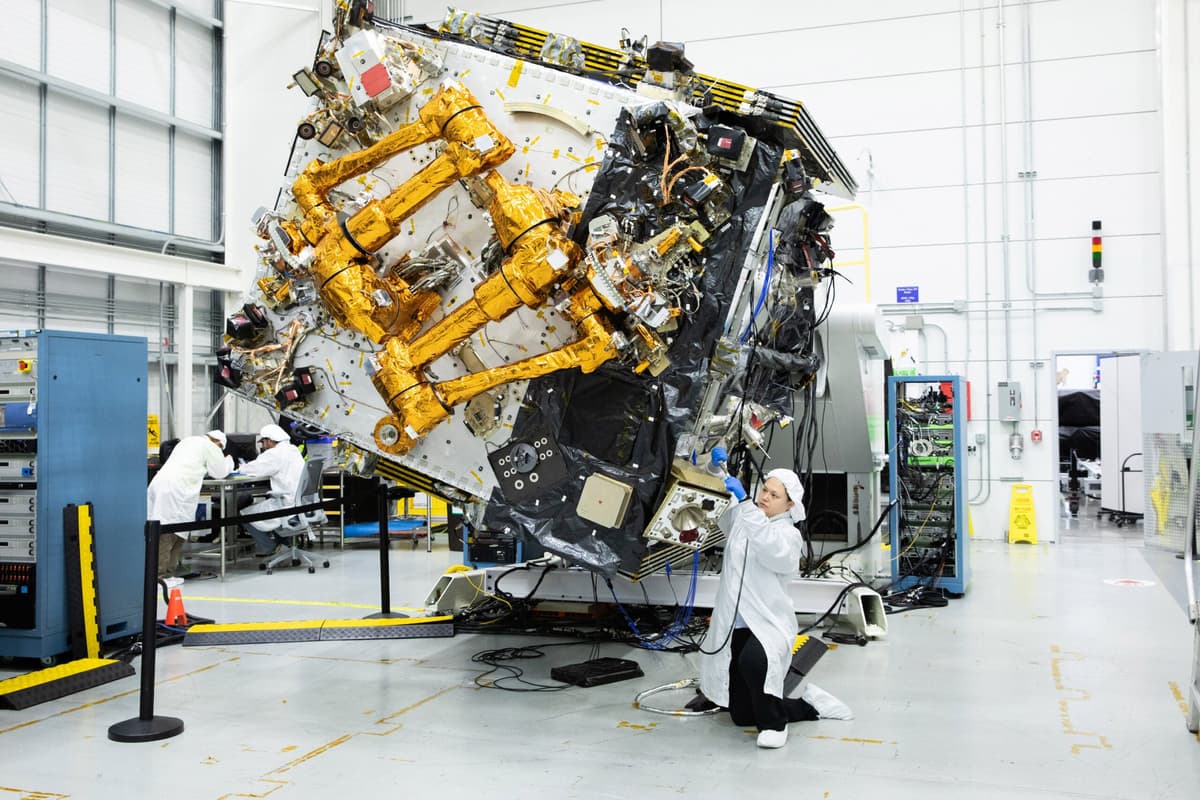
Northrop Grumman’s First MRV Readies for Summer Launch to Expand the Space Servicing Toolkit
Companies Mentioned
Why It Matters
The MRV expands the limited toolkit for GEO satellite maintenance, potentially extending satellite lifespans and reducing replacement costs while supporting U.S. Space Force maneuver warfare strategies. Its success could accelerate commercialization of in‑space servicing, a market projected to reach $15 billion by 2031.
Key Takeaways
- •First commercial robotic servicing mission, launching summer 2026
- •Dual arms and LIDAR enable refueling of GEO satellites
- •Carries three Mission Extension Pods to extend satellite life six years
- •Supports U.S. Space Force refueling interface (Passive Refueling Module)
- •Addresses 20‑25 GEO service opportunities annually
Pulse Analysis
The in‑space servicing, assembly and manufacturing (ISAM) sector is moving from concept to commercial reality, driven by government investment and a looming need to preserve the crowded geostationary belt. Analysts project a $15 billion global market by 2031, as hundreds of GEO satellites approach end‑of‑life each year. Northrop Grumman, leveraging its Mission Extension Vehicle (MEV) heritage, is positioning itself at the forefront with the Mission Robotic Vehicle (MRV). By offering a reusable platform that can refuel, inspect and repair satellites, the company aims to turn satellite maintenance into a routine service rather than a rare exception.
The MRV’s design integrates two robotic arms, LIDAR, infrared and visible sensors, and a standardized Passive Refueling Module developed with the U.S. Space Force and the Defense Innovation Unit. Launched on a dedicated SpaceX ride alongside three Mission Extension Pods, the vehicle will grapple a client satellite’s liquid apogee engine, insert a refueling lance and perform soft‑capture docking. This capability not only extends the operational life of a typical 2,000‑kg GEO platform by at least six years but also provides the agility needed for rapid maneuvering in contested space environments, a priority for the Space Force’s maneuver warfare strategy.
Northrop Grumman now competes with a growing roster of specialists, including Astroscale’s LEXI vehicle, Infinite Orbits’ Endurance dockers, and Rocket Lab’s orbital transfer tugs. Successful demonstration of the MRV could lock in lucrative contracts with commercial operators such as SES and Optus, while reinforcing U.S. defense logistics for on‑orbit refueling of military payloads. As the market matures, the ability to service satellites in place will reduce launch demand, lower orbital debris risk, and enable more flexible mission architectures. The MRV therefore represents both a technological milestone and a catalyst for broader adoption of on‑orbit servicing.
Northrop Grumman’s First MRV Readies for Summer Launch to Expand the Space Servicing Toolkit
Comments
Want to join the conversation?
Loading comments...