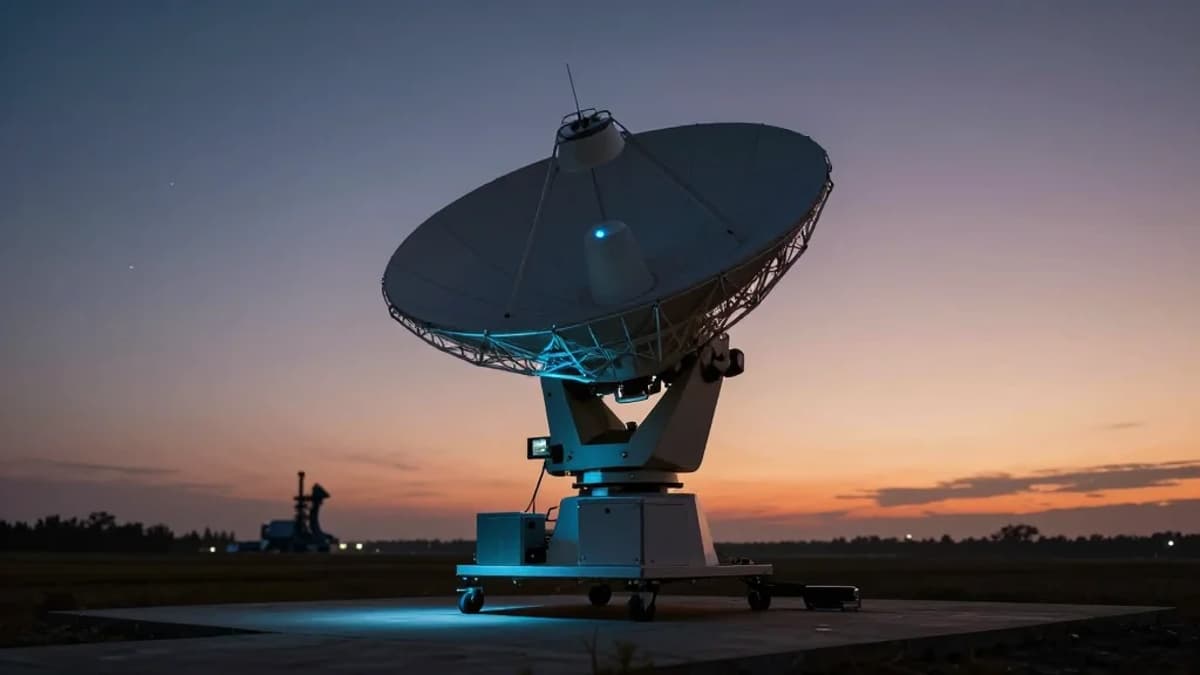
Northwood Space Raises $100M in Series B and Works With Space Force on Satellite Control Network
•January 27, 2026
0
Companies Mentioned


Why It Matters
It eliminates the long‑standing ground‑segment bottleneck, accelerating satellite operations for commercial users and strengthening U.S. defense communications.
Key Takeaways
- •$100M Series B funding plus $49.8M Space Force award.
- •Portal array installed in 12 hours, operational next day.
- •Target: 12+ arrays/month, 82 beams, 18 sites by year‑end.
- •Vertically integrated stack cuts deployment from years to days.
- •Supports DoD TT&C via Satellite Control Network partnership.
Pulse Analysis
The satellite ground segment has long lagged behind rapid advances in launch and payload technology, creating a costly bottleneck for operators that need reliable telemetry, tracking and command (TT&C) services. Northwood Space tackles this gap with a vertically integrated architecture that combines proprietary narrow‑band and wide‑band modems, a networking backbone, and its flagship Portal phased‑array antenna. By consolidating hardware, software and services under one roof, the company can field a complete ground station in a matter of hours rather than months, a capability that aligns with the growing demand for low‑latency, multi‑orbit missions.
The recent $100 million Series B, led by Washington Harbour Partners and Andreessen Horowitz, signals strong venture confidence in Northwood’s model, especially after a successful $30 million Series A. The parallel $49.8 million award from the U.S. Space Force to support the Satellite Control Network adds a strategic defense endorsement, positioning the firm as a key supplier for Department of Defense TT&C needs. This dual capital infusion not only accelerates hardware production—targeting over a dozen Portal arrays per month—but also expands the company’s global footprint to 18 sites, enhancing redundancy and coverage.
Looking ahead, Northwood’s rapid‑deployment approach could reshape how both commercial constellations and government constellations manage ground connectivity, potentially lowering entry barriers for smaller players and improving mission agility for legacy operators. The ability to scale from low Earth orbit to geostationary platforms with a single, modular system addresses the industry’s shift toward heterogeneous constellations. As competitors scramble to modernize legacy ground stations, Northwood’s integrated stack and proven contract performance may set a new benchmark for speed, cost efficiency, and resilience in the evolving space ecosystem.
Northwood Space Raises $100M in Series B and Works With Space Force on Satellite Control Network
0
Comments
Want to join the conversation?
Loading comments...