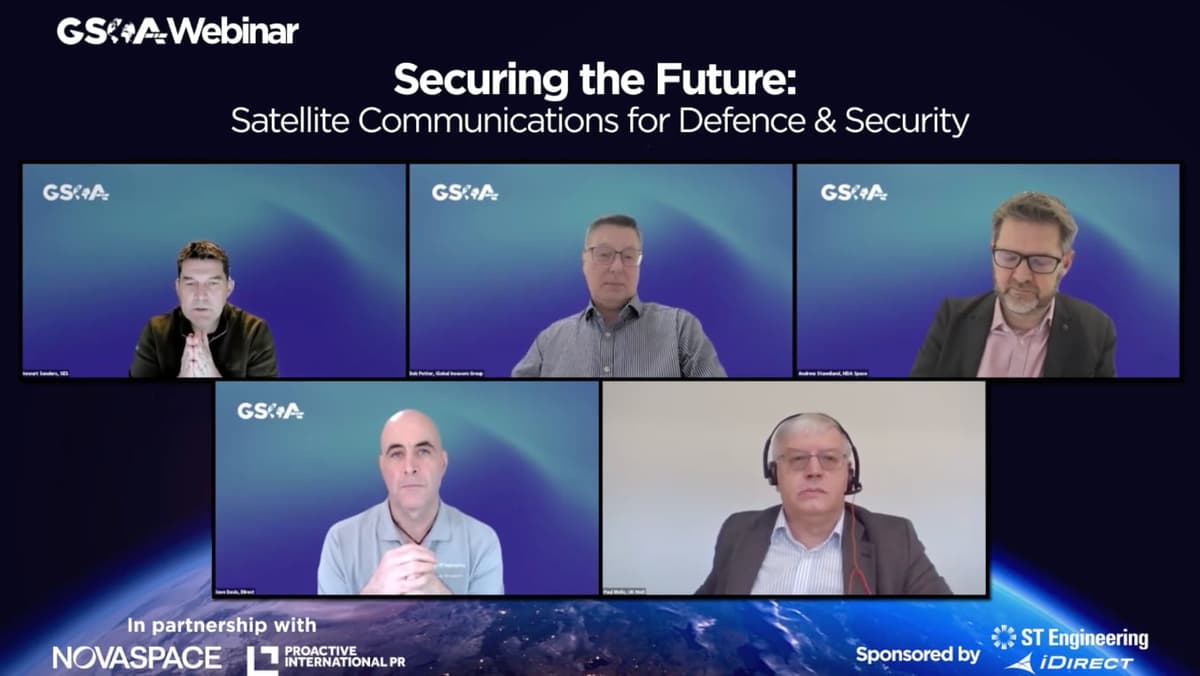
Operational Resilience Is the New Gold Standard in Defence SatCom
•February 4, 2026
0
Companies Mentioned


Why It Matters
Resilient SatCom ensures command‑and‑control continuity in contested environments, directly influencing defence readiness and market competition.
Key Takeaways
- •Multi‑orbit constellations create layered, jam‑resistant networks
- •AI automates real‑time traffic routing and interference mitigation
- •Software‑defined terminals enable remote waveform updates
- •Low Probability of Intercept reduces enemy geolocation risk
- •Open‑architecture procurement accelerates capability deployment
Pulse Analysis
In today’s contested electromagnetic spectrum, traditional satellite links that rely solely on encryption are no longer sufficient for military operations. Operational resilience—designing networks that assume constant attack—has become the benchmark for defence SatCom. By integrating low‑Earth, medium‑Earth and geostationary assets, forces create a moving‑target architecture that automatically reroutes traffic when a node is jammed or destroyed, preserving mission‑critical data flow and maintaining a tactical edge.
Artificial intelligence and software‑defined technologies are the enablers that turn this concept into reality. AI‑powered network managers detect interference, allocate bandwidth and switch waveforms in milliseconds, keeping the system inside the adversary’s OODA loop. Software‑defined radios and ground terminals allow remote updates, eliminating the need for hardware swaps in the field. Low Probability of Detection/Intercept (LPx) techniques further shield transmitters from geolocation, while mass‑produced phased‑array antennas drive down costs and support higher frequency bands such as Q and V, expanding capacity without sacrificing resilience.
The shift toward resilient, hybrid SatCom also reshapes procurement and policy. Open‑architecture standards and public‑private partnerships—exemplified by initiatives like Europe’s Iris 2 and NATO’s MGS contracts—enable rapid integration of commercial constellations with sovereign capabilities. Streamlined acquisition processes and real‑time threat briefings empower defence ministries to field adaptable communications faster than legacy cycles allow. As geopolitical pressures intensify, the ability to field flexible, AI‑driven satellite networks will be a decisive factor in maintaining secure, uninterrupted connectivity for armed forces worldwide.
Operational resilience is the new gold standard in defence SatCom
0
Comments
Want to join the conversation?
Loading comments...