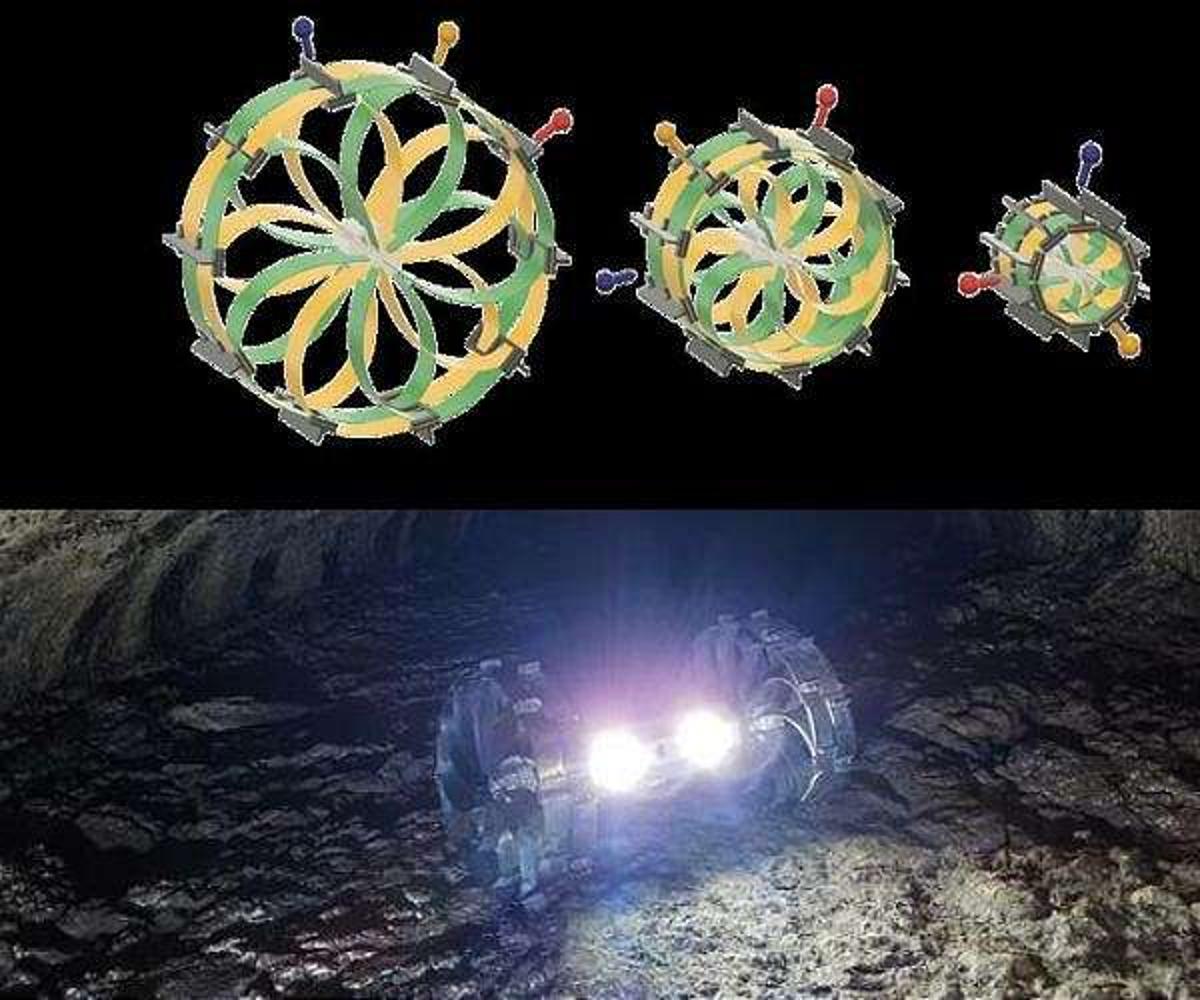
Origami Style Lunar Rover Wheel Expands to Climb Steep Caves
•March 5, 2026
0
Why It Matters
The wheel dramatically expands mobility for compact rovers, opening access to protected subsurface habitats and reducing mission risk through redundancy. Its lightweight, dust‑tolerant architecture could accelerate Korea’s role in upcoming lunar exploration programs.
Key Takeaways
- •Wheel expands from 230 mm to 500 mm diameter.
- •Origami-inspired design eliminates hinges, reduces cold welding risk.
- •Tested in lunar simulant, survived 100‑meter lunar‑gravity drop.
- •Supports small rover redundancy for lunar pit exploration.
- •Handles 300 °C temperature swings using elastic metal frame.
Pulse Analysis
Lunar exploration is shifting from surface scouting to subsurface habitation, where lava tubes and pits offer radiation shielding and thermal stability. Traditional rovers struggle with the sharp inclines and fine regolith at pit entrances, limiting scientific return and increasing mission risk. Engineers therefore seek mobility solutions that combine compact launch configurations with on‑site adaptability, enabling a fleet of small, affordable robots to access these hidden environments without relying on a single, massive lander.
The KAIST‑UEL wheel addresses this need through an origami‑based, deployable structure that expands its diameter without hinges. By leveraging elastic metal ribs and fabric tensioners, the wheel deforms uniformly, preserving structural integrity in vacuum and avoiding cold‑welding—a common failure mode for metal joints exposed to lunar dust. Tested in simulated regolith, the wheel demonstrated high traction on loose slopes and survived impact loads equivalent to a 100‑meter drop under lunar gravity, while thermal analyses proved resilience across 300 °C temperature swings.
Beyond the technical breakthrough, the wheel could reshape lunar mission architecture. Its lightweight, modular nature supports a distributed rover strategy, offering redundancy and flexibility for commercial and governmental programs alike. As agencies plan sustained presence on the Moon, technologies that lower the barrier to subsurface access will be pivotal, potentially accelerating partnerships, payload diversification, and the commercialization of lunar resources. The Korean team's success positions them as key contributors to the next generation of lunar exploration hardware.
Origami style lunar rover wheel expands to climb steep caves
0
Comments
Want to join the conversation?
Loading comments...