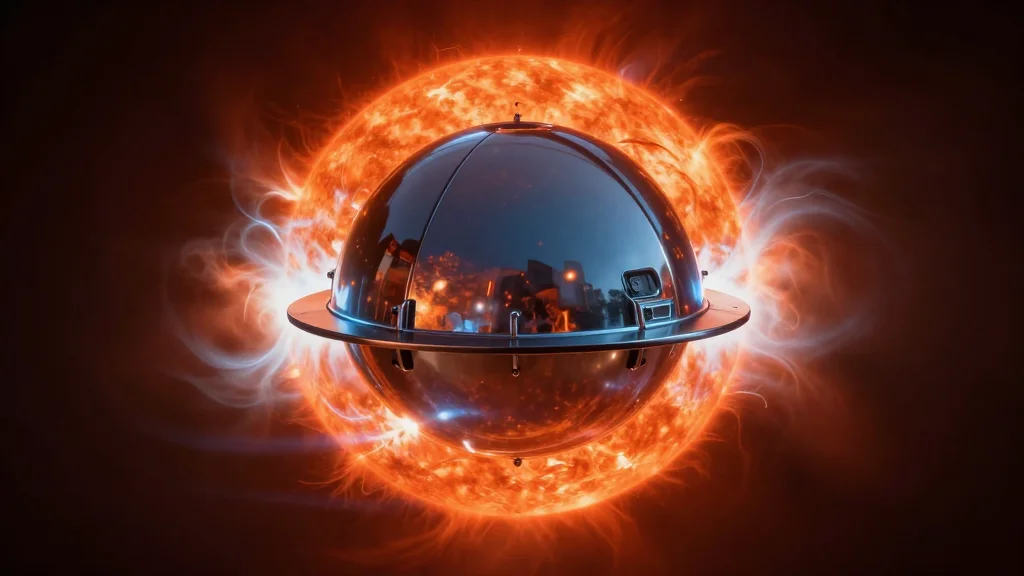
Parker Makes 28th Close Fly-By of the Sun
Why It Matters
Parker’s near‑Sun observations fill critical gaps in our understanding of coronal heating and solar‑wind dynamics, directly improving space‑weather forecasting that protects satellites, communications, and power grids.
Key Takeaways
- •Parker flew within 3.8 million miles of Sun’s surface
- •Probe reached 430,000 mph, matching its speed record
- •Heat shield endured temperatures above 1,700 °F during flyby
- •Instruments collected corona data across solar cycle phases
- •Data will improve space‑weather forecasting and solar physics models
Pulse Analysis
The Parker Solar Probe, launched in 2018, remains the only spacecraft designed to skim the Sun’s outer atmosphere. By using a series of gravity‑assist flybys of Venus, the probe gradually shrinks its orbit, allowing it to plunge to within 3.8 million miles of the photosphere. Each pass subjects the 4.5‑meter carbon‑composite heat shield to temperatures exceeding 1,700 °F, a thermal environment no other mission has survived. The probe’s record‑breaking velocity of 430,000 mph—equivalent to 193 km/s—places it at the forefront of high‑speed solar exploration.
During its 28th perihelion, Parker’s four instrument suites sampled the corona at unprecedented proximity, capturing plasma densities, magnetic field fluctuations, and energetic particle streams in real time. Because the probe has been operating since the Sun’s last minimum, its data set now spans a full solar cycle, offering a rare longitudinal view of how coronal heating and solar wind acceleration evolve with sunspot activity. These measurements are critical for testing competing theories of magnetic reconnection and wave‑driven heating, and they provide the empirical foundation needed to refine predictive models of space‑weather events.
The insights gathered by Parker are already influencing commercial and governmental stakeholders that rely on accurate space‑weather forecasts. Satellite operators, GPS providers, and power‑grid managers use solar‑storm predictions to mitigate radiation‑induced disruptions, and the probe’s real‑time observations tighten the lead time of those alerts. Moreover, the engineering breakthroughs—particularly the heat‑shield technology—are informing the design of next‑generation missions such as the proposed Solar‑C mission and deep‑space probes destined for Mercury or the Jovian system. As our reliance on space‑based infrastructure grows, Parker’s contributions become a strategic asset for both scientific discovery and economic resilience.
Parker makes 28th close fly-by of the Sun
Comments
Want to join the conversation?
Loading comments...