Companies Mentioned
Why It Matters
Understanding Callisto’s thermal and compositional properties informs models of icy moon evolution and guides the design of instruments for JUICE and other future explorations, crucial for assessing habitability beyond Earth.
Key Takeaways
- •ALMA thermal data reveal 133 K surface temperature
- •Regolith composition varies across Callisto’s terrains
- •Study establishes baseline for subsurface thermal mapping
- •Findings support potential liquid‑water ocean beneath icy crust
- •Results guide upcoming JUICE mission observations
Pulse Analysis
The Atacama Large Millimeter/submillimeter Array (ALMA) has long been a workhorse for probing cold cosmic environments, but its application to Solar System bodies is relatively new. By re‑examining six archival thermal images of Callisto, researchers extracted precise brightness temperatures and linked them to specific surface units. This approach leverages ALMA’s high spatial resolution and sensitivity at millimeter wavelengths, allowing scientists to peer beneath the moon’s heavily cratered veneer and quantify how heat is retained in the top few centimeters of regolith. The resulting temperature baseline, anchored at 133 K, offers a reference point for future comparative studies.
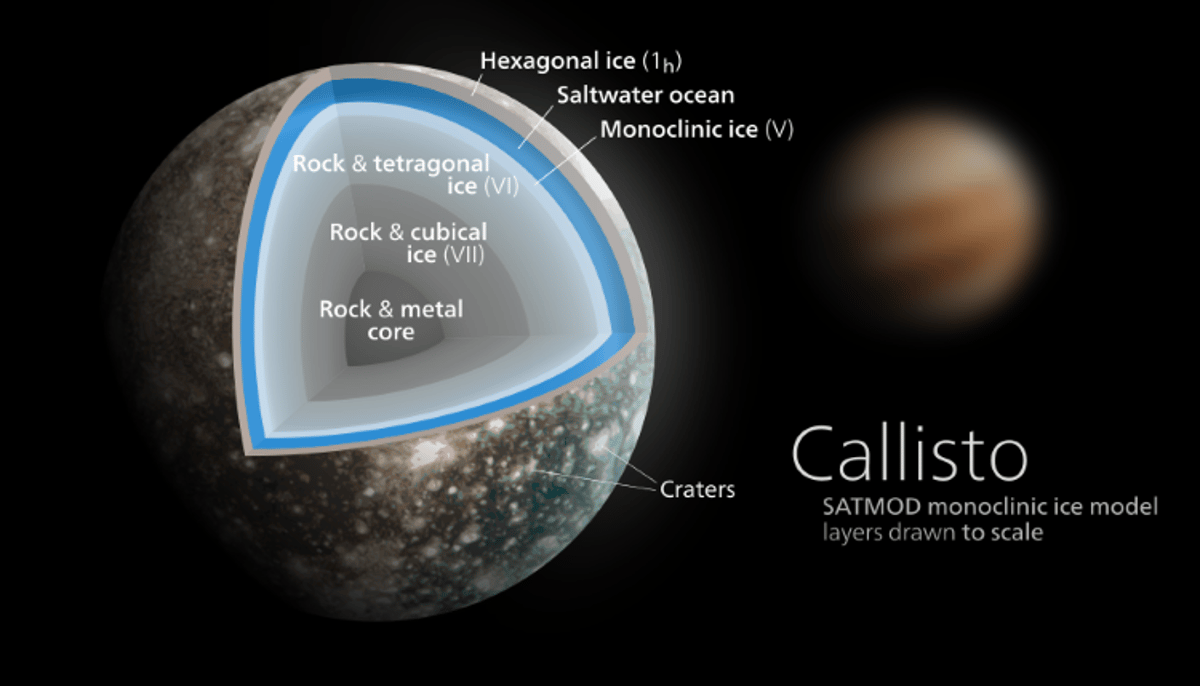
Callisto’s geological quietude contrasts sharply with the active resurfacing seen on Europa and Ganymede, yet magnetic field interactions hint at a hidden ocean beneath its icy shell. The new thermal maps reveal subtle temperature gradients that could reflect variations in ice thickness, porosity, or latent heat from a subsurface liquid layer. By integrating these findings with Galileo’s historic data, researchers can refine thermal conductivity models and better constrain the depth and salinity of any oceanic reservoir. This contributes to a broader understanding of how tidal forces—or the lack thereof—affect ocean formation across the Galilean system.
Looking ahead, the European Space Agency’s JUICE mission, slated to arrive at Jupiter in 2031, will capitalize on these ALMA insights. JUICE’s suite of instruments will extend thermal measurements into three dimensions, mapping heat flow from the surface down to the interior. The synergy between ground‑based millimeter observations and spacecraft data promises to reduce uncertainties in brightness temperature estimates, enhancing mission planning and instrument calibration. Ultimately, this collaborative methodology not only sharpens our picture of Callisto’s hidden ocean but also establishes a template for studying other icy worlds, from Saturn’s Enceladus to distant Kuiper Belt objects.
Peering Below Callisto’s Icy Crust with ALMA
0
Comments
Want to join the conversation?
Loading comments...