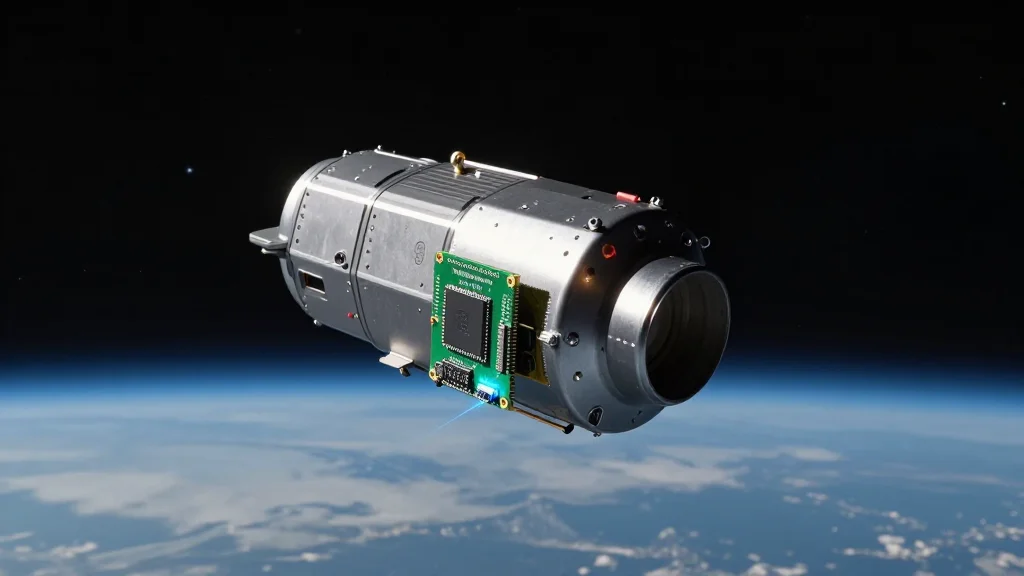
Planet Details AI-Driven Object Detection Onboard Pelican-4 Satellite
Companies Mentioned
Why It Matters
Onboard AI cuts data‑downlink latency and costs while delivering near‑real‑time insights, giving customers faster decision‑making for critical applications. This shift could redefine satellite imagery business models from raw data sales to value‑added analytics services.
Key Takeaways
- •Planet used Nvidia Jetson Orin for onboard AI inference
- •First Earth imaging satellite to detect objects in orbit
- •Real-time detection reduces downlink latency and operational costs
- •Owl satellites will add AI with 1‑meter resolution
- •Planetary Intelligence aims to enable rapid Earth change response
Pulse Analysis
Running artificial intelligence directly on a satellite marks a turning point for remote‑sensing operations. Planet’s Pelican‑4 leveraged Nvidia’s Jetson Orin system‑on‑chip, a GPU‑accelerated processor originally designed for autonomous vehicles, to run a convolutional neural network that identified aircraft over Alice Springs without sending raw pixels to the ground. This edge‑computing approach sidesteps the traditional capture‑then‑download workflow, allowing the platform to transform imagery into actionable information while still in orbit. The successful demonstration validates the feasibility of high‑performance AI hardware surviving the harsh space environment.
The immediate business impact is a dramatic cut in downlink volume and latency. By extracting only the relevant detections—airplanes, ships, or infrastructure changes—Planet can transmit a fraction of the data, lowering bandwidth costs and freeing capacity for higher‑resolution scenes. Real‑time alerts enable customers to react within minutes rather than hours, a critical advantage for disaster monitoring, supply‑chain tracking, and defense surveillance. Moreover, onboard inference reduces the computational burden on ground stations, streamlining processing pipelines and shortening the time‑to‑insight for enterprise users.
Planet’s roadmap extends this capability to its upcoming Owl constellation, which will pair 1‑meter resolution optics with the same Jetson GPUs, promising richer object catalogs and more sophisticated reasoning models. As more operators adopt edge AI, the market is likely to see a shift toward “planetary intelligence” services that bundle detection, classification, and predictive analytics as a subscription. Competitors such as Maxar and ICEYE are already exploring similar hardware, suggesting a near‑term arms race for on‑orbit processing power. Investors should watch how these technologies reshape revenue models from pure image sales to value‑added analytics.
Planet Details AI-Driven Object Detection Onboard Pelican-4 Satellite
Comments
Want to join the conversation?
Loading comments...