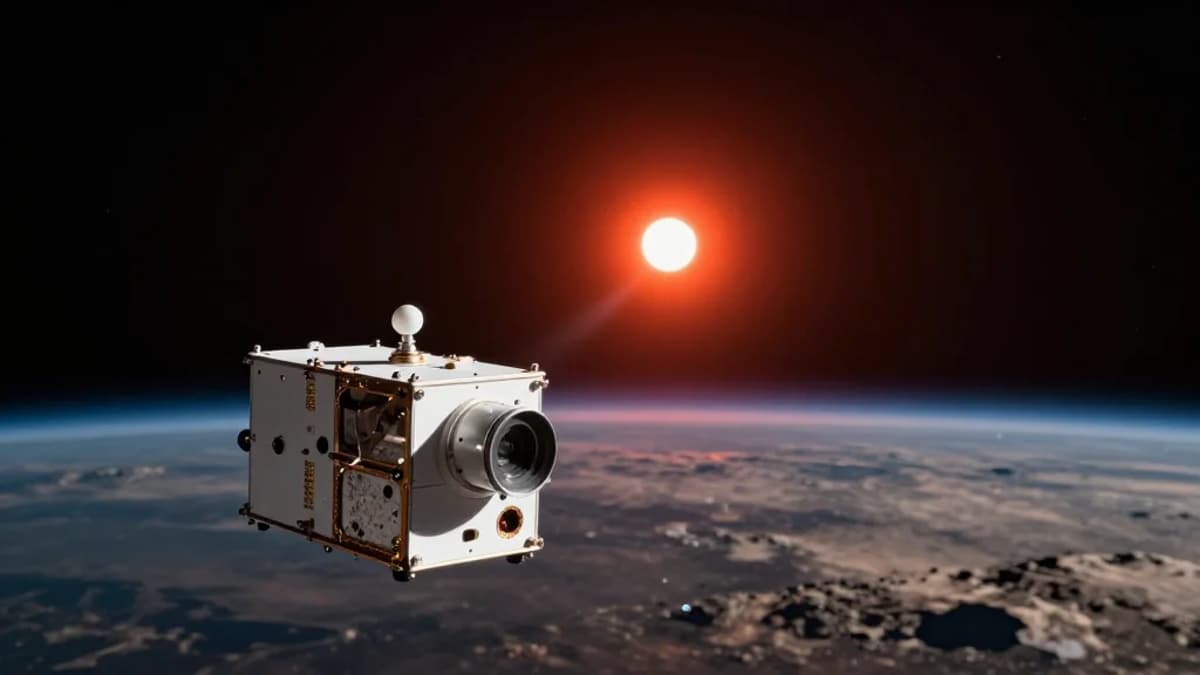
Plasma Rings Around M Dwarf Stars Offer New Clues to Planetary Habitability
•January 7, 2026
0
Why It Matters
The plasma torus provides direct measurements of stellar particle fluxes that are otherwise inaccessible, improving predictions of atmospheric erosion and radiation exposure on nearby exoplanets. Understanding these space‑weather effects is crucial for evaluating the true habitability potential of the abundant M‑dwarf planetary systems.
Key Takeaways
- •Plasma torus observed around young M dwarf star
- •Torus formed by magnetically trapped cool plasma clumps
- •At least 10% of M dwarfs may host plasma rings
- •Natural plasma torus acts as space‑weather station
- •Helps assess stellar particle impact on exoplanet habitability
Pulse Analysis
M‑dwarf stars dominate the galaxy’s stellar population and host the majority of known Earth‑sized exoplanets. Their low luminosity places the habitable zone close to the star, exposing planets to intense stellar activity such as flares, ultraviolet bursts, and powerful winds. Traditional observations capture only the light output, leaving the particle environment largely inferred. This gap hampers accurate climate and atmospheric loss models, which are essential for assessing whether these worlds can retain liquid water over geological timescales.
The recent detection of a plasma torus around the young M‑dwarf TIC 141146667 bridges that knowledge gap. By creating time‑resolved spectroscopic movies, Bouma and Jardine traced periodic dimming to dense, cool plasma clumps locked in the star’s rotating magnetosphere. These clumps form a toroidal ring that moves synchronously with the stellar surface, effectively acting as a built‑in space‑weather monitor. Because the torus emits characteristic spectral signatures, astronomers can now map particle density, velocity, and magnetic field strength directly from the star’s light.
With an estimated 10 % of early‑life M dwarfs exhibiting similar structures, this natural probe could become a standard tool for exoplanet habitability assessments. Researchers can integrate plasma‑torus measurements into atmospheric escape simulations, refining predictions of ozone depletion and surface radiation levels. Future missions such as the James Webb Space Telescope and the upcoming HabEx concept will benefit from these constraints, targeting worlds where stellar particle fluxes are quantified. Ultimately, the discovery reshapes how the astrophysics community evaluates the habitability prospects of the galaxy’s most common planetary systems.
Plasma rings around M dwarf stars offer new clues to planetary habitability
0
Comments
Want to join the conversation?
Loading comments...