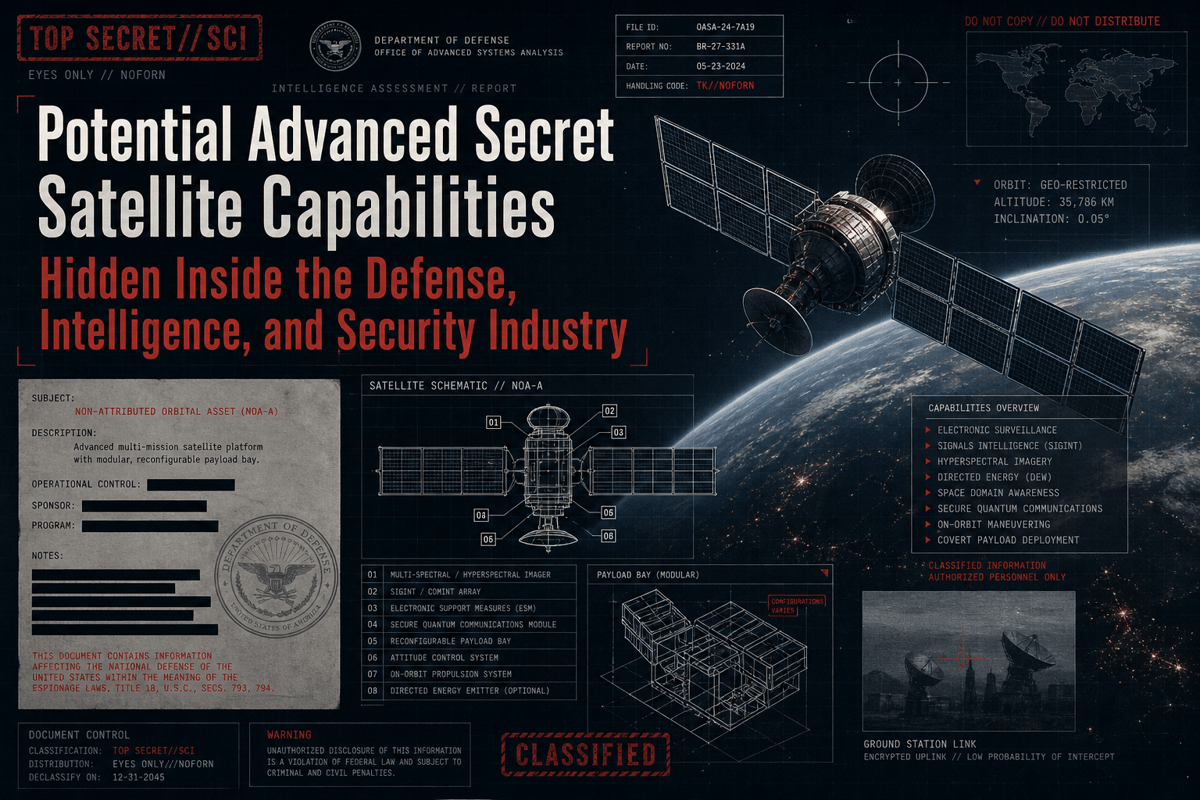
Potential Advanced Secret Satellite Capabilities Hidden Inside the Defense, Intelligence, and Security Industry
Companies Mentioned
Why It Matters
Understanding the public‑driven evolution of satellite capabilities helps industry players anticipate procurement needs and informs policymakers about the growing reliance on commercial data for national‑security missions.
Key Takeaways
- •Public contracts reveal sensor families governments prioritize
- •Commercial multisensor data drives faster, fused intelligence products
- •Secret capabilities likely sit in tasking, processing, and secure links
- •Space domain awareness underpins resilient satellite operations
Pulse Analysis
The defense and intelligence community is no longer confined to wholly classified spacecraft. Publicly disclosed awards from the National Reconnaissance Office and the Department of Defense’s commercial space integration strategy highlight a deliberate shift toward using commercial providers for sensors such as mid‑wave infrared, synthetic‑aperture radar and radio‑frequency geolocation. By anchoring procurement in open‑source contracts, agencies gain visibility into the sensor families deemed most valuable, while allies like NATO and the EU echo the same approach in their space strategies. This transparency creates a baseline for analysts to track emerging demand without speculating on classified payloads.
Modern missions demand more than a single image; they require a seamless blend of radar, thermal, hyperspectral and RF data to generate actionable intelligence. Companies like Capella Space, HawkEye 360 and SatVu already deliver components of this multisensor ecosystem, offering all‑weather radar, RF emission mapping and thermal imaging. The hidden advantage for classified programs lies in how these streams are fused, prioritized and delivered—often through automated tasking, on‑board processing and encrypted downlinks that reduce latency. Faster revisit rates, tighter collection geometry and proprietary calibration further amplify the value of seemingly routine commercial services, turning them into strategic assets for threat detection and decision support.
Space domain awareness, missile warning and resilient communications form the operational backbone of this evolving architecture. Public programs such as the Space Development Agency’s proliferated LEO constellations illustrate a move toward distributed, fault‑tolerant networks that can track objects, detect launches and relay data in near‑real time. While the sensor hardware may be commercially sourced, the classified layer resides in secure data pathways, priority routing and AI‑driven analytics that protect source integrity. As the orbital environment grows more congested, the ability to fuse SDA data with multisensor observations and deliver it through protected cloud infrastructures will define the next generation of national‑security satellite capability.
Potential Advanced Secret Satellite Capabilities Hidden Inside the Defense, Intelligence, and Security Industry
Comments
Want to join the conversation?
Loading comments...