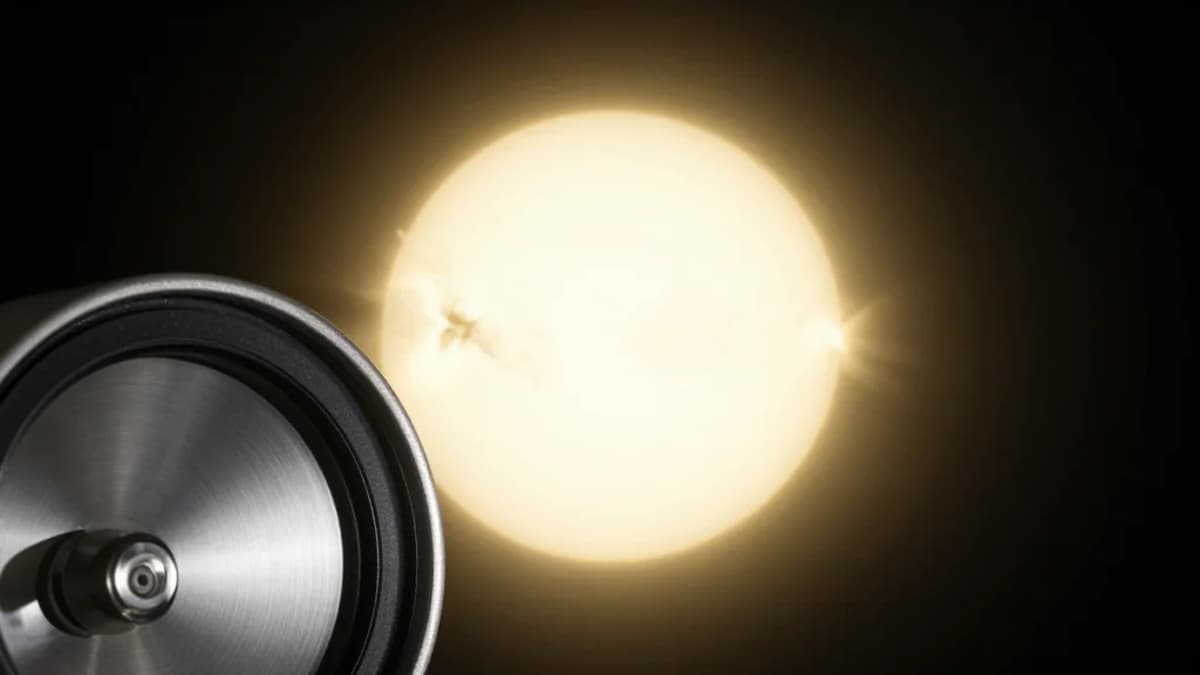
Proba-3 Mission Captures Rare Solar Prominence Eruptions in Sun's Inner Corona
•January 19, 2026
0
Companies Mentioned


Why It Matters
These observations fill a long‑standing gap in inner‑corona imaging, improving models of solar dynamics and space‑weather prediction. The data provide critical insight into how prominences trigger coronal mass ejections that can affect Earth’s technology.
Key Takeaways
- •Proba‑3 uses formation flying to create artificial eclipses
- •ASPIICS captured three prominence eruptions in five hours
- •Eruptions observed on 21 September 2025, rare event
- •Helium spectral line reveals inner corona structures
- •Data complements NASA SDO AIA observations for comprehensive view
Pulse Analysis
The sun’s corona has long eluded continuous observation because its brightness overwhelms traditional telescopes. Proba‑3’s innovative approach—two spacecraft maintaining millimetre‑scale separation to block direct sunlight—creates a controlled eclipse in orbit, enabling the ASPIICS coronagraph to image the inner corona where temperatures soar to millions of degrees. This capability marks a leap forward from earlier missions that could only glimpse the outer layers, offering scientists a new window into the region where magnetic fields begin to dominate plasma behaviour.
During an active solar period on 21 September 2025, ASPIICS recorded a time‑lapse every five minutes, capturing three distinct prominence eruptions in just five hours. These cold plasma structures, visible in a helium emission line, contrast sharply with the surrounding hot corona, highlighting the complex thermal gradients that drive solar activity. By pairing the yellow‑filtered ASPIICS images with ultraviolet data from NASA’s Solar Dynamics Observatory, researchers assembled a multi‑spectral animation that reveals how prominences expand, destabilise, and potentially seed coronal mass ejections.
The scientific payoff extends beyond visual spectacle. Detailed inner‑corona measurements refine magnetic field models, improve predictions of solar storms, and enhance our understanding of the mechanisms that heat the corona itself. As space‑based assets and ground‑based power grids become increasingly vulnerable to solar disturbances, insights from Proba‑3 will inform next‑generation forecasting tools. Moreover, the mission’s formation‑flight technology sets a precedent for future cooperative satellites, paving the way for more ambitious solar observatories and deep‑space interferometry projects.
Proba-3 mission captures rare solar prominence eruptions in sun's inner corona
0
Comments
Want to join the conversation?
Loading comments...