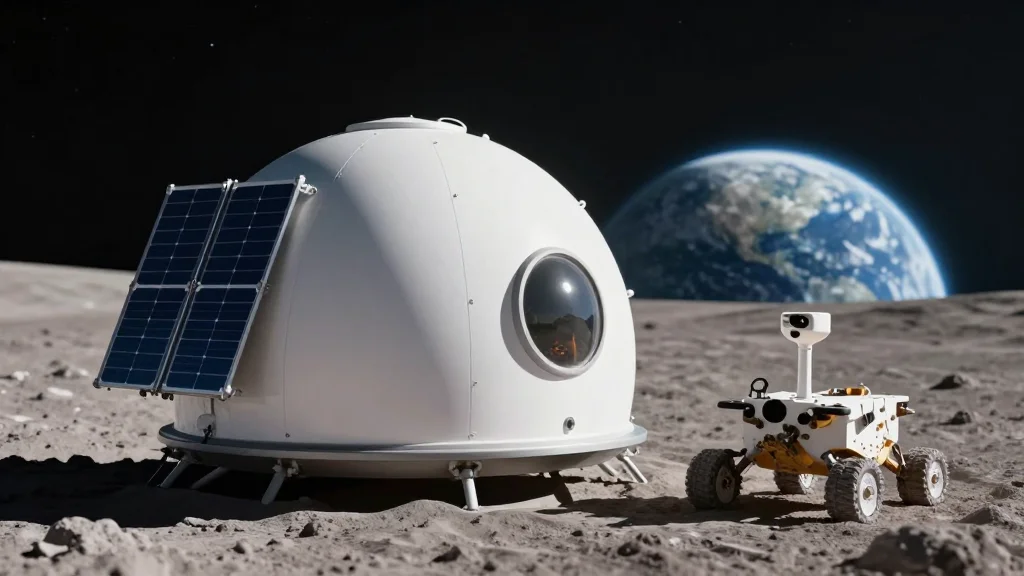
PwC Report: Lunar Economy Projected to Generate up to US$127 Billion by 2050
Why It Matters
The projection signals a viable commercial market that could attract private capital and reshape space policy, while creating new technology spillovers for Earth.
Key Takeaways
- •PwC forecasts lunar economy revenue up to $127 billion by 2050
- •Infrastructure investment projected between $72.7 billion and $88.5 billion
- •Transport costs dominate early lunar projects, dropping to ~55% by 2050
- •Moon‑rover‑as‑a‑service model emerging, NASA contracts $4.6 billion
Pulse Analysis
The PwC assessment marks a turning point for space commerce, moving the narrative from government‑driven science missions to a profit‑oriented lunar ecosystem. By quantifying a $127 billion revenue horizon, the study gives investors a concrete market size that rivals mature terrestrial sectors such as renewable energy. This valuation rests on coordinated development of five infrastructure pillars, each demanding specialized technology and capital. The analysis underscores how the economics of launch logistics—currently the dominant cost driver—will evolve as reusable rockets and in‑situ resource extraction mature, reshaping cost structures for the next generation of lunar operators.
Mobility, communications, habitation, energy and water form the backbone of the projected lunar marketplace. Early rover deployments will be lightweight and exploratory, but the sector is already pivoting toward "rover‑as‑a‑service" contracts, exemplified by NASA’s $4.6 billion Lunar Terrain Vehicle services award. Simultaneously, a constellation of relay satellites and surface data centers will enable high‑bandwidth, low‑latency links essential for autonomous operations and real‑time decision making. Energy solutions are shifting from solar‑only concepts to small nuclear micro‑reactors, while ISRU initiatives aim to harvest water ice for propellant production, dramatically lowering the mass that must be launched from Earth. These advances collectively reduce the logistical burden that currently accounts for up to 80% of project costs.
Beyond the Moon, the forecast has broader strategic implications. A thriving lunar economy could catalyze new supply chains, stimulate private‑sector R&D, and generate technology spin‑offs—ranging from advanced robotics to high‑efficiency water recycling—that benefit terrestrial industries. However, the pace of commercialization hinges on clear regulatory frameworks governing resource rights and property claims. Policymakers who establish predictable, internationally‑aligned rules will unlock the capital needed to bridge the $70‑$90 billion investment gap. For investors, the report offers a roadmap of high‑growth niches, from lunar telecom services to micro‑reactor manufacturing, positioning the Moon as the next frontier for diversified, long‑term returns.
PwC report: Lunar Economy projected to generate up to US$127 billion by 2050
Comments
Want to join the conversation?
Loading comments...