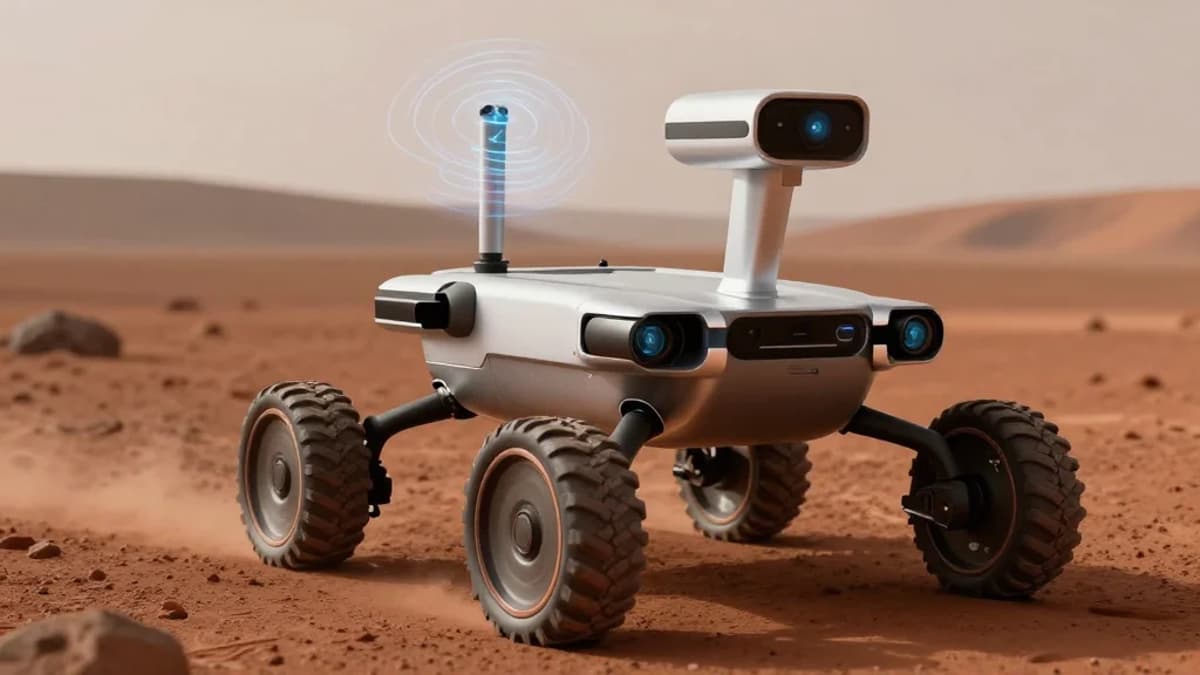
Q&A: How AI Changes NASA's Search for Life in Outer Space
•January 21, 2026
0
Companies Mentioned

NASA

Unsplash
Why It Matters
Bias in AI‑driven analysis could steer NASA’s life‑detection missions off course, affecting scientific credibility and resource allocation. Ensuring expert oversight preserves the reliability of future astrobiology discoveries.
Key Takeaways
- •AI tools rely on Earth analog data, introducing bias.
- •Synthetic data generation amplifies decision-making power for programmers.
- •Domain experts must guide AI development for unbiased results.
- •Bias in AI could misdirect life‑detection missions.
- •Study highlights responsibility in AI‑driven scientific discovery.
Pulse Analysis
NASA’s embrace of artificial intelligence promises faster data processing and pattern recognition across vast planetary datasets, yet the foundation of those models matters. Most AI systems are trained on Earth analogs—deserts, volcanic terrains, and other accessible locales—that mirror conditions on Mars or Titan. Because these sites are chosen for logistical convenience or scientific prestige, the resulting models inherit a skew toward familiar, charismatic environments, potentially overlooking subtler biosignatures that lie outside the training set.
A second frontier is synthetic data, where engineers fabricate realistic‑looking inputs to augment scarce observations. While this expands training volumes, it also concentrates power in the hands of programmers who decide what constitutes a plausible scenario. Without rigorous input from planetary scientists, synthetic datasets risk reinforcing existing biases or introducing new blind spots. Interdisciplinary governance structures—combining AI ethicists, astrobiologists, and mission planners—are essential to audit model assumptions, validate synthetic outputs, and maintain scientific rigor.
The stakes extend beyond individual missions; they shape public trust in AI‑enabled space exploration. As NASA prepares for ambitious endeavors on Mars and Titan, transparent model documentation and continuous expert oversight will be critical to ensure that AI augments, rather than dictates, discovery pathways. By embedding responsibility into the AI development lifecycle, the agency can harness computational power while safeguarding the integrity of humanity’s search for life beyond Earth.
Q&A: How AI changes NASA's search for life in outer space
0
Comments
Want to join the conversation?
Loading comments...