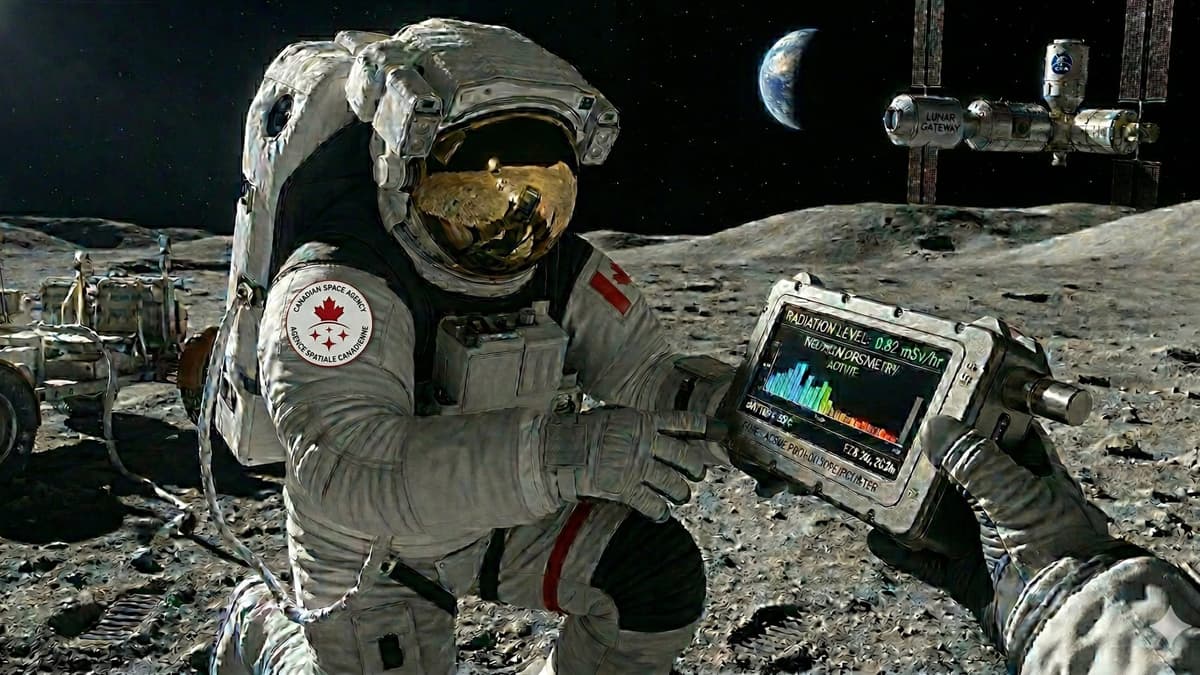
Real-Time Radiation Tracking: Canada’s Newest Contribution to the Moon Race
•February 26, 2026
0
Why It Matters
Accurate neutron monitoring is critical for protecting crew health on long‑duration lunar and Martian missions, and the technology’s dual‑use potential expands Canada’s strategic role in both space and medical sectors.
Key Takeaways
- •CSA allocates $5.5M to BTI for CANS development.
- •CANS measures neutron radiation in real time aboard spacecraft.
- •Neutron exposure accounts for ~30% of space radiation risk.
- •Data supports astronaut health and cancer therapy research.
- •Autonomous system streams data to Earth for analysis.
Pulse Analysis
Radiation remains the most insidious obstacle to sustained human presence beyond low‑Earth orbit, with neutrons contributing roughly a third of the total dose astronauts receive. As NASA’s Artemis program transitions from lunar flybys to permanent outposts, agencies worldwide are scrambling to quantify and mitigate this invisible threat. Canada’s $5.5 million injection signals a decisive shift from passive shielding concepts toward active, data‑driven protection strategies, positioning the nation as a key partner in the next phase of deep‑space exploration.
The Canadian Active Neutron Spectrometer (CANS) represents a leap in sensor technology. Leveraging BTI’s legacy bubble‑detector platforms—Radi‑N and Radi‑N2—that flew on the International Space Station, CANS incorporates solid‑state neutron detection with onboard processing and real‑time telemetry. This autonomy eliminates the need for crew‑managed sampling, delivering continuous exposure profiles directly to ground‑based analysts. By capturing high‑resolution spectra, CANS enables precise modeling of neutron interactions with spacecraft materials and human tissue, informing both engineering design and biomedical countermeasures.
CANS’s impact extends far beyond the lunar gateway. The neutron data stream can be repurposed for terrestrial applications such as targeted radiotherapy, where dose accuracy determines treatment efficacy, and for aviation safety, where crew members face elevated cosmic radiation at cruising altitudes. Moreover, the technology offers a low‑cost solution for nuclear threat detection and particle‑physics experiments, reinforcing Canada’s reputation for innovative, dual‑use aerospace solutions. As commercial lunar initiatives accelerate, the availability of real‑time radiation analytics will become a market differentiator, opening new revenue streams for Canadian firms and strengthening the country’s foothold in the emerging space‑health ecosystem.
Real-time radiation tracking: Canada’s newest contribution to the Moon race
0
Comments
Want to join the conversation?
Loading comments...