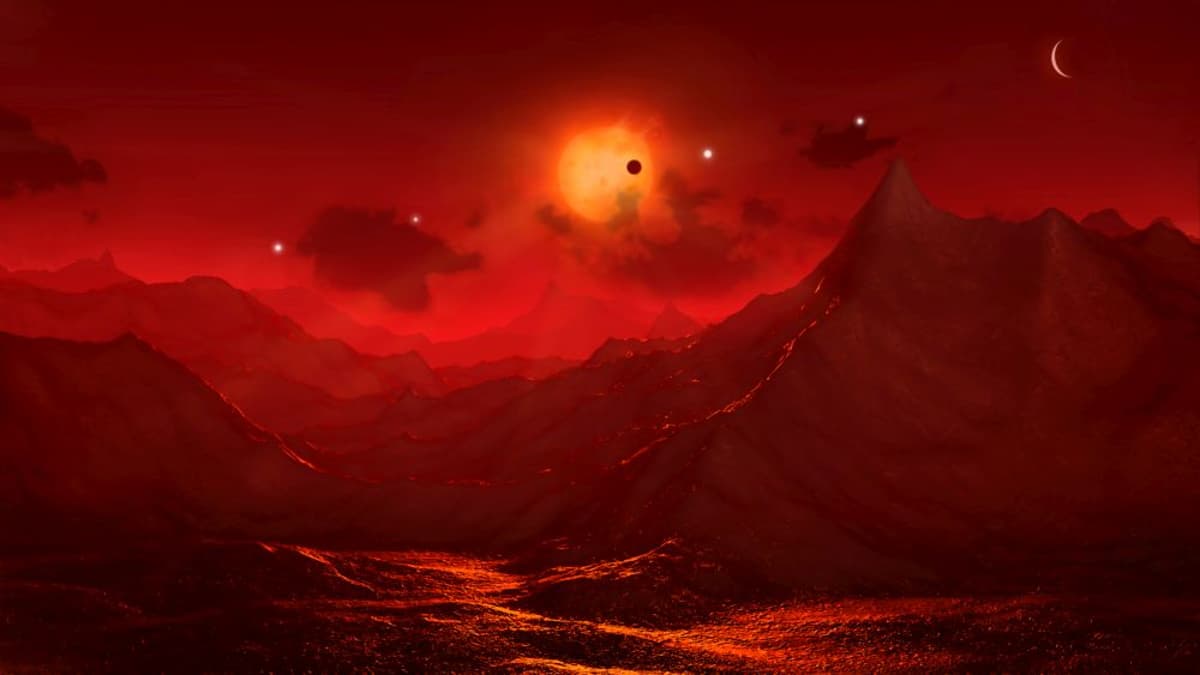
Red Dwarfs Are Too Dim To Generate Complex Life
•January 15, 2026
0
Why It Matters
The findings challenge the habitability optimism for the most common exoplanet hosts, reshaping target selection for biosignature searches. Understanding stellar radiation limits refines models of where complex life could arise.
Key Takeaways
- •TRAPPIST‑1e gets 0.9% Earth’s PAR
- •GOE would need 63 Gyr under Sun‑like assumptions
- •Adjusted models lower GOE to 1‑5 Gyr
- •Anoxygenic bacteria outcompete oxygenic photosynthesizers
- •Complex life unlikely on late‑M‑star planets
Pulse Analysis
Red dwarfs dominate the Milky Way’s stellar population, making their planets prime candidates in the search for extraterrestrial life. However, the new analysis highlights a fundamental energy shortfall: the photosynthetically active radiation (PAR) emitted by late‑M stars falls well below the threshold needed for robust oxygenic photosynthesis. By quantifying the photon flux at TRAPPIST‑1e, the researchers demonstrate that an Earth‑analog would receive less than one percent of the light that drives cyanobacterial oxygen production on our planet, stretching the timeline for a Great Oxidation Event far beyond the universe’s current age.
When the model incorporates realistic biological constraints—such as photoinhibition, which curtails photosynthetic efficiency at higher light levels, and the potential to harness near‑infrared photons—the projected GOE window contracts to a few billion years. Even this optimistic scenario remains marginal, because anoxygenic photosynthetic microbes, which thrive on far fewer photons and can use wavelengths up to 1.1 µm, would likely dominate early ecosystems. Their metabolic pathways do not release oxygen, meaning atmospheric O₂ levels may never reach the concentrations required for complex, multicellular organisms to evolve.
The implications for exoplanet exploration are profound. Habitability assessments that focus solely on a planet’s location within the traditional liquid‑water zone may overlook the crucial role of stellar spectral output. Missions targeting biosignatures should prioritize stars with sufficient PAR or consider alternative metabolic signatures that do not rely on oxygen. As the field refines its criteria, the study serves as a reminder that the abundance of red dwarfs does not automatically translate into abundant habitats for complex life.
Red Dwarfs Are Too Dim To Generate Complex Life
0
Comments
Want to join the conversation?
Loading comments...