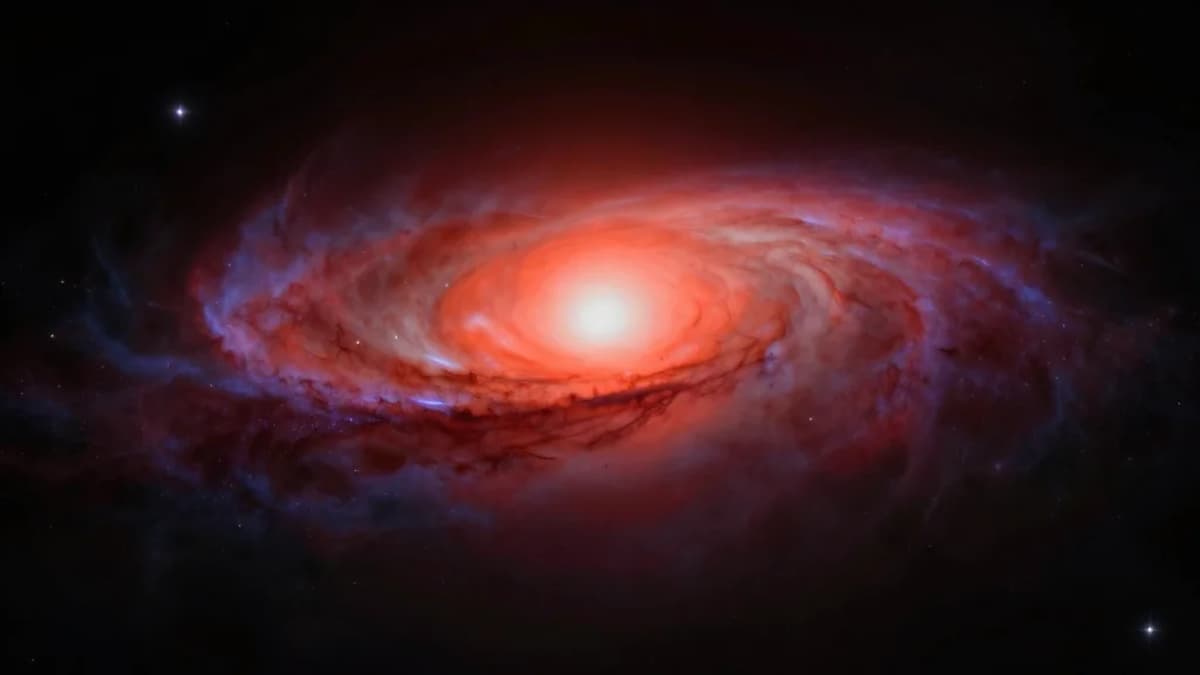
'Red Potato' Galaxy Discovered by Astronomers
•February 4, 2026
0
Why It Matters
The finding provides rare evidence of early massive galaxy quenching within a dense protocluster environment, informing models of galaxy evolution and feedback mechanisms.
Key Takeaways
- •JWST identified massive quiescent galaxy at z≈3.25.
- •Stellar mass 110 billion M☉, radius 3,260 ly.
- •Star formation rate 4 M☉/yr, below main sequence.
- •Molecular‑gas fraction below 6%, indicating gas depletion.
- •Nearby AGN jet likely drives CGM turbulence, suppressing accretion.
Pulse Analysis
The discovery of the “Red Potato” underscores JWST’s transformative power for high‑redshift astronomy. By combining NIRCam imaging with NIRSpec spectroscopy, researchers can resolve the structure and composition of galaxies formed just two billion years after the Big Bang. Such capabilities reveal not only luminous star‑forming systems but also rare, massive quiescent galaxies that challenge conventional timelines for galaxy assembly. The Red Potato’s extraordinary stellar mass and compact size place it among the most massive early‑universe objects, prompting a reevaluation of how quickly massive halos can shut down star formation.
Key to this puzzle is the galaxy’s remarkably low molecular‑gas fraction and star‑formation rate, both far below expectations for a galaxy embedded in a dense, cool‑gas reservoir. The data suggest that internal processes—or external influences—have efficiently removed or heated the gas needed for star formation. This early quenching provides a crucial data point for simulations that must account for rapid gas depletion mechanisms, such as virial shock heating or early feedback, in the most massive halos at z>3.
Perhaps the most intriguing aspect is the role of a neighboring active galactic nucleus. Deep X‑ray imaging reveals an extended jet that likely injects turbulence into the circumgalactic medium surrounding the Red Potato. Such jet‑mode feedback can inhibit gas inflow, maintaining the galaxy’s quiescent state despite abundant surrounding material. Understanding this interaction will refine models of AGN‑driven regulation in protocluster environments and guide future JWST and next‑generation X‑ray missions aimed at mapping feedback across cosmic time.
'Red Potato' galaxy discovered by astronomers
0
Comments
Want to join the conversation?
Loading comments...